

Top Deals
 Back
Back Preqt
Preqt11:18 AM · Jan 30, 2026
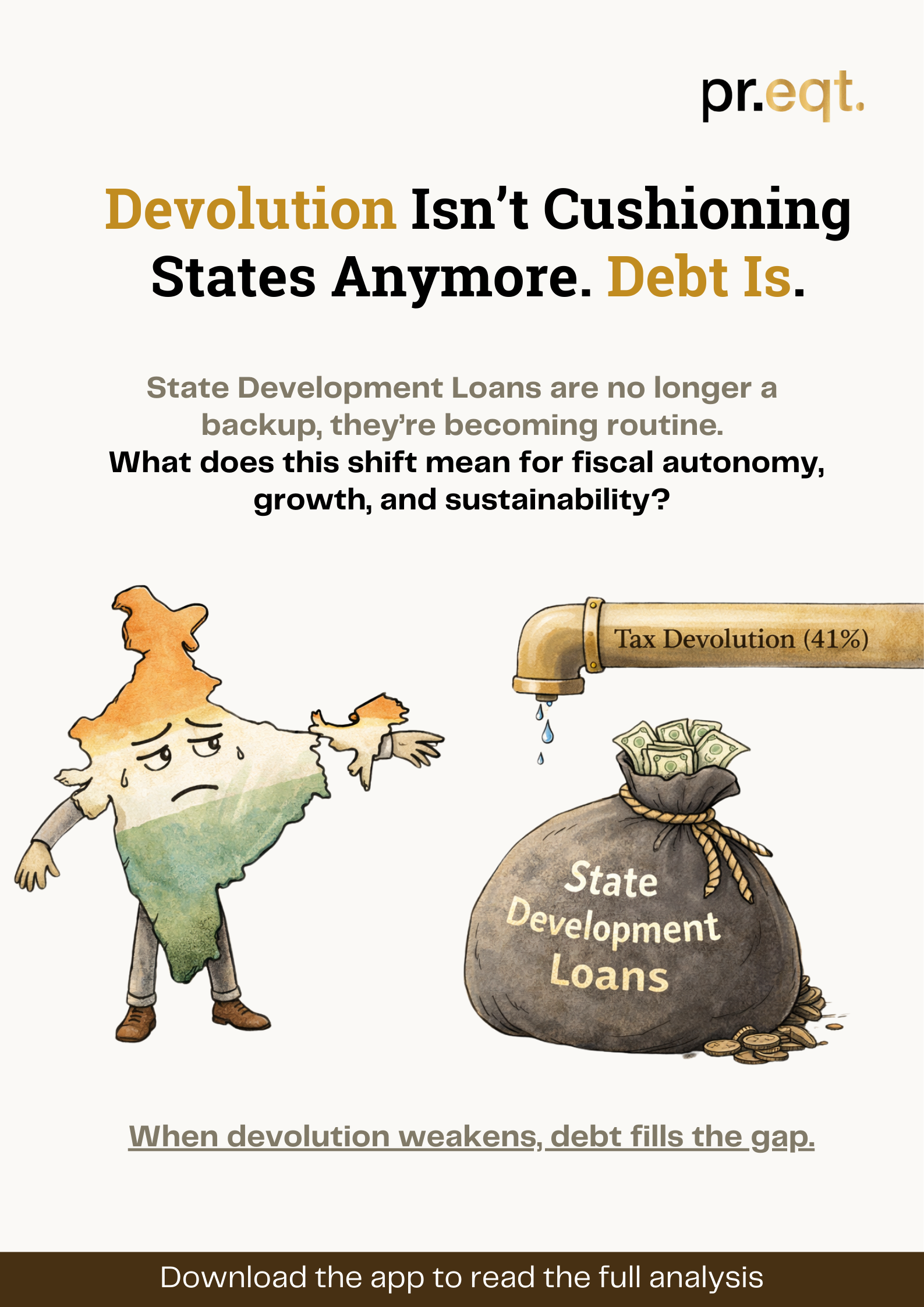
For years, States have looked to the Union Budget to gauge how much fiscal breathing room they would get through tax devolution. On paper, the 15th Finance Commission fixed the States’ share at 41% of the divisible pool. In reality, that promise is weakening. A growing share of Central revenues now comes through cesses and surcharges, which do not enter the divisible pool at all.
The result is visible in how States fund themselves today.
State Development Loans, once used sparingly, have become a regular financing tool. In 2024–25, SDLs made up nearly 35% of Tamil Nadu’s total revenue receipts and about 26% of Maharashtra’s. A decade ago, such dependence would have raised alarms. The shift accelerated after the COVID-19 shock, when Central devolution proved insufficient, and borrowing filled the gap.
What began as crisis financing has now become structural.
Even as nominal tax transfers have risen, effective resource flow to States has weakened. The expanding use of cesses and surcharges has reduced what is actually shareable. Industrialised States face a sharper strain, especially after GST centralised indirect tax collection and redistribution through formulas that dilute the link between tax effort and reward.
This weakens fiscal incentives and compresses State autonomy.
As assured revenues shrink, States are increasingly borrowing to fund pensions, health insurance schemes, and other welfare commitments. Public capital expenditure — crucial for long-term growth — gets crowded out. Private investment suffers as well, as State balance sheets absorb more debt instead of supporting infrastructure.
Over time, this trade-off becomes costly.
Between Punjab, Uttar Pradesh, Tamil Nadu, Maharashtra, and West Bengal, borrowing patterns tell a consistent story. West Bengal, despite receiving nearly 48% of its revenues through Central devolution on average over the past five years, still relied on SDLs for roughly 35% of its revenues. Rising transfers did not reduce borrowing. They merely coexisted with it.
That signals erosion, not resilience.
As debt-to-GSDP ratios climb and revenue certainty weakens, India’s federal shock absorber is quietly shifting from devolution to borrowing. If this continues, fiscal sustainability itself comes into question. Whether higher effective devolution and a rethink of horizontal sharing can restore balance remains unresolved.

2 Likes

0 comments

Share
No comments yet