


ArMee Infotech
Infrastructure for Digital GrowthEngineering Digital Infrastructure
IPO Summary (PreQT)
ArMee Infotech Limited is an Ahmedabad-headquartered IT infrastructure solutions and system-integration company with a growing renewable-energy vertical. The Company executes end-to-end IT infrastructure projects, IT managed services and public-sector digitisation assignments, while its newer renewable-energy platform covers solar EPC, solar projects under power-purchase arrangements and Battery Energy Storage Systems (BESS). It also operates two Acer-branded Experience Zones in Ahmedabad.
The operating model is project-led and procurement-intensive. Government and PSU customers remain the principal end-market, contributing approximately 83.8% of FY26 revenue, while the top five clients contributed approximately 76.7%. As of June 30, 2026, the Company had 99 ongoing projects and an order book of approximately INR 2,663.4 Cr, with renewable-energy projects representing approximately 88.4% of the order book.
This creates substantial execution visibility but also increases dependence on tender wins, performance guarantees, working capital and timely project delivery.
The IPO is a 100.0% fresh issue of 80,00,000 shares at INR 350.0-INR 375.0 per share, aggregating to INR 280.0-INR 300.0 Cr. At the cap price, post-Issue market capitalisation is approximately INR 1,189.9 Cr. The principal stated uses include INR 155.0 Cr for performance bank guarantees / procurement of new Government and PSU projects, INR 60.0 Cr for working capital and INR 6.5 Cr for repayment of borrowings, with the balance for general corporate purposes.
IPO Review Rating
Below Avg
MainboardBuilding Future-Ready Digital Infrastructure for Government and Enterprise Clients
The BRLM track record is adequate but not institutionally strong. Saffron has a reasonably positive six-IPO mainboard history, but Khandwala lacks prior mainboard execution experience.
The principal financial weakness is earnings quality and cash conversion. FY26 EBITDA Margin of only 5.4% and PAT Margin of 3.3% are thin, while operating cash flow of INR 12.5 Cr is substantially below INR 45.5 Cr PAT. Borrowings have also increased materially over the last two years.
Customer concentration is another major concern. Government/PSU clients contribute 83.84% of Revenue, the top five customers contribute 76.66%, and over 86% of Revenue comes from only three states. This creates significant dependence on tender wins, government payment cycles and regional project execution.
At the cap price, ArMee trades at approximately 26.2x post-Issue P/E. While this is ~63% below the arithmetic peer average, that average is distorted by Orient Technologies' very high multiple; compared with the ~14.6x peer median, ArMee trades at a substantial premium.
Accordingly, ArMee may be viewed as a growing but execution-sensitive IPO, with good return ratios and a constructive Fresh Issue structure offset by thin margins, weak operating cash conversion, high customer concentration and limited merchant-banker depth.
PARAMETER
WEIGHT
SCORE
KEY FACTORS
Financial Performance
40.0%
3.0/5
ArMee demonstrates healthy ~17% Revenue CAGR and strong 28.5% ROE, but margins remain thin and cash conversion is weak.
Show more
Detailed Analysis
Revenue from Operations increased from INR 1,020.6 Cr in FY24 to INR 1,396.6 Cr in FY26, implying ~17.0% CAGR
FY26 EBITDA was INR 75.6 Cr, with EBITDA Margin of only 5.4%
FY26 PAT was INR 45.5 Cr, implying a thin 3.3% PAT Margin
FY26 D/E was approximately 0.96x, materially higher than earlier years but still below 1.0x
FY26 ROE was 28.5%, indicating strong return generation
FY26 OCF was only INR 12.5 Cr against PAT of INR 45.5 Cr; FY25 OCF was negative
Top five customers contributed 76.7% of FY26 Revenue, representing very high concentration
Industry
15.0%
3.0/5
ArMee operates across structurally growing IT infrastructure and renewable-energy segments, supported by Digital India and public-sector digitisation.
Show more
Detailed Analysis
Indian IT industry is projected to grow at approximately 9.0% CAGR to 2027
IT infrastructure remains structurally supported by digitalisation, cloud adoption and government digitisation
Government tender rules, GeM requirements and project inspections create meaningful regulatory/execution exposure
Management
15.0%
5.0/5
ArMee has an experienced promoter-led management team, 66.7% Board independence and no promoter OFS in the IPO.
Show more
Detailed Analysis
Promoter-led business operating since 2003, providing more than two decades of sector experience
4 of 6 Directors are Independent = 66.7%, representing strong independent oversight
No material promoter pledge concern identified in current disclosures; ordinary-course legal/regulatory risks remain
Group-company/service transactions exist, but no unusually large operating RPT concentration has been identified from available disclosures
IPO is 100% Fresh Issue with Nil OFS, showing no promoter monetisation
Valuation
20.0%
3.0/5
ArMee's valuation is mixed rather than outright cheap.
Show more
Detailed Analysis
ArMee trades at 26.2x versus peer average ~70.5x, implying a ~62.9% discount; however, peer median is only ~14.6x, making ArMee ~79.4% premium to median
ArMee's indicative EV/EBITDA is approximately 17–18x, above several peers and not clearly cheap on enterprise-value basis
Gross pro-forma P/B is approximately 2.5x
Merchant Banker Track Record
10.0%
3.0/5
The BRLM track record is adequate but not institutionally strong. Saffron has a reasonably positive six-IPO mainboard history, but Khandwala lacks prior mainboard execution experience.
Show more
Detailed Analysis
Saffron's historical mainboard franchise has delivered positive outcomes overall, while Khandwala has no prior mainboard IPO record
Saffron-managed Tolins Tyres was subscribed 25.03x; the combined consortium has limited recent mainboard depth
Saffron has handled 6 mainboard IPOs, ~83% listing positively; Khandwala has no prior mainboard IPOs
Both are SEBI-registered merchant bankers but are not top-tier institutional ECM franchises
TOTAL
100%
3.3/5
Weighted Composite Score
Issue Price
₹350.0 to ₹375.0
As of 19 Sep 2026
GMP
₹1.0
As of 19 Sep 2026
Estimated Gain / Loss
+0.3%
Lot Size
40.0 Shares
Grey Market Premium (GMPs) are shared for knowledge purpose only. PrEqt doesn’t promote or execute the trades.
| Issue Size (in Cr) | |
|---|---|
| Overall | ₹300.0 Cr |
| Fresh Issue | ₹300.0 Cr |
| Offer for Sale | ₹0.0 Cr |
Minimum Investment
₹15,000.0 / 1,600 shares

Merchant Banker
Khandwala Securities Ltd., Saffron Capital Advisors Private Limited
Khandwala Securities Ltd.
Saffron Capital Advisors Private Limited
IPO Document
Offer Start Date
Offer End Date
Valuation
Revenue (FY'26)
PAT (FY'26)
Issue Size (in Cr)
Face Value
₹ 10.0Offer Price
₹ 375.0Lot Size
40.0 sharesSale Type
Fresh capital onlyPAT (FY'26)
₹ 45.5 CrPAT Margin (FY'26)
3.3 %P/E Multiple
26.2xEBITDA (FY'26)
₹ 75.6 CrCAGR Growth 2Y
17.4 %ROE (FY'26)
28.5 %ROCE (FY'26)
24.1 %Price to Book Value
2.5xDebt/Equity
1.0xCompany Website
www.armeeinfotech.comExplore new deals
Overview
Fund Allocation
Total: ₹0 CrSource:Company DRHP
Timeline
IPO Open Date
To Be Announced
IPO Close Date
To Be Announced
Tentative Allotment
To Be Announced
Initiation of Refunds
To Be Announced
Credit of Shares to Demat
To Be Announced
Tentative Listing Date
To Be Announced
Business
Business Model
Geographical Presence
Sales Channel
Key Risk Factor
Financial Highlights
Income Statement
Revenue growth with EBITDA and PAT margins
| Financial Metric | FY 2024 | FY 2025 | FY 2026 |
|---|---|---|---|
| Revenue (₹ Cr) | 1,024.0 | 1,315.8 | 1,410.1 |
| Growth (%) | - | 28.7% | 6.3% |
| EBITDA (₹ Cr) | 71.6 | 58.6 | 75.6 |
| EBITDA Margin (%) | 7.0% | 4.5% | 5.4% |
| PAT (₹ Cr) | 50.1 | 41.7 | 45.5 |
| PAT Margin (%) | 4.9% | 3.2% | 3.3% |
OBSERVATIONS & INSIGHTS
Revenue from operations increased 28.7% in FY25 and 6.3% in FY26, indicating strong scale expansion followed by a moderation in growth
EBITDA declined 18.1% in FY25 despite revenue growth, before recovering 29.0% to INR 75.6 Cr in FY26. This reflects the sensitivity of operating earnings to project and product mix. Margin fell from 7.0% in FY24 to 4.5% in FY25 and improved to 5.4% in FY26, but remained below the FY24 level
PAT declined from INR 50.1 Cr in FY24 to INR 41.7 Cr in FY25 and recovered to INR 45.5 Cr in FY26. PAT margin remained modest at 3.3% in FY26
Balance Sheet
| Financial Metric | FY 2024 | FY 2025 | FY 2026 |
|---|---|---|---|
| Net Worth | ₹ 95.2 Cr | ₹ 136.7 Cr | ₹ 182.2 Cr |
| Total Assets | ₹ 673.5 Cr | ₹ 828.5 Cr | ₹ 958.9 Cr |
| Total Borrowing | ₹ 27.3 Cr | ₹ 48.1 Cr | ₹ 174.4 Cr |
OBSERVATIONS & INSIGHTS
Net worth increased from INR 95.2 Cr in FY24 to INR 182.2 Cr in FY26, reflecting retained earnings and capital accumulation
Assets expanded to INR 958.9 Cr in FY26 as the Company scaled project execution, receivables, working capital and renewable-energy deployment
Total borrowings increased sharply to INR 174.4 Cr in FY26 from INR 48.1 Cr in FY25. Current public disclosures indicate further borrowing growth by June 2026, reinforcing the importance of the IPO’s working-capital and PBG objectives
Cash Flow
| Financial Metric | FY 2024 | FY 2025 | FY 2026 |
|---|---|---|---|
CFO in Cr Cash generated from core business operations. | +55.2 Cr | -18.0 Cr | +12.5 Cr |
CFI in Cr Cash used in / generated from investing activities. | -21.3 Cr | -12.6 Cr | -101.7 Cr |
CFF in Cr Cash from / used in financing activities. | -13.0 Cr | +15.9 Cr | +103.9 Cr |
Working Capital
| Efficiency Metric | FY 2023 | FY 2024 | FY 2025 |
|---|---|---|---|
Debtor Days Average number of days taken to collect customer payments. | - | - | - |
Creditor Days Average time taken to pay suppliers and vendors. | - | - | - |
Inventory Days Average number of days inventory remains unsold. | - | - | - |
CCC (Cash Conversion Cycle) (Debtor Days + Inventory Days - Creditor Days) | - | - | - |
Financial Ratios
Measures the company’s leverage relative to shareholder equity.
OBSERVATIONS & INSIGHTS
Return ratios moderated materially over FY24-FY26 as the equity and capital base expanded faster than earnings, although FY26 ROE and ROCE remained at 28.5% and 24.1%, respectively
Debt/Equity increased from 0.3x in FY24 to approximately 1.0x in FY26 as borrowings rose to support working capital and business expansion
The current ratio remained close to 1.1x-1.2x, indicating limited excess short-term liquidity relative to the scale of project-related current liabilities
The consolidated interest-coverage declined from approximately 10.5x in FY24 to 3.4x in FY26, reflecting the sharp increase in finance costs and borrowings
ROA moderated from 7.4% in FY24 to 4.7% in FY26 as the asset base expanded faster than PAT
Industry Overview
Industry Drivers
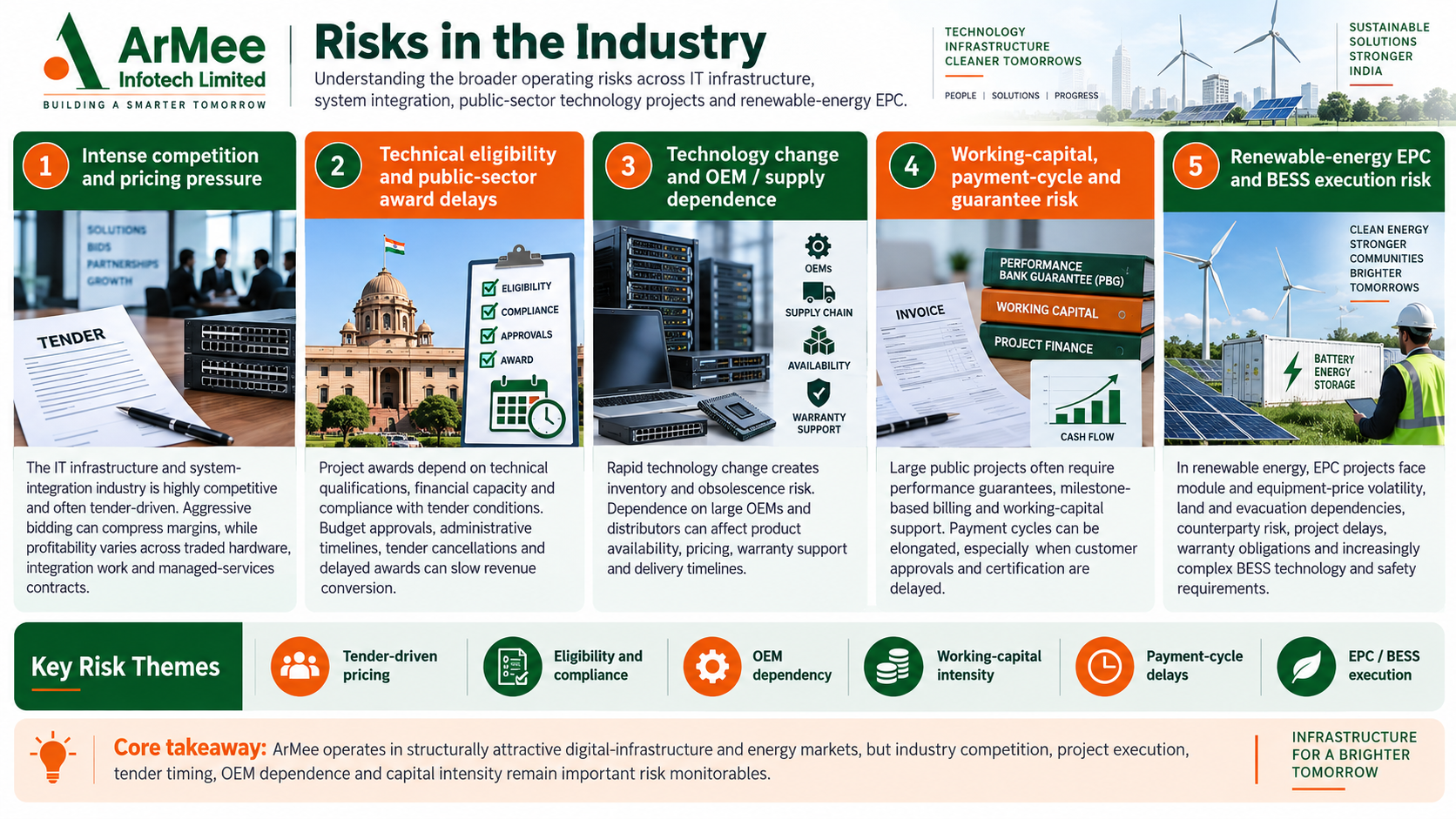
Government Digitisation and Public-Sector IT Modernisation
Government technology spending remains a structural demand driver for system integrators. Digital public-service delivery, education digitisation, rural connectivity, e-governance, direct-benefit infrastructure and PSU technology refresh programmes require hardware procurement, networking, data infrastructure, field deployment and ongoing support. These projects can be large and multi-location, creating opportunities for integrators with tendering credentials, OEM relationships and field-service capabilities.
The key points are:
Digital governance programmes are increasing demand for IT hardware, networking, servers, storage, cybersecurity and system-integration services across Government departments and PSUs
Education digitisation is supporting deployment of smart classrooms, ICT laboratories, interactive displays, endpoint devices and connected-learning infrastructure
Rural and citizen-service digitisation requires distributed IT infrastructure across large geographic areas, creating opportunities for integrators capable of multi-location execution
Public-sector technology refresh cycles generate recurring opportunities as Government institutions upgrade ageing hardware, networks, data infrastructure and digital-service platforms
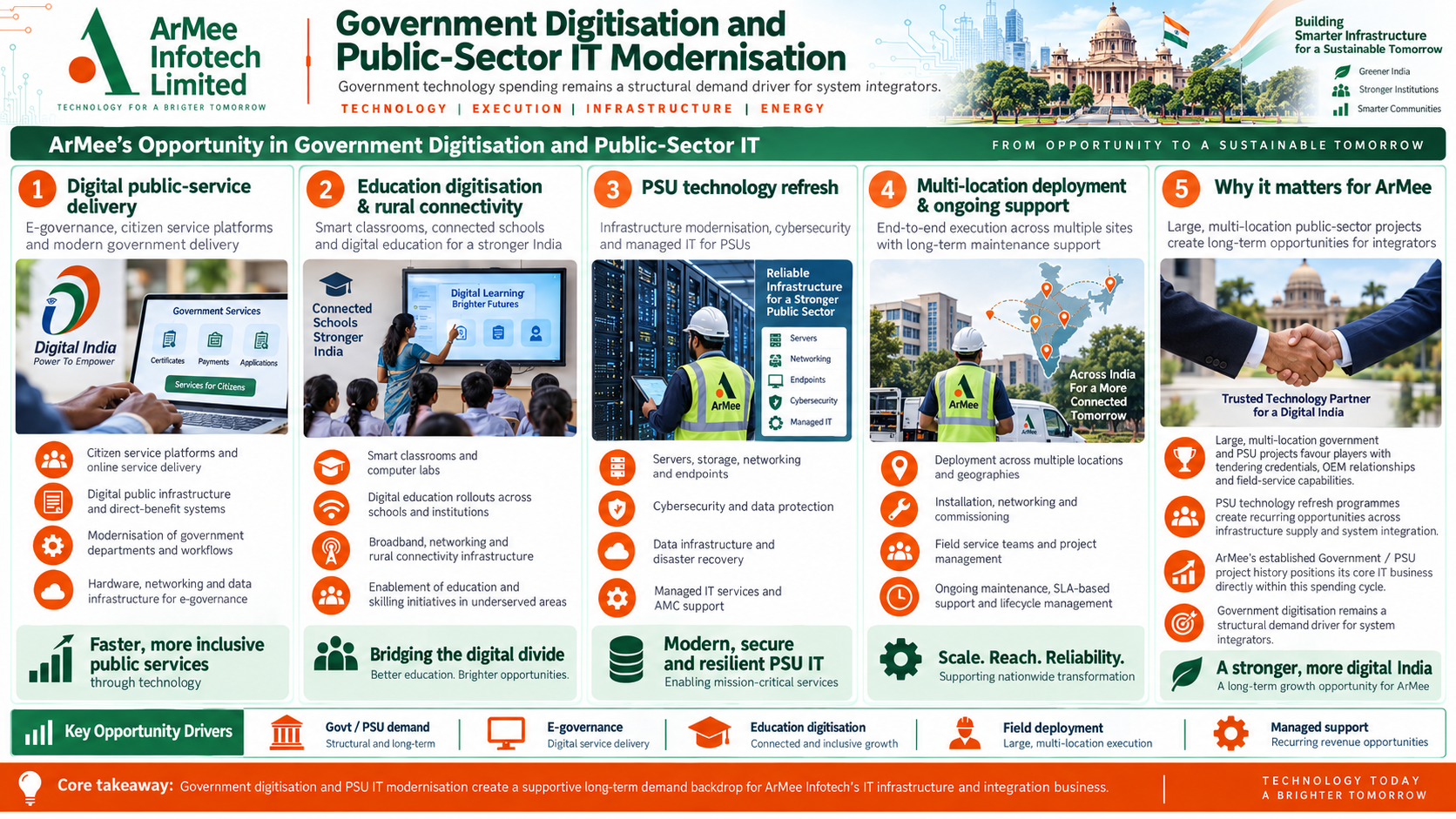
Enterprise Cloud, Data Centre and Cybersecurity Investment
India’s corporate IT environment is shifting toward cloud-enabled infrastructure, hybrid data centres, cybersecurity, modern networks and managed services. The D&B report estimates domestic IT spending at USD 138.9 billion in 2024, with data-centre systems, software and IT services all expanding. The Data Centre Policy 2020 and increasing data-protection requirements also encourage investment in secure IT architecture.
The key points are:
Cloud adoption and hybrid IT infrastructure are encouraging enterprises to modernise servers, storage, networking architecture and endpoint environments
Data-centre expansion is increasing demand for computing infrastructure, networking equipment, storage systems, power-management solutions and implementation services
Cybersecurity requirements are becoming more important as enterprises digitise operations and face higher exposure to data breaches, ransomware and regulatory requirements
Hybrid working and distributed operations require secure connectivity, endpoint management and reliable enterprise networks across offices and operating locations
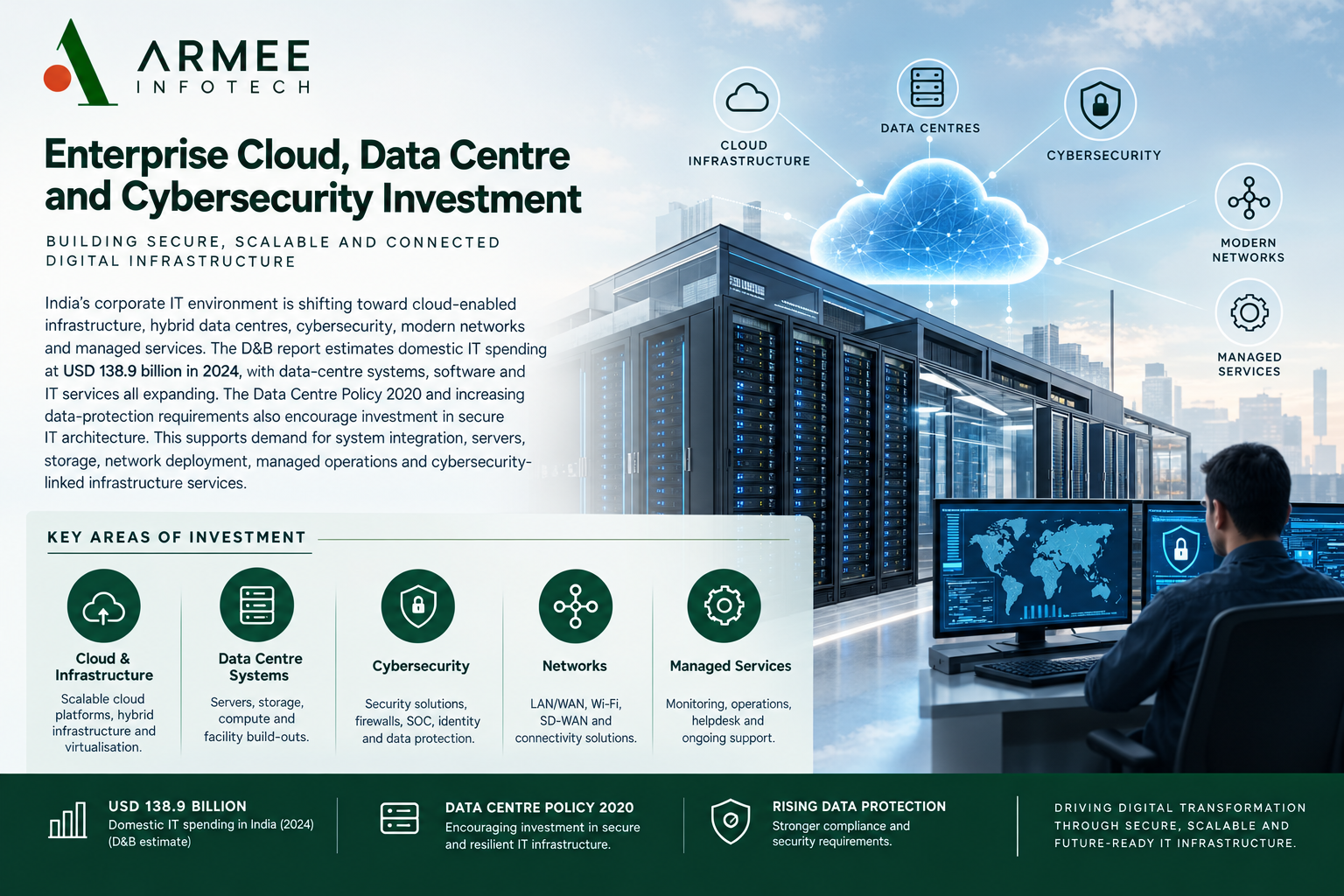
Digital Education and Technology-Enabled Public Services
Public education and citizen-service programmes are increasing demand for ICT laboratories, smart classrooms, interactive displays, endpoint devices and connected infrastructure. Government schemes supporting school digitisation, STEM labs and technology-enabled learning create recurring tender opportunities for integrators capable of deploying solutions at scale. Similar digitisation is occurring in BFSI, public distribution and rural-service delivery.
The key points are:
Smart-classroom adoption is increasing demand for interactive displays, audio-visual systems, endpoint devices, digital-content infrastructure and classroom connectivity
ICT and STEM laboratories require computers, networking equipment, specialised devices and system integration, creating sizeable deployment opportunities across schools
Government education schemes can create large multi-location contracts where vendors must supply, install and maintain infrastructure across hundreds or thousands of institutions
Digital public-service programmes in BFSI, public distribution, rural services and citizen-service centres require integrated technology infrastructure and field deployment
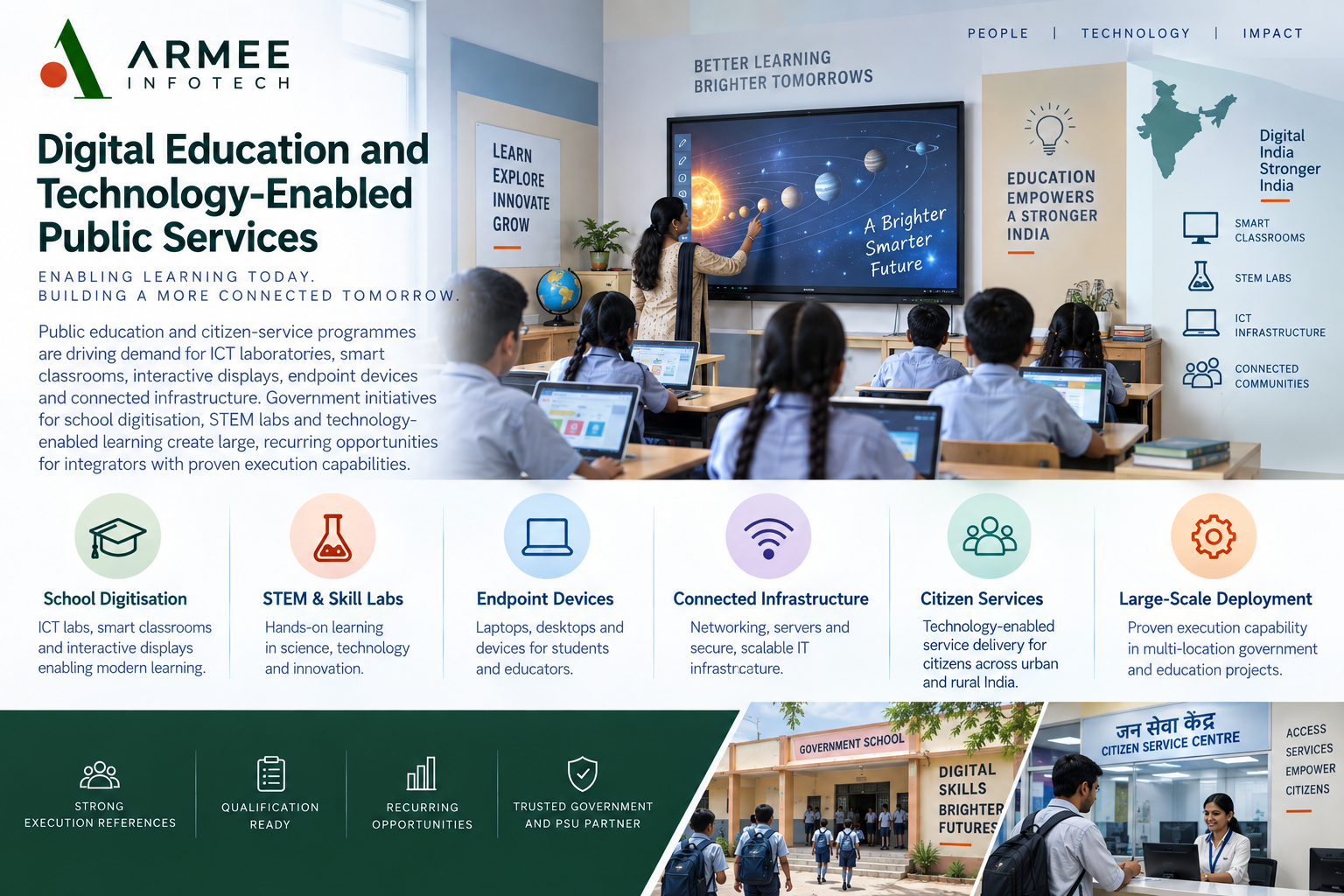
Risks in the Industry
The IT infrastructure and system-integration industry is intensely competitive and often tender-driven. Pricing can be aggressive, project awards depend on technical and financial eligibility, and gross margins can vary materially between traded hardware, integration work and managed-services contracts. Rapid technology change also creates inventory and obsolescence risk, while dependence on large OEMs and distributors can affect pricing, availability and delivery timelines.
Government technology spending may be resilient over the long term, but award timelines, budget approvals, tender cancellations and payment cycles can delay revenue conversion and cash collection. Large public projects also require performance guarantees and working-capital support. In renewable energy, EPC companies face module and equipment-price volatility, land / evacuation dependencies, counterparty risk, project delays, warranty obligations and the need to manage increasingly complex BESS technology and safety requirements.
The key points are:
Tender dependence and award uncertainty: A significant portion of industry opportunities originates from Government and institutional tenders. Bid cancellations, delays, budget revisions or unsuccessful bids can affect order inflow and revenue visibility
Aggressive price competition: System-integration contracts are often awarded through competitive bidding, which can lead to pricing pressure and lower project margins, particularly where hardware represents a large share of contract value
Working-capital requirements: Large projects may require upfront procurement, earnest-money deposits, performance guarantees and extended customer-credit periods, creating substantial funding requirements before cash is collected
OEM and supply-chain dependence: Integrators depend on technology manufacturers and distributors for hardware availability, pricing and technical support. Supply shortages, product discontinuation or vendor-price changes can affect project timelines and margins
Technology obsolescence: Rapid changes in hardware, cybersecurity, networking and cloud technologies can shorten product lifecycles and create inventory risk if equipment becomes outdated before deployment
Government Policy Support
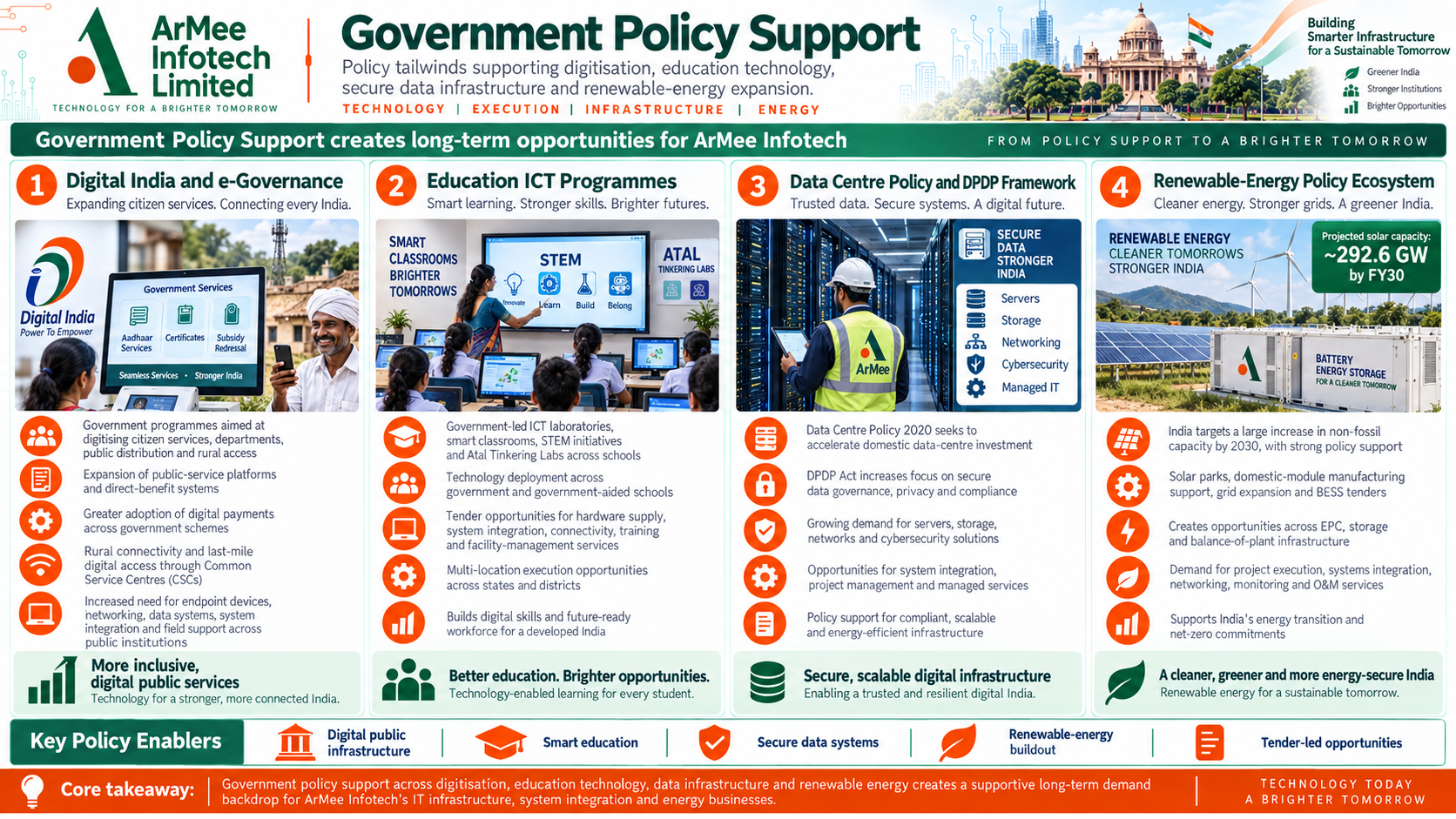
Government policy support provides a structural demand backdrop for ArMee Infotech across both its IT and renewable-energy businesses. Digital India, e-Governance and education ICT programmes expand requirements for connected devices, networking, system integration and managed support across public institutions. At the same time, the Data Centre Policy and DPDP framework support investment in secure digital infrastructure, while India’s renewable-energy expansion, grid modernisation and BESS tenders create additional opportunities in solar EPC and storage.
The key points are:
Digital India and e-Governance: Government programmes aimed at digitising citizen services, departments, public distribution, rural access and digital payments expand the requirement for endpoint devices, networking, data systems, system integration and field support across public institutions
Education ICT programmes: Government-led ICT laboratories, smart classrooms, STEM initiatives and Atal Tinkering Labs support technology deployment across schools. Such programmes create tender opportunities for hardware supply, integration, connectivity, training and facility-management providers with multi-location execution capabilities
Data Centre Policy and DPDP framework: The Data Centre Policy 2020 is intended to accelerate domestic data-centre investment, while the DPDP Act increases the focus on secure data governance. Both can support demand for servers, storage, networks, cybersecurity, project management and compliant infrastructure
Renewable-energy policy ecosystem: India targets a large increase in non-fossil capacity by 2030. Solar parks, domestic-module manufacturing support, grid expansion and BESS tenders create opportunities across EPC and storage. The D&B report projects solar capacity of approximately 292.6 GW by FY30
Fundraise/Future Plans
Shareholding
Pre-issue shareholding
Promoter Holding 0.0%
Post-Issue Shareholding
Promoter Holding 0.0%
Category
Pre-Issue%Post-Issue%
Promoters
Ami Ridhish Patel
76.2%57.0%
Kiritkumar Chimanbhai Patel
10.6%7.9%
Ridhish Kiritbhai Patel
5.9%4.4%
Total Promoter Holding
92.7%69.3%
Additional Shareholders
Other Shareholders
7.3%5.4%
Total Additional Holding
7.3%5.4%
Total Shareholding
100.0%74.7%
Documentation
Documents & Filings
No documents available
- Overview
- Business
- Financial Highlights
- Industry Overview
- Fundraise/Future Plans
- Documentation
Get the Preqt App and keep in touch around the clock!
 Monitor your investments in real-time.
- Receive tailored deal suggestions.
- Get real-time updates and alerts.