
Crystal Crop Protection
Science for Better HarvestsInnovation for Indian Agriculture
IPO Summary (PreQT)
Crystal Crop Protection Limited (CCPL) is a Delhi-headquartered, diversified Indian agri-input company operating two business lines: branded and traded crop protection products (insecticides, fungicides, herbicides and plant growth regulators, including its own technical-grade manufacturing) and a seeds business (hybrid and varietal field-crop and vegetable/flower seeds). The Company is raising up to approximately INR 455.5 Cr through a Mainboard IPO on BSE and NSE, comprising a Fresh Issue of 13,051,580 equity shares (up to approximately INR 354.8 Cr) and an Offer for Sale of 3,702,694 equity shares (up to approximately INR 100.7 Cr) by existing shareholders, at a confirmed price band of INR 259.0 to INR 272.0 per share (lot size 55 shares, bidding and listing window November 18 to 26, 2026).
Revenue from operations moved from INR 2,513.3 Cr (FY23) to INR 2,229.9 Cr (FY24, a 11.3% decline) to INR 2,690.5 Cr (FY25, a 20.6% recovery), a path driven by a genuine, monsoon-linked herbicide and traded-crop-protection demand correction in FY24 followed by a broad-based FY25 rebound and the first-quarter contribution of a large December 2024 brand acquisition from Bayer. PAT grew steadily through the cycle, from INR 76.6 Cr (FY23) to INR 87.2 Cr (FY24) to INR 118.4 Cr (FY25), even through the FY24 revenue dip, aided by cost discipline and a lower effective tax rate that year.
The Company has pursued an unusually acquisitive growth strategy, having acquired sixteen separate brands, businesses or technology rights since 2012 (including Bavistin, Proclaim, Gramoxone and, most recently in December 2024, a package of agrochemical brands and the Ethoxysulfuron technology from Bayer, alongside I&B Seeds Private Limited for entry into vegetable and flower seeds), funded through a mix of internal accruals and a borrowing book that rose sharply in FY25 (total borrowings up 64.0% to INR 947.0 Cr) to fund the Bayer transaction.
IPO Review Rating
Below Avg
MainboardAdvancing Indian Agriculture Through Science, Seeds, and Crop Protection
Crystal Crop Protection represents an established and diversified Indian agrochemicals and seeds business with a strong operating franchise, extensive distribution network and long-standing promoter-management experience. The company benefits from more than 174 crop-protection brands, integrated manufacturing and R&D capabilities, and exposure to structurally growing agrochemical and hybrid seed markets. Revenue and profitability have improved following FY24 weakness, with FY25 EBITDA and PAT reaching INR 315.3 Cr and INR 118.4 Cr, respectively. CRISIL's provisional FY26 group figures indicate continued growth, with operating income of INR 3,180.7 Cr and PAT of INR 142.7 Cr. The company's operating cash generation in FY24–FY25, diversified customer base and established institutional backers, including IFC-linked investors and WhiteOak-managed funds, strengthen its fundamental profile.
However, Crystal's capital efficiency and financial risk profile remain areas of concern. Historical FY25 ROE stood at only 8.3%, despite the company's substantial equity base. Borrowings increased to INR 947.0 Cr in FY25, and although the revised IPO earmarks INR 270.0 Cr for debt repayment, the proposed INR 2,268.0 Cr acquisition of FMC India's commercial business introduces considerable uncertainty regarding future leverage, integration costs and return on invested capital. CRISIL's long-term rating remains A+/Watch Developing, reflecting the need to assess the potential impact of this acquisition on the group's financial profile.
CRISIL
Governance also requires scrutiny. The unresolved terminal excise duty refund matter, involving a demand of INR 109.4 Cr plus interest and INR 30.2 Cr of provisionally attached fixed deposits, represents a significant legal and reputational overhang. Although the company disputes the allegations and the matters remain subject to legal proceedings, their eventual financial implications are uncertain. This concern is particularly relevant for public-market investors because the legal exposure exists alongside a sizeable acquisition strategy and evolving financing requirements.
Valuation is the principal concern at the INR 272 upper price band. Based on the specified post-issue capitalisation, Crystal is valued at approximately 37.5x audited FY25 PAT and 31.1x CRISIL's provisional FY26 group PAT. Both figures represent substantial premiums to the indicative peer-average P/E of 19.7x. The 16.1x indicative EV/EBITDA also exceeds the peer average of 14.4x, despite Crystal's historically lower profit margins and equity returns than several established competitors. While the recent institutional investment provides confidence in the business, the IPO valuation does not appear to offer sufficient compensation for its litigation, leverage and acquisition-related risks. Unconfirmed anchor participation and inconsistent GMP quotations provide limited additional comfort.
PARAMETER
WEIGHT
SCORE
KEY FACTORS
Financial Performance
40.0%
3.0/5
Crystal demonstrates improving profitability, strong operating cash generation in FY24–FY25 and diversified customer exposure. However, historically modest revenue growth, low equity returns, significant working-capital requirements and acquisition-related financing uncertainty constrain overall financial quality
Show more
Detailed Analysis
Audited revenue declined 11.3% in FY24 before recovering 20.7% in FY25, yielding only 3.5% FY23–FY25 CAGR. CRISIL's provisional FY26 group revenue of INR 3,180.7 Cr indicates improving momentum, subject to reporting-basis comparability
EBITDA margin increased from 9.2% in FY23 to 11.7% in FY25. This reflects operational improvement, although margins remain below several larger listed agrochemical companies
PAT margin improved from 3.0% to 4.3% over FY23–FY25, while provisional FY26 group PAT margin was 4.5%. The margins remain modest for an established branded crop-protection business
Borrowings reached INR 947.0 Cr in FY25, while net debt/equity increased to approximately 0.7x. The revised INR 270.0 Cr debt-repayment allocation is positive, but the proposed FMC India acquisition could require substantial additional financing
ROE increased from 6.1% in FY23 to 8.3% in FY25, but remains below the returns generated by several listed industry peers. Additional equity issuance will dilute returns unless earnings increase correspondingly
FY24 and FY25 generated operating cash flow of INR 337.8 Cr and INR 383.0 Cr, respectively. However, FY23 operating cash flow was negative, and seasonal working-capital requirements remain substantial
No individual customer accounted for more than 10.0% of consolidated revenue. The company benefits from a broad distribution network and diversified agricultural customer exposure
Industry
15.0%
3.0/5
Crystal operates in a growing agrochemicals and seeds industry supported by increasing demand for specialty formulations, crop productivity and hybrid seeds. Its established distribution and R&D capabilities provide differentiation, while regulatory risks, competitive intensity and domestic-market dependence remain significant
Show more
Detailed Analysis
India's branded insecticide, herbicide and fungicide markets are projected to grow at 6.9%, 11.1% and 8.0% CAGR, respectively, while the Indian seeds market is expected to expand at 7.4% CAGR through FY30
Agrochemicals and seeds are established agricultural input industries, but specialty formulations, biological crop protection, hybrid seeds and precision agriculture provide additional growth opportunities
Crystal has over 174 crop-protection brands, an established research and development platform, multiple manufacturing facilities and a distribution network exceeding 12,500 active distributors in FY25. However, multinational competitors possess substantial technological and financial resources
Agrochemical manufacturers face pesticide registration requirements, environmental restrictions, product bans, raw-material volatility and monsoon-dependent demand. The proposed acquisition of FMC India's commercial business also introduces integration risk
Management
15.0%
4.0/5
Crystal benefits from experienced promoters, balanced Board independence, relatively limited related-party exposure and recognised institutional investors. However, unresolved CBI and ED proceedings, potential financial liabilities and additional acquisition-financing uncertainty materially weaken overall governance comfort
Show more
Detailed Analysis
Established in 1994, Crystal benefits from promoter-management with more than three decades of agrochemical industry experience. Nand Kishore Aggarwal and Ankur Aggarwal have developed a diversified crop-protection and seeds business
The six-member Board comprises three independent directors, representing 50.0% independence, including a woman independent director. The composition provides a reasonable formal governance structure
No promoter pledging was identified in the DRHP. However, unresolved CBI and Enforcement Directorate proceedings concerning historical terminal excise duty refunds create significant legal and reputational risks
FY25 related-party transactions amounted to approximately INR 95.6 Cr, representing 3.6% of revenue. The proportion is manageable, although transactions and financial relationships with promoter-linked entities require continued oversight
Valuation
20.0%
2.0/5
Crystal's INR 272 upper price implies demanding earnings and enterprise-value multiples relative to listed peers. Low historical returns, potential acquisition-related leverage and unresolved litigation limit the margin of safety, despite IPO-funded debt reduction and institutional backing
Show more
Detailed Analysis
Crystal trades at 37.5x audited FY25 PAT and 31.1x provisional FY26 group PAT on the post-issue market-cap method. Both are significantly above the indicative peer average of 19.7x, despite weaker historical returns
Indicative EV/EBITDA of 16.1x exceeds the peer average of 14.4x. The valuation offers limited compensation for financing requirements, acquisition-related uncertainty and material litigation exposure
Indicative post-issue P/B of 2.2x is not excessive in isolation, but the business generates relatively low returns on its substantial equity base compared with stronger listed peers
FY25 historical RoNW was 7.5%, while indicative pro forma RoNW falls to 5.8% using FY25 PAT. Capital efficiency remains modest despite the company's large operating scale
Merchant Banker Track Record
10.0%
5.0/5
Crystal is supported by three established mainboard merchant bankers with extensive IPO execution and institutional distribution experience. Their combined track record is a significant positive, although mixed historical aftermarket outcomes underscore the importance of disciplined issue pricing
Show more
Detailed Analysis
The three BRLMs have managed several successful mainboard IPOs, although recent examples also include negative aftermarket performance. Their experience supports pricing and execution capability, but does not eliminate valuation risk
Established relationships with domestic mutual funds, FIIs, insurance companies and other institutional investors support strong distribution capabilities
The managers have successfully executed numerous mainboard offerings, including large institutional transactions. Historical outcomes remain mixed across individual companies and market cycles
TOTAL
100%
3.1/5
Weighted Composite Score
Issue Price
₹259.0 to ₹272.0
As of 17 Nov 2026
GMP
₹0.0
As of 17 Nov 2026
Estimated Gain / Loss
0.0%
Lot Size
55.0 Shares
Grey Market Premium (GMPs) are shared for knowledge purpose only. PrEqt doesn’t promote or execute the trades.
| Issue Size (in Cr) | |
|---|---|
| Overall | ₹455.5 Cr |
| Fresh Issue | ₹354.8 Cr |
| Offer for Sale | ₹100.7 Cr |
Minimum Investment
₹14,960.0 / 3,025 shares

Merchant Banker
IIFL Capital Services Ltd., DAM Capital Advisors, Motilal Oswal Investment Advisors
IIFL Capital Services Ltd.
DAM Capital Advisors
Motilal Oswal Investment Advisors
IPO Document
Offer Start Date
Offer End Date
Valuation
Revenue (FY'25)
PAT (FY'25)
Issue Size (in Cr)
Face Value
₹ 10.0Offer Price
₹ 272.0Lot Size
55.0 sharesSale Type
Fresh capital cum OFSPAT (FY'25)
₹ 118.4 CrPAT Margin (FY'25)
4.3 %P/E Multiple
31.1xEBITDA (FY'25)
₹ 315.3 CrCAGR Growth 2Y
3.5 %ROE (FY'25)
7.3 %ROCE (FY'25)
16.4 %Price to Book Value
2.2xDebt/Equity (FY'25)
0.7xCompany Website
www.crystalcropprotection.comExplore new deals
Overview
Fund Allocation
Total: ₹0 CrSource:Company DRHP
Timeline
IPO Open Date
To Be Announced
IPO Close Date
To Be Announced
Tentative Allotment
To Be Announced
Initiation of Refunds
To Be Announced
Credit of Shares to Demat
To Be Announced
Tentative Listing Date
To Be Announced
Business
Business Model
Geographical Presence
Sales Channel
Key Risk Factor
Financial Highlights
Income Statement
Revenue growth with EBITDA and PAT margins
| Financial Metric | FY 2024 | FY 2025 | FY 2026 |
|---|---|---|---|
| Revenue (₹ Cr) | 2,229.9 | 2,690.5 | 3,152.0 |
| Growth (%) | -11.3% | 20.6% | 17.2% |
| EBITDA (₹ Cr) | 209.1 | 315.3 | 456.2 |
| EBITDA Margin (%) | 9.4% | 11.7% | 14.5% |
| PAT (₹ Cr) | 87.2 | 118.4 | 144.9 |
| PAT Margin (%) | 3.8% | 4.3% | 4.6% |
OBSERVATIONS & INSIGHTS
Revenue grew from INR 2,690.5 Cr (FY2025) to INR 3,152.0 Cr (FY2026), a 17.2% increase, following the 20.6% FY2025 recovery from the FY2024 dip (INR 2,229.9 Cr, which the detailed FY2023-FY2025 MD&A narrative in the DRHP attributed to a LLP wind-down plus genuine, monsoon-linked traded crop-protection and herbicide-category softness)
EBITDA grew from INR 209.1 Cr (FY2024) to INR 315.3 Cr (FY2025, +50.8%) to INR 456.2 Cr (FY2026, +44.7%), lifting EBITDA margin from 9.4% to 11.7% to 14.5% over the period, a sustained and accelerating margin-expansion trend across all three years
PAT grew from INR 87.2 Cr (FY2024) to INR 118.4 Cr (FY2025, +35.7%) to INR 144.9 Cr (FY2026, +22.4%); PAT margin improved from 3.8% to 4.3% to 4.6% over the same period. PAT grew more slowly than EBITDA in FY2026 (22.4% versus 44.7%), implying higher depreciation, finance costs or tax below the EBITDA line consumed a larger share of the incremental operating profit than in FY2025
Balance Sheet
| Financial Metric | FY 2024 | FY 2025 | FY 2026 |
|---|---|---|---|
| Net Worth | ₹ 1,488.4 Cr | ₹ 1,600.1 Cr | ₹ 2,039.8 Cr |
| Total Assets | ₹ 2,541.9 Cr | ₹ 3,542.9 Cr | ₹ 3,927.2 Cr |
| Total Borrowing | ₹ 577.3 Cr | ₹ 947.0 Cr | ₹ 820.0 Cr |
OBSERVATIONS & INSIGHTS
Net Worth: Grew steadily from INR 1,488.4 Cr to INR 1,600.1 Cr to INR 2,039.8 Cr. The FY2026 jump (27.5%) is driven by retained earnings from INR 144.9 Cr of PAT, plus the Pre-IPO Placement proceeds and the newly-recognized CCD equity component
Total Assets: Rose sharply from INR 2,541.9 Cr to INR 3,542.9 Cr (39.4%) in FY2025 on the Bayer and I&B Seeds acquisitions, then grew more moderately to INR 3,927.2 Cr (10.8%) in FY2026, an organic-growth year without a repeat of large acquisition-driven additions
Total Borrowings: Rose from INR 577.3 Cr to INR 947.0 Cr in FY2025 to fund the Bayer acquisition, then fell to INR 820.0 Cr (13.4%) in FY2026 as the Company deleveraged, consistent with the improvement in Net Debt to Equity
Cash Flow
| Financial Metric | FY 2024 | FY 2025 | FY 2026 |
|---|---|---|---|
CFO (₹ Cr) Cash generated from core business operations. | +337.8 Cr | +383.0 Cr | +256.4 Cr |
CFI (₹ Cr) Cash used for investments and long-term assets. | -229.7 Cr | -673.4 Cr | -215.9 Cr |
CFF (₹ Cr) Cash flow related to funding and borrowings. | -95.1 Cr | +278.8 Cr | +10.2 Cr |
Working Capital
| Efficiency Metric | FY 2023 | FY 2024 | FY 2025 |
|---|---|---|---|
Debtor Days Average number of days taken to collect customer payments. | - | - | - |
Creditor Days Average time taken to pay suppliers and vendors. | - | - | - |
Inventory Days Average number of days inventory remains unsold. | - | - | - |
CCC (Cash Conversion Cycle) (Debtor Days + Inventory Days - Creditor Days) | - | - | - |
Financial Ratios
Measures the company’s leverage relative to shareholder equity.
OBSERVATIONS & INSIGHTS
Return on Equity: Rose from 6.8% (FY2024) to 8.6% (FY2025) to 8.9% (FY2026). PAT grew faster than the equity base in FY2025 on the Bayer-acquired business; FY2026’s rise is slower because Total Equity itself expanded sharply from the Pre-IPO Placement and CCD equity component
Return on Capital Employed: Jumped from 10.4% to 16.4% in FY2025, then eased marginally to 16.1% in FY2026. The FY2025 spike reflects a timing mismatch: the Bayer-acquired assets were funded with debt in December 2024 but contributed revenue for only a partial year; FY2026 shows a full year of normalized contribution
Debt to Equity: Rose from 0.4x to 0.7x in FY2025 as the Company raised debt to fund the Bayer acquisition, then fell back to 0.4x in FY2026 as borrowings were repaid and the equity base grew from the Pre-IPO Placement and retained earnings
Current Ratio: Declined steadily from 2.24x to 1.50x to 1.44x. The fall reflects a mix shift toward short-term working-capital borrowings (current borrowings rose from INR 319.5 Cr to INR 555.8 Cr in FY2026) rather than deteriorating liquidity
Return on Assets: Dipped from 3.4% to 3.3% in FY2025 as total assets nearly doubled on the Bayer and I&B Seeds acquisitions, outpacing profit growth; recovered to 3.7% in FY2026 as PAT growth (22.4%) outran the more modest 10.8% asset growth that year
Interest Coverage Ratio: Improved from 3.17x to 3.71x in FY2025 as EBIT grew faster than finance costs, then fell back to 3.17x in FY2026 as finance costs rose 44.3% (acquisition-related debt), outpacing EBIT growth
Industry Overview
Industry Drivers
Rising Crop-Protection Intensity on a Still-Underpenetrated Treated Area Base
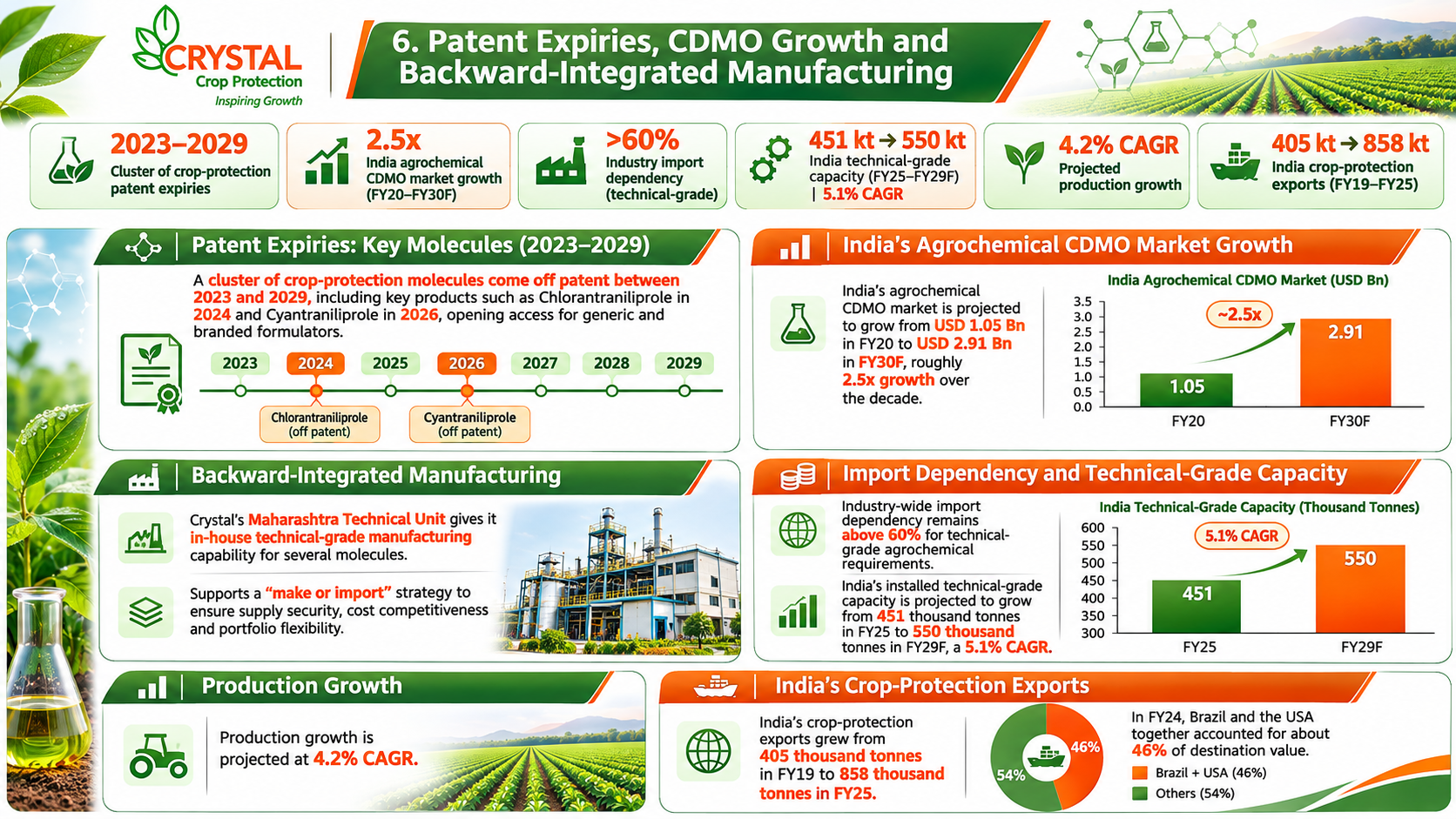
India's cultivated area grew from 198.6 Mn hectares (FY20) to 213.4 Mn hectares (FY24), a 1.8% CAGR, while the area actually treated with chemical pesticides grew more slowly, from 108.0 Mn to 113.4 Mn hectares (1.2% CAGR); this persistent gap between cultivated and treated area implies meaningful headroom for further crop-protection penetration, particularly in semi-arid, rainfed and smallholder regions that remain under-treated relative to irrigated, commercially-oriented farming belts. National average foodgrain yield rose from 2,246 kg/ha (FY20) to 2,471 kg/ha (FY25), a roughly 10% improvement driven by irrigation, improved seed varieties and more precise input use; higher yields raise the economic cost of crop loss to pests and disease, making protection expenditure more integral to a farmer's planning rather than a discretionary cost.
The key drivers are:
Direct relevance to Crystal: Crystal's branded crop-protection business grew at an 18% revenue CAGR over FY23-FY25, outpacing the issuer/F&S-cited industry average of 10-13% over the same period, consistent with the Company gaining penetration faster than the broader underpenetrated-area tailwind alone would imply
Minimum Support Price support for farmer purchasing power: MSP for key crops grew at a 4.4% to 5.7% CAGR over FY21-FY25 (paddy and wheat at 5.3%, cotton at 5.6%-5.7%), supporting the cash flow available to farmers for planned, branded-input purchases rather than lower-cost unorganized or counterfeit alternatives
Insecticide market growth, Crystal's largest crop-protection category: The Indian insecticide market is projected to grow from USD 2.38 Bn (FY25) to USD 3.32 Bn (FY30F), a 6.94% CAGR; Crystal's own insecticide portfolio contributed 33% of its crop-protection revenue mix in FY25, and its newly-launched Jivora brand (2025, cotton sucking-pest control) achieved a 20% usage share and 30% spontaneous recall among surveyed growers within its debut period
Herbicide category, the fastest-growing but most cyclical segment: Herbicides grew from 16.2% to 21% of Indian crop-protection value between FY21 and FY25, the fastest-gaining of the three major categories, reflecting rural labour shortages and weed-resistance management needs; Crystal's own herbicide share of crop-protection revenue rose from 32% (FY24) to 36% (FY25), concentrating its exposure in this segment's monsoon-driven demand cyclicality, which is also the primary driver of Crystal's FY24 revenue decline
Structural Shift Toward Branded, Organized Seeds
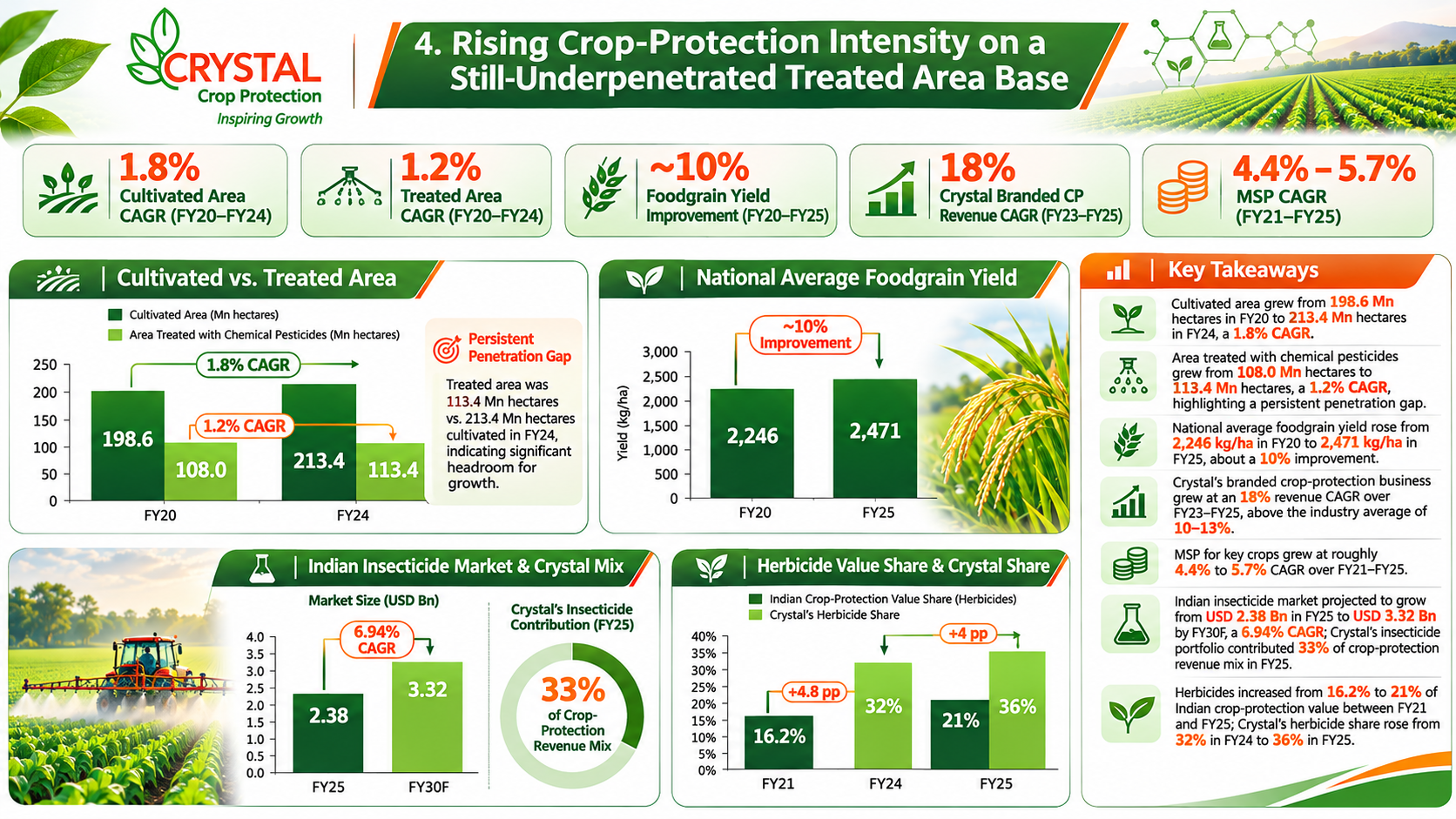
The organized share of the Indian seed market rose from 43% (USD 1.35 Bn, FY19) to an estimated 57.7% (USD 2.25 Bn, FY25), and is projected to reach 58.5% (USD 3.25 Bn) by FY30, a clear and sustained share gain for branded, R&D-backed players at the expense of unorganized and farm-saved seed. This shift is reinforced by the government's Seed Replacement Rate policy targets of 33% (self-pollinated crops), 50% (cross-pollinated) and 100% (hybrids) under the Sub Mission on Seed and Planting Material, which structurally favour branded-hybrid suppliers as India's actual SRR converges toward these targets over time.
The key drivers are:
Crystal's seeds segment is already outgrowing this tailwind: Crystal's seeds segment revenue grew at a 24.9% CAGR over FY23-FY25 (from INR 301.3 Cr to INR 469.9 Cr), materially faster than the underlying organized-market growth rate, aided by the 2024 I&B Seeds and 2021 Bayer seed-portfolio acquisitions
Category leadership in pearl millet and mustard: Crystal holds a 20.6% volume share of the organized pearl millet seed market (the Company's third-largest share position behind Corteva-Pioneer) and a 6.3% share of mustard, both top-three positions, built on its decades-old ProAgro brand legacy and, for mustard, a technology collaboration with BASF for Clearfield non-GM herbicide-tolerant traits
Vegetable and flower seeds, the newest and highest-value-density category: The Indian vegetable seed market is projected to nearly double from approximately INR 5,500-5,700 Cr (2025) to INR 9,800-9,900 Cr by 2030 (9-10% CAGR), and is more than 80% hybridized in crops such as okra, chilli and tomato; Crystal's I&B Seeds acquisition gives it a 25-30% share of the Indian marigold flower-seed segment specifically, alongside two joint R&D programs with the World Vegetable Centre and the Asia and Pacific Seed Association
R&D intensity underpinning the organized-market position: Crystal's seed R&D investment grew from INR 20.5 Cr (FY23) to INR 31.6 Cr (FY25), a 24.1% CAGR, equivalent to 6.7% of seed-segment revenue in FY25; the Company holds 60 Plant Variety Protection applications for pearl millet and sorghum germplasm (11 approved, 23 under review) across 14 dedicated breeding locations
Patent Expiries, CDMO Growth and Backward-Integrated Manufacturing
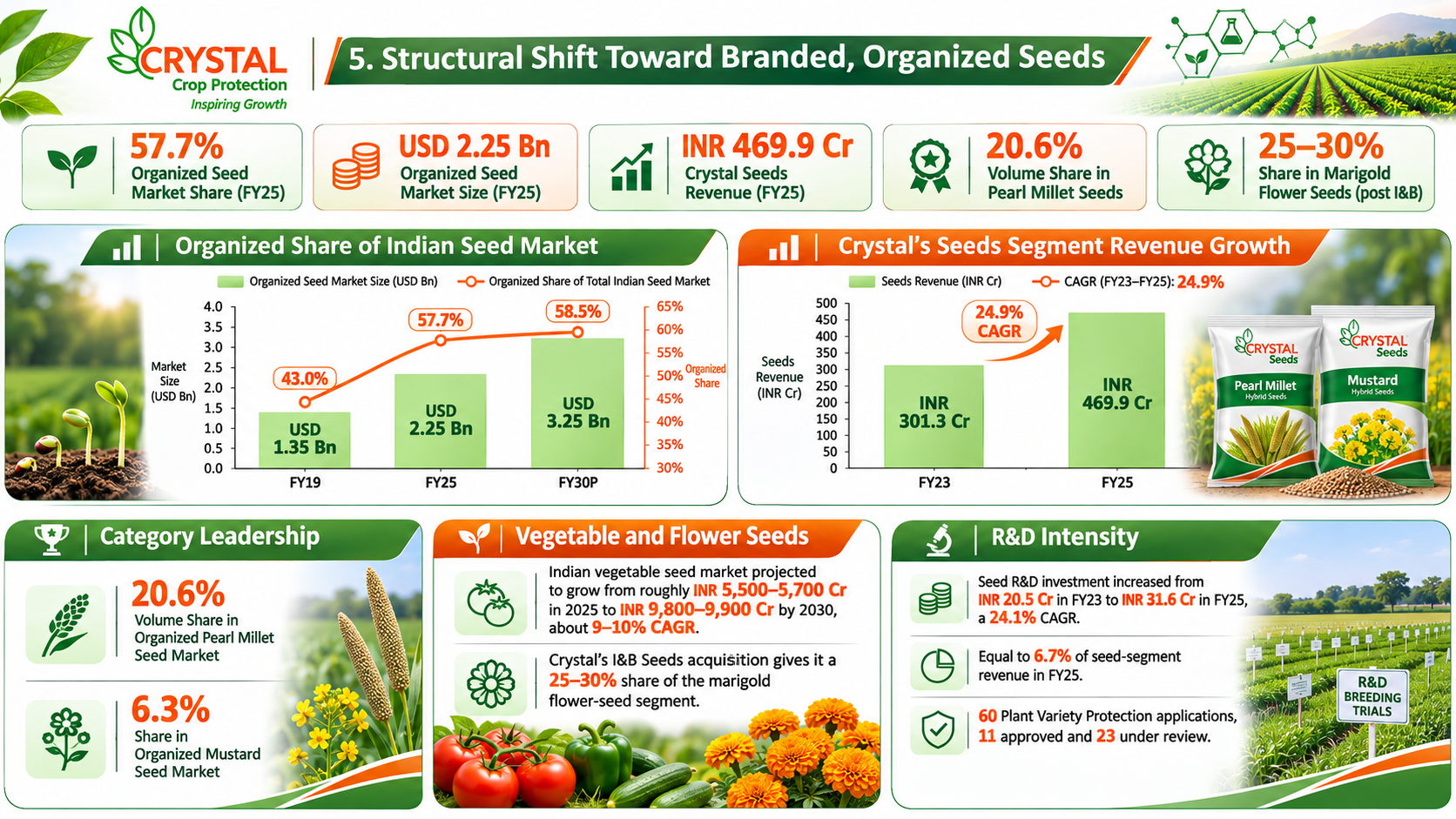
A cluster of globally-patented crop-protection molecules (including Chlorantraniliprole in 2024 and Cyantraniliprole in 2026, among others) come off patent between 2023 and 2029, opening access for Indian generic and branded formulators, including Crystal, to manufacture and market high-efficacy, globally-validated actives without incurring the originator's R&D cost. In parallel, India's Contract Development and Manufacturing Organisation (CDMO) market for agrochemicals is projected to grow from USD 1.05 Bn (FY20) to USD 2.91 Bn (FY30F), roughly 2.5x growth over the decade, as global innovator companies increasingly outsource manufacturing to Indian formulators with proven technical-grade capability
The key drivers are:
Direct relevance to Crystal's manufacturing base: Crystal's Maharashtra Technical Unit (acquired from Cytec India in 2018) gives it in-house technical-grade manufacturing capability for several molecules, reducing import dependency for those lines even as the Company, like the wider industry, continues to import for others; the DRHP and F&S report cite Crystal as one of the few domestic players demonstrating proven “Make or Import” flexibility, backed by backward integration into intermediates
Industry-wide import dependency remains a structural feature, not solely a Crystal-specific exposure: More than 60% of India's technical-grade agrochemical requirement is still imported industry-wide; India's installed technical-grade capacity is nonetheless projected to grow from 451 thousand tonnes (FY25) to 550 thousand tonnes (FY29F), a 5.1% CAGR, alongside production growth of 4.2% CAGR, providing a tailwind for backward-integrated players to capture a larger share of a growing domestic manufacturing base
Export market access supported by patent expiries and registration reform: India's crop-protection exports (technical plus formulation) grew from 405 thousand tonnes (FY19) to 858 thousand tonnes (FY25), with Brazil and the USA together accounting for approximately 46% of destination value in FY24; simplified export-registration categories and fast-track processing for Star Export Houses reduce the regulatory lead time for formulators seeking to monetise patent-expiry opportunities internationally, though Crystal's own export revenue remains a small and declining share of its total revenue
Industry Risks
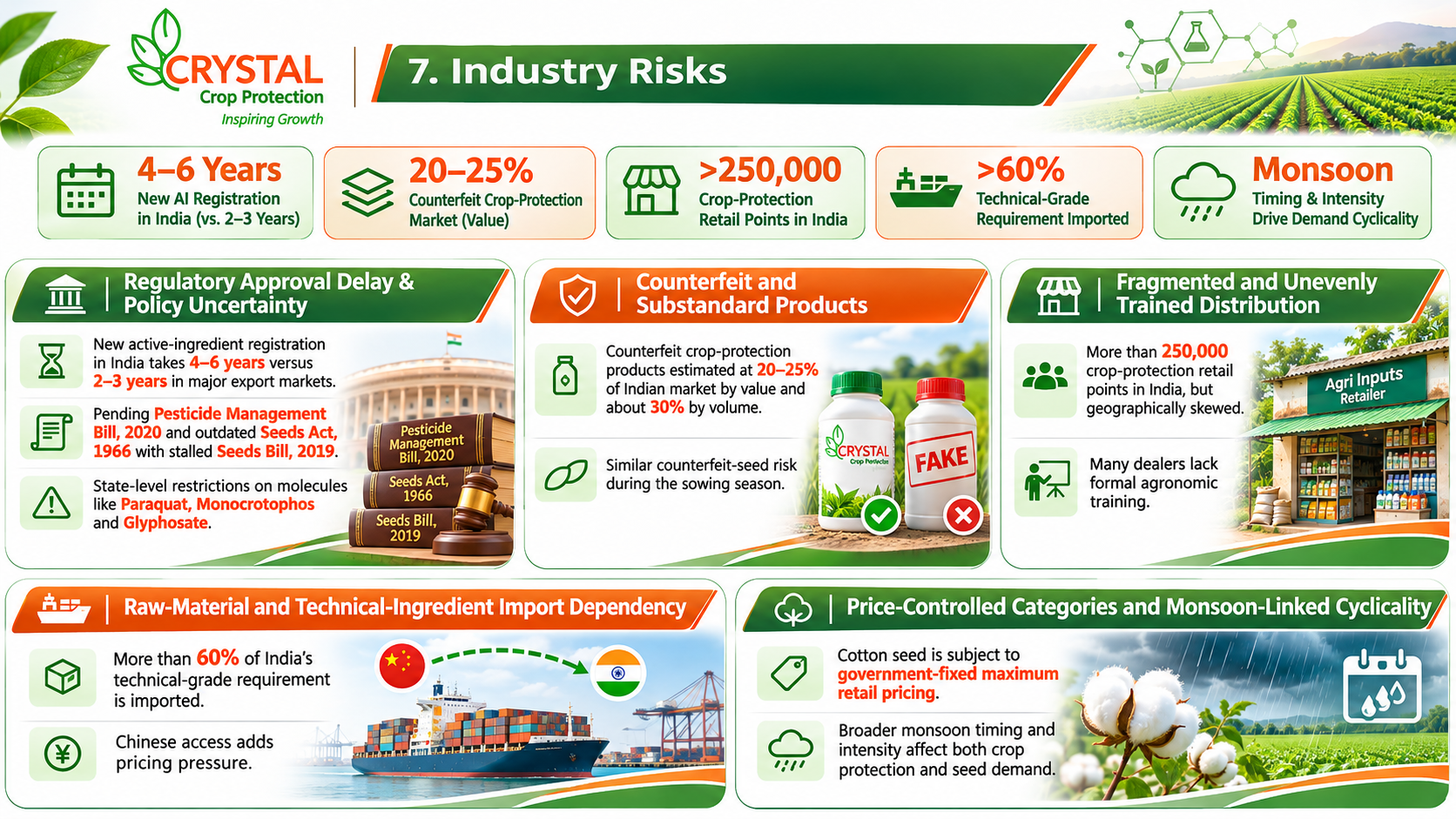
The Indian crop protection and seeds industries in which Crystal operates carry a set of structural, industry-wide risks that affect all participants, including Crystal, independent of company-specific execution
The key risks are:
Regulatory approval delay and policy uncertainty: New active-ingredient registration in India takes 4 to 6 years, materially longer than the 2 to 3 years typical in major export markets, under the Insecticides Act, 1968 framework; the pending Pesticide Management Bill, 2020 (intended to replace this Act) and the outdated Seeds Act, 1966 (with a stalled Seeds Bill, 2019) both create prolonged regulatory ambiguity, while frequent state-level bans on specific molecules (Paraquat, Monocrotophos, Glyphosate have all faced state-level restriction) disrupt industry-wide product planning and channel confidence with limited advance notice
Counterfeit and substandard products: A FICCI study found counterfeit crop-protection products constitute an estimated 20-25% of the Indian market by value and approximately 30% by volume, concentrated in states with weaker regulatory oversight (Bihar, Odisha, Assam, parts of Uttar Pradesh); counterfeiting directly erodes genuine manufacturers' realized pricing and can damage brand equity when counterfeit product underperforms in the field and is misattributed to the genuine brand. A parallel counterfeit-seed risk exists in the seeds industry, particularly during high-demand sowing windows
Fragmented, unevenly-trained distribution infrastructure: India has more than 250,000 crop-protection retail points, but distribution is geographically skewed, with Uttar Pradesh, Gujarat and West Bengal together accounting for over a third of all distributors, leaving Jammu & Kashmir, the Northeast and parts of eastern India comparatively under-served; many dealers lack formal agronomic training, which the industry itself cites as a cause of product misapplication and reduced realized field efficacy, a factor that can depress customer satisfaction independent of underlying product quality
Raw-material and technical-ingredient import dependency: More than 60% of India's technical-grade agrochemical active ingredient requirement is sourced from imports industry-wide, exposing all formulators, including vertically-integrated players, to global input-price volatility, logistics disruption and source-country regulatory or currency risk; competition from direct, lower-cost access by Chinese manufacturers to Indian customers is separately cited in the DRHP as intensifying price competition in the formulation segment
Government Policy Support
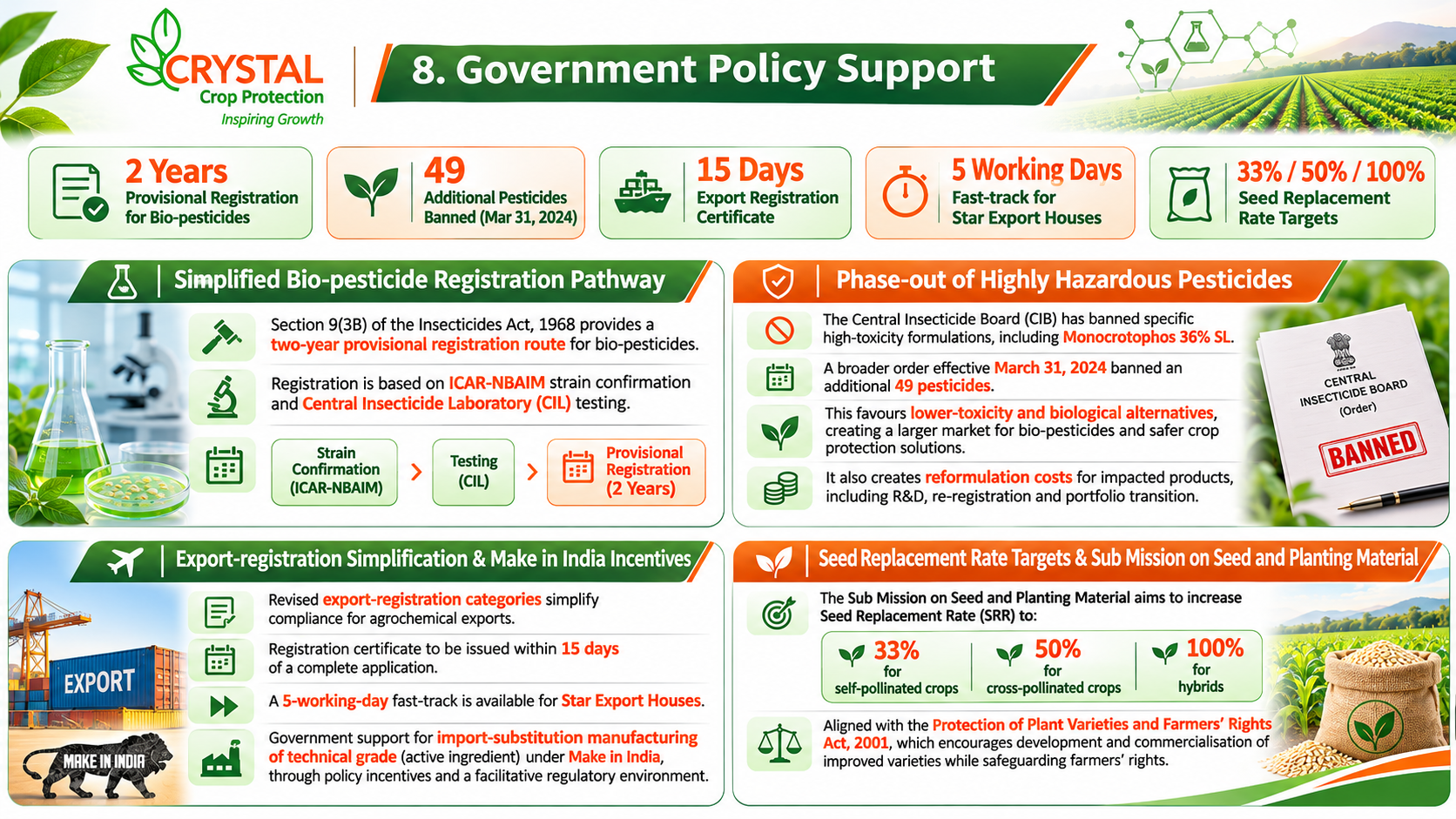
Government policy in India is broadly supportive of the organized, branded segment of both the crop-protection and seed industries in which Crystal participates, through a combination of registration-process reforms, phase-outs of legacy hazardous chemistry, and seed-sector targets that favour certified, hybrid-seed adoption.
The key policies are:
Simplified bio-pesticide registration pathway: Section 9(3B) of the Insecticides Act, 1968 provides a two-year provisional registration route for bio-pesticides based on ICAR-NBAIM strain confirmation and Central Insecticide Laboratory testing, a materially faster pathway than conventional chemical-pesticide registration, directly supporting faster commercialisation for Crystal's GreenAg biologicals pipeline
Phase-out of Highly Hazardous Pesticides: The Central Insecticide Board has banned specific high-toxicity formulations (including Monocrotophos 36% SL), with a broader government prohibition order effective March 31, 2024 banning an additional 49 pesticides for manufacture, import or use; this policy direction favours formulators, including Crystal, that are diversifying toward lower-toxicity and biological alternatives, while creating compliance and reformulation costs for any legacy products affected
Export-registration simplification and “Make in India” manufacturing incentives: Revised export-registration categories (simplified from categories A-I to B-IV) and mandated 15-day registration certificate issuance, with a 5-working-day fast-track for Star Export Houses, reduce the regulatory lead time for Indian formulators pursuing export-led growth; separately, “Make in India” incentives for chemical manufacturers support continued technical-grade, import-substitution capacity build-out, an area in which Crystal already has an established manufacturing base at its Maharashtra Technical Unit
Seed Replacement Rate targets and the Sub Mission on Seed and Planting Material: Government SRR targets of 33% (self-pollinated), 50% (cross-pollinated) and 100% (hybrid) crops, pursued under the SMSP, together with the Protection of Plant Varieties and Farmers' Rights Act, 2001 regime underpinning Crystal's own Plant Variety Protection filings, structurally support continued organized/branded-seed share gains of the kind driving Crystal's seeds-segment growth
Fundraise/Future Plans
Shareholding
Pre-issue shareholding
Promoter Holding 0.0%
Post-Issue Shareholding
Promoter Holding 0.0%
Category
Pre-Issue%Post-Issue%
Promoters
Nand Kishore Aggarwal
33.2%30.6%
Ankur Aggarwal
9.8%6.8%
Komal Aggarwal
4.9%4.5%
Ankur Aggarwal KNK Family Trust
32.2%29.6%
Total Promoter Holding
80.1%71.5%
Additional Shareholders
Promoter Group
4.7%4.3%
Other Shareholders
15.2%24.2%
Total Additional Holding
19.9%28.5%
Total Shareholding
100.0%100.0%
- Overview
- Business
- Financial Highlights
- Industry Overview
- Fundraise/Future Plans
- Documentation
Get the Preqt App and keep in touch around the clock!
 Monitor your investments in real-time.
- Receive tailored deal suggestions.
- Get real-time updates and alerts.