

Lohia Corp
Engineering Global GrowthPrecision Meets Productivity
IPO Summary (Pre-QT)
Lohia Corp is a leading manufacturer of machinery for woven raffia and technical-textile applications, with operations spanning approximately 100 countries. The Company reported FY'26 consolidated revenue of INR 1,717 Cr, EBITDA of INR 339 Cr and PAT of INR 193 Cr, supported by improving margins and an order book of INR 1,359 Cr. The IPO is a 100% Offer for Sale of approximately INR 1,102 Cr, and therefore no fresh capital will be received by the Company. The investment proposition is supported by market leadership, strong return ratios and technological capabilities, while key concerns include the complete OFS structure, high dependence on woven-raffia machinery and limited comparability of historical carve-out financials.
IPO Review and Rating
Lohia Corp
Mainboard IPOOverall Observation
Lohia Corp presents a strong operating business with high returns, improving margins, low leverage, good cash conversion and a defensible market position. The biggest reservations are:
100% OFS with no fresh capital for the Company
High 8.61x price-to-book valuation
Short comparable consolidated financial history after the demerger
Material, though declining, related-party transactions
Moderate growth in the core global machinery TAM
Near-term market sentiment that is cautious rather than decisively bullish
The business is stronger than the IPO structure. The long-term investment thesis depends on sustaining margins, converting the order book and successfully expanding beyond conventional woven-raffia machinery - not merely on GMP or listing-day demand.
PARAMETER
WEIGHT
SCORE
KEY FACTORS
Industry
20.0%
3.0/5
Show more
Detailed Analysis
The global woven-raffia machinery market is expected to grow from approximately US$1.01 billion in 2024 to US$1.37 billion by 2030, a 5.2% CAGR. The Indian market is projected to grow at 10.0%, while Indian technical textiles are projected to grow at 10.5%
The RHP classifies the woven-raffia machinery industry as being in a growth phase, supported by automation, replacement of older equipment, higher packaging demand and expansion across agriculture, cement and construction
Lohia Corp held approximately 15.4% of the global market in 2024, behind Starlinger at approximately 42%. Domestically, Lohia led with approximately 40.7% market share in FY25. The exact HHI is not disclosed, but the available shares indicate moderate concentration rather than a fragmented commodity market
Make in India, PLI, the National Technical Textiles Mission and PM MITRA provide policy support. Conversely, environmental restrictions, anti-plastic sentiment, EPR requirements and substitution by paper, jute or biodegradable materials create long-term risks for the downstream raffia industry
Overseas revenue represented 42.18% of FY26 revenue, compared with 58.18% in FY25. The Company has offices in Brazil, Russia, Thailand, the UAE and the US, along with 17 exclusive overseas agents and service engineers across multiple countries.
Management
20.0%
4.0/5
Show more
Detailed Analysis
Chairman and Managing Director Raj Kumar Lohia has more than 43 years of industry experience, while Gaurav Lohia has over 20 years of manufacturing experience. The CFO has approximately 32 years of finance experience.
The Board comprises eight directors, of whom four are independent directors, representing exactly 50% of the Board
Promoter contribution shares are not subject to any pledge or encumbrance. The RHP reports no criminal, material civil or regulatory action against the promoters. However, independent director Dinesh Kumar Mittal has a pending SEBI matter relating to a previous directorship, and the Company has small non-material indirect-tax proceedings
The absolute sum of related-party transactions represented 12.02% of FY26 revenue, down sharply from 33.36% in FY25. Transactions included sales, loans, recoveries and dealings with subsidiaries and promoter-group entities
The parameter is labelled “Management Consulting” in the scoring sheet, but its thresholds measure promoter selling. Lohia Corp’s IPO is a 100% OFS, with no fresh capital entering the Company. Promoters and the promoter group are estimated to retain approximately 75.23% after the issue
Valuation Metrics
20.0%
4.0/5
Show more
Detailed Analysis
At ₹425, Lohia Corp is valued at 23.21x FY26 earnings. This is above Rajoo Engineers at 18.27x but substantially below Mamata Machinery at 62.07x, Jyoti CNC at 54.60x and LMW at 134.25x
At the upper band, implied enterprise value is approximately ₹4,613.66 crore and EV/EBITDA is approximately 13.59x. A standardized current EV/EBITDA comparison for every RHP peer is not disclosed in the supplied material
The upper-band price of ₹425 compared with FY26 NAV of ₹49.37 implies a P/B multiple of 8.61x
The RHP’s Basis for Offer Price section reports FY26 RoNW of 72.95%, whereas the operating KPI table reports standard ROE of 36.80%. The difference arises from different net-worth definitions, including the treatment of capital reserves and averaging conventions
As of the morning of 22 July 2026, the reported GMP was approximately ₹40 per share, implying a potential premium of around 9.41% over the ₹425 upper band
The IPO comprises an OFS of approximately 2.59 crore shares and no fresh issue. Lohia Corp will receive no proceeds from the offering
Merchant Banker Track Record
20.0%
4.0/5
Show more
Detailed Analysis
BRLM: Equirus Capital and Motilal Oswal Investment Advisors
A limited sample of the two most recent clearly attributable mandates gives highly divergent Average Listing-Day Return: Turtlemint listed at an 11.25% discount, while CMR Green Technologies listed at a 39.58% premium. The simple two-issue average is approximately 14.2%. AIBI identifies Motilal Oswal and/or Equirus among the relevant lead managers
Of the two recent mandates used above, one produced a positive listing and one a negative listing, giving a provisional success rate of 50%
Motilal Oswal is among the domestic banks with a leading upcoming-IPO mandate book, while Equirus is an established domestic investment bank with multiple recent IPO mandates
Financial Performance
20.0%
4.0/5
Show more
Detailed Analysis
Revenue increased from INR 1,165.81 Cr in FY24 to INR 1,376.87 Cr in FY25 and INR 1,717.00 Cr in FY26, representing a two-year CAGR of approximately 21.36%. FY24 is based on special-purpose combined and carve-out financial statements, while comparable FY23 consolidated information is unavailable
EBITDA increased from INR 105.96 Cr in FY24 to INR 228.60 Cr in FY25 and INR 339.45 Cr in FY26. EBITDA margin expanded from 9.03% to 19.53% over the same period
PAT margin increased from 2.54% in FY24 to 8.50% in FY25 and 11.13% in FY26. FY26 PAT stood at INR 193.45 Cr
FY26 net debt-to-equity was 0.23x, while gross borrowings of approximately INR 152.78 Cr imply gross debt-to-equity of roughly 0.29x. Net debt-to-EBITDA was only 0.36x
FY26 ROE was 36.80%, while ROCE was 40.92%. Both ratios improved materially from the earlier comparable periods
Operating cash flow increased from approximately INR 141.28 Cr in FY25 to INR 325.16 Cr in FY26. FY26 operating cash flow was approximately 1.68 times PAT
TOTAL
100%
3.8/5
Weighted Composite Score
Issue Price
₹404.0 to ₹425.0
As of 5 Sep 2026
GMP
₹40.0
As of 5 Sep 2026
Estimated Gain / Loss
+9.4%
Lot Size
35.0 Shares
Grey Market Premium (GMPs) are shared for knowledge purpose only. PrEqt doesn’t promote or execute the trades.
| Issue Size (in Cr) | |
|---|---|
| Overall | ₹1,101.0 Cr |
| Fresh Issue | - |
| Offer for Sale | ₹1,101.0 Cr |
Minimum Investment
₹14,875.0 / 1,225 shares

Merchant Banker
Equirus Capital Ltd.
IPO Document
RHP / Anchor Document
Offer Start Date
23rd Jul 2026
Offer End Date
27th Jul 2026
Valuation
₹4,490.1 Cr
Revenue (FY'26 Revenue)
FY'26 Revenue
₹1,717.0 Cr
PAT FY'25
₹193.5 Cr
Issue Size (in Cr)
₹1,101.0 Cr
Face Value
₹ 1.0Lot Size
35.0 sharesSale Type
OFS onlyPAT FY'25
₹ 193.5 CrPAT Margin (FY'26)
8.5 %P/E Multiple
23.2xEBITDA (FY'26)
₹ 339.5 CrCAGR Growth 2Y
21.4 %ROE (FY'26)
36.8 %ROCE (FY'26)
40.9 %Price to Book Value
8.6xDebt/Equity
0.2xCompany Website
www.lohiagroup.comExplore new deals
Overview
Fund Allocation
Total: ₹0 CrSource:Company DRHP
Timeline
IPO Open Date
To Be Announced
IPO Close Date
To Be Announced
Tentative Allotment
To Be Announced
Initiation of Refunds
To Be Announced
Credit of Shares to Demat
To Be Announced
Tentative Listing Date
To Be Announced
Business
Machinery
Business Model
Geographical Presence
Sales Channel
Financial Highlights
Income Statement
Revenue growth with EBITDA and PAT margins
| Financial Metric | FY 2025 | FY 2026 |
|---|---|---|
| Revenue (₹ Cr) | 1,386.5 | 1,737.9 |
| Growth (%) | 18.1% | 24.7% |
| EBITDA (₹ Cr) | 228.6 | 339.5 |
| EBITDA Margin (%) | 16.5% | 19.5% |
| PAT (₹ Cr) | 117.8 | 193.5 |
| PAT Margin (%) | 8.5% | 11.1% |
OBSERVATIONS & INSIGHTS
The comparable financial trend shows strong operating leverage between FY24 and FY26. Revenue grew steadily, while EBITDA and PAT expanded substantially faster as material costs, employee expenses and other operating expenses were absorbed over a larger revenue base.
The key factors are:
Revenue increased at a two-year CAGR of approximately 21.36% from FY24 to FY26
EBITDA increased at a two-year CAGR of approximately 78.98%
PAT increased at a two-year CAGR of approximately 154.97% from a low FY24 base
EBITDA margin expanded by 10.50 percentage points between FY24 and FY26
PAT margin improved from 2.54% in FY24 to 11.13% in FY26
Balance Sheet
| Financial Metric | FY 2025 | FY 2026 |
|---|---|---|
| Total Assets | ₹ 967.6 Cr | ₹ 1,304.7 Cr |
| Total Borrowing | ₹ 212.2 Cr | ₹ 152.8 Cr |
| Reserves & Surplus | ₹ 361.1 Cr | ₹ 515.2 Cr |
Cash Flow
| Financial Metric | FY 2024 | FY 2025 | FY 2026 |
|---|---|---|---|
CFO (₹ Cr) Cash generated from core business operations. | - | +141.3 Cr | +325.2 Cr |
CFI (₹ Cr) Cash used for investments and long-term assets. | - | -39.3 Cr | -239.1 Cr |
CFF (₹ Cr) Cash flow related to funding and borrowings. | - | -87.8 Cr | -95.5 Cr |
Financial Ratios
Measures the company’s leverage relative to shareholder equity.
OBSERVATIONS & INSIGHTS
Return ratios and debt-servicing capacity improved materially as profitability increased and borrowings declined
ROCE reached 40.92% in FY26, while gross debt-to-equity declined to approximately 0.29x
The current ratio improved but remained below 1.5x, indicating that working-capital management continues to be important for the capital-equipment model
Industry Overview
Industry Drivers
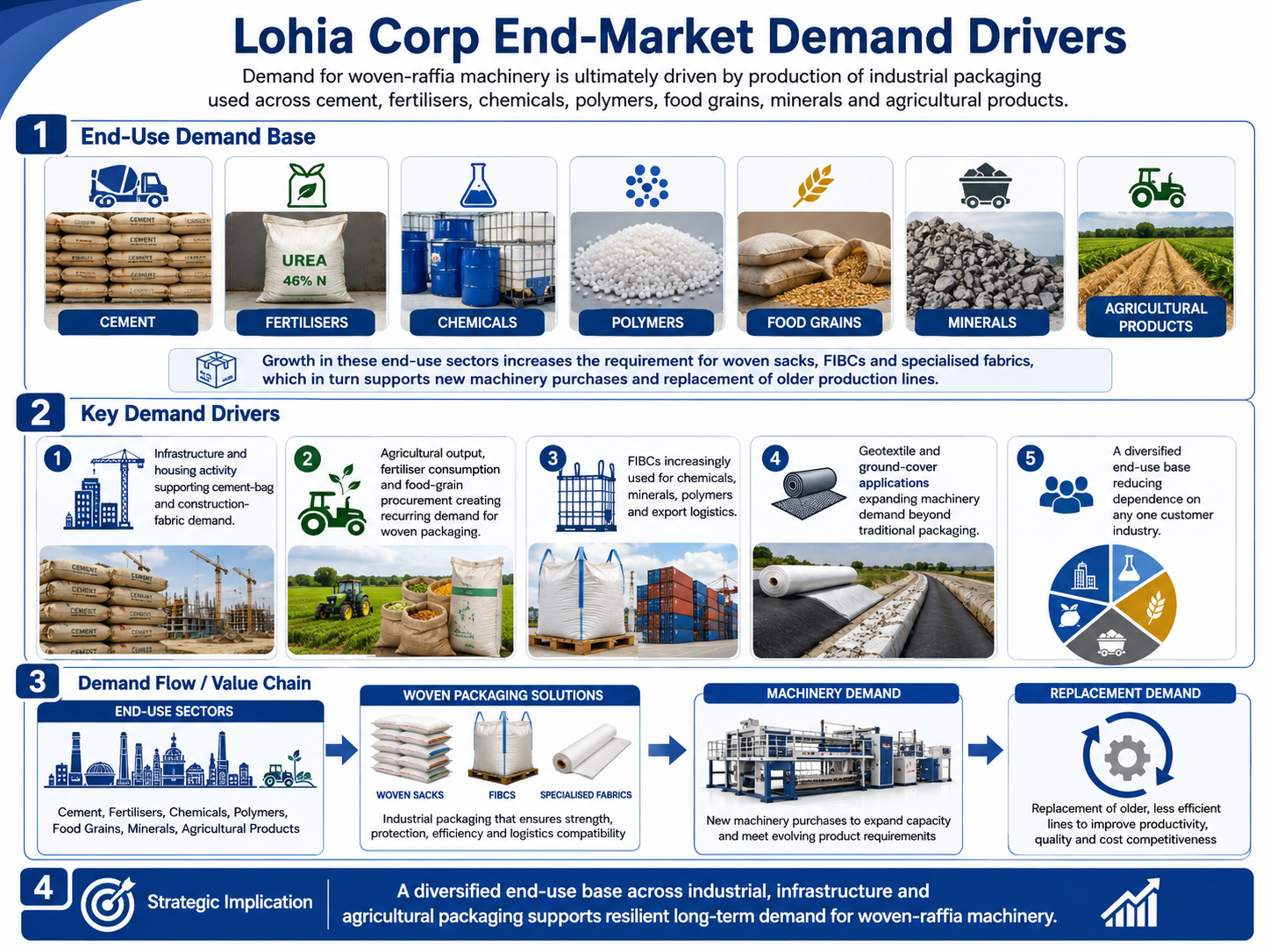
Growth in Packaging and End-Use Industries
Demand for woven-raffia machinery is ultimately driven by the production of industrial packaging used across cement, fertilisers, chemicals, polymers, food grains, minerals and agricultural products. Growth in these end-use sectors increases the requirement for woven sacks, FIBCs and specialised fabrics, which in turn supports new machinery purchases and the replacement of older production lines.
The key factors are:
Infrastructure and housing activity supports cement-bag and construction-fabric demand
Agricultural output, fertiliser consumption and food-grain procurement create recurring demand for woven packaging
FIBCs are increasingly used for chemicals, minerals, polymers and export logistics
Geotextile and ground-cover applications expand machinery demand beyond traditional packaging
A diversified end-use base reduces dependence on any one final customer industry
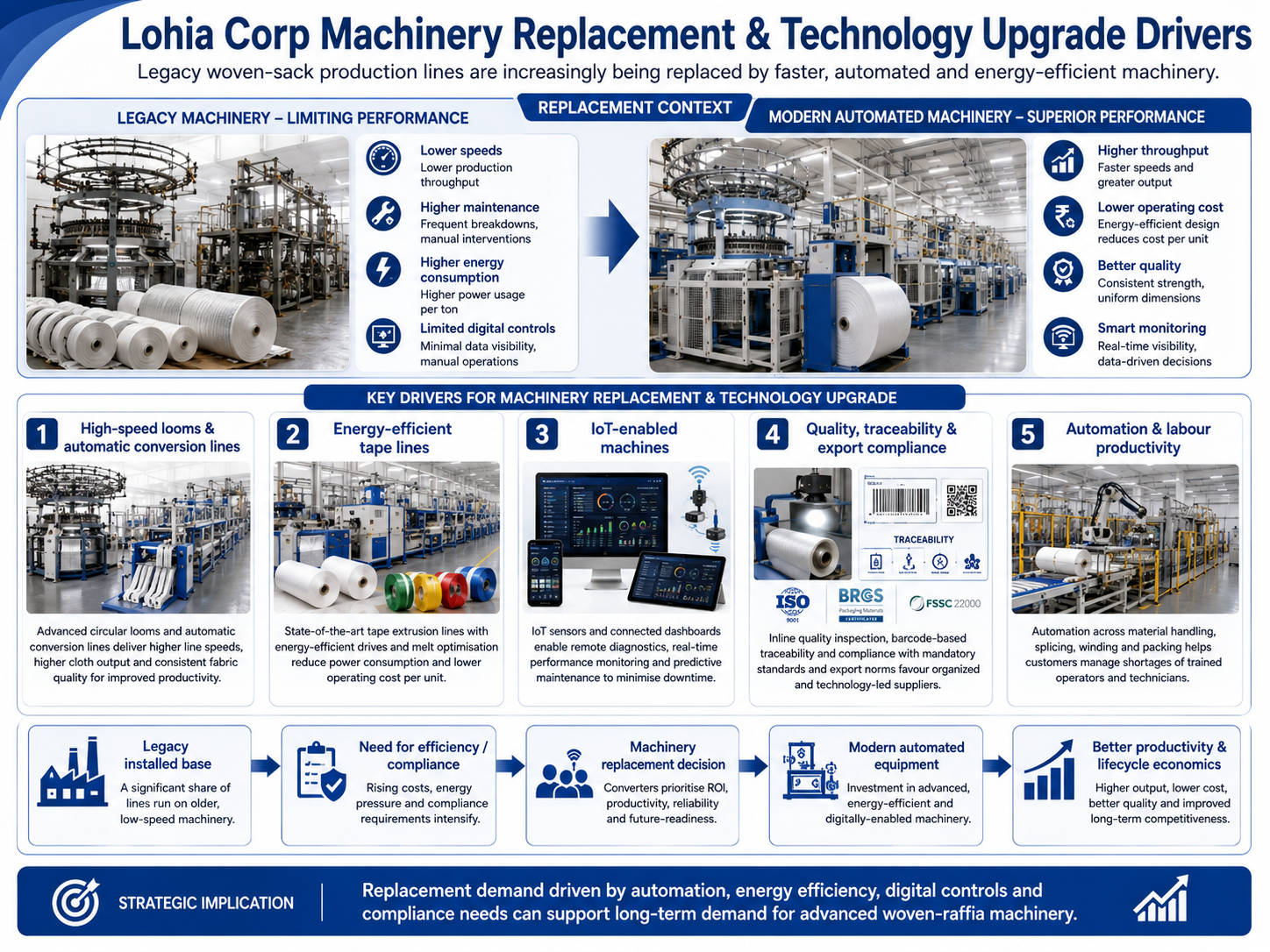
Modernisation, Automation and Replacement Demand
A meaningful part of the installed woven-sack manufacturing base operates with older machinery that has lower speeds, higher energy consumption and limited digital controls. Rising maintenance costs and the need to meet quality, traceability and sustainability requirements are encouraging converters to replace legacy equipment with automated and energy-efficient machinery.
The key factors are:
High-speed looms and automatic conversion lines improve production throughput
Energy-efficient tape lines reduce power consumption and operating cost per unit
IoT-enabled machines support remote diagnostics, performance monitoring and predictive maintenance
Mandatory quality standards and export compliance favour organised machinery suppliers
Automation helps customers manage shortages of trained operators and technicians
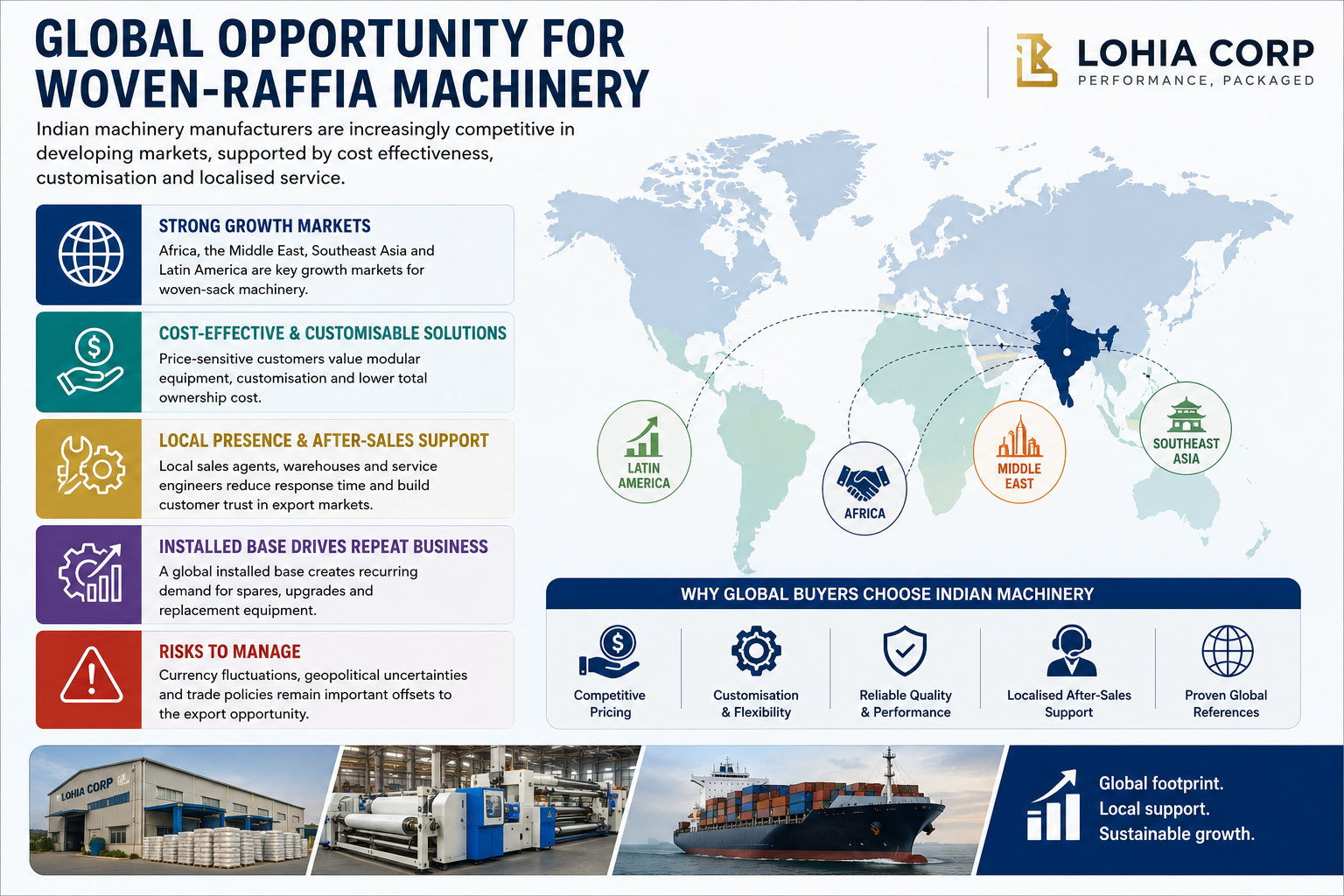
Export Opportunity and Global Supply Diversification
Indian equipment manufacturers are increasingly competitive in developing markets because they can offer cost-effective machinery, customisation and localised after-sales support. Global buyers are also diversifying suppliers beyond traditional European and Chinese vendors, creating opportunities for Indian manufacturers with established references and international service infrastructure.
The key factors are:
Africa, the Middle East, Southeast Asia and Latin America are important growth markets for woven-sack machinery
Price-sensitive customers value modular equipment and lower total ownership cost
Local sales agents, warehouses and service engineers reduce response time in export markets
A global installed base generates opportunities for spares, upgrades and replacement equipment
Currency and geopolitical risks remain important offsets to the export opportunity
Recycling and Specialty Technical Textiles
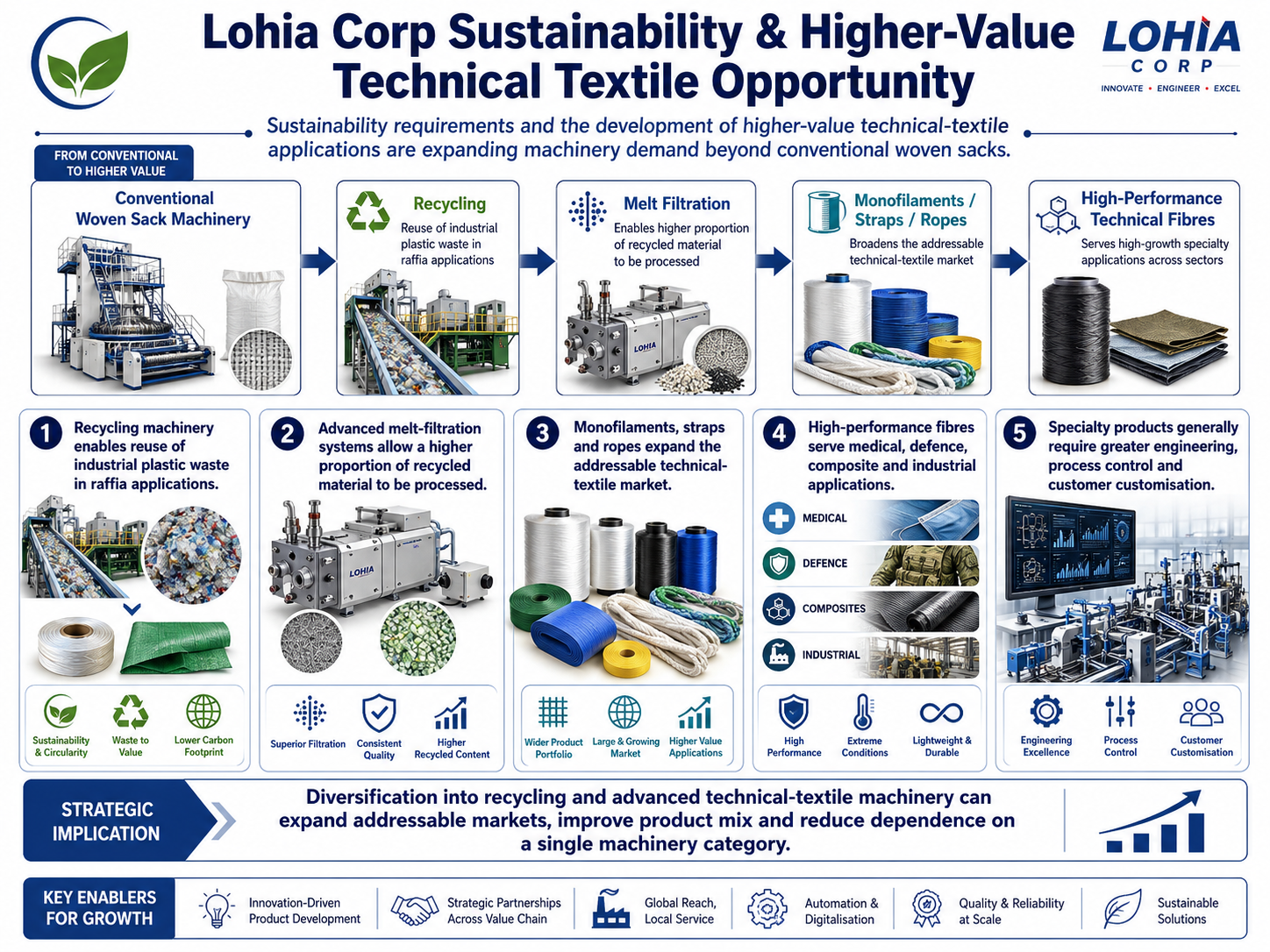
Sustainability requirements and the development of higher-value technical-textile applications are broadening the machinery opportunity beyond conventional woven sacks. Recycling systems, monofilament lines, high-performance fibre machinery and equipment for geotextiles, medical, defence and industrial applications can improve product mix and reduce dependence on a single machinery category.
The key factors are:
Recycling machinery enables reuse of industrial plastic waste in Raffia applications
Advanced melt-filtration systems allow a higher proportion of recycled material to be processed
Monofilaments, straps and ropes expand the addressable technical-textile market
High-performance fibres serve medical, defence, composite and industrial applications
Specialty products generally require greater engineering, process control and customer customisation
Risks in the Industry
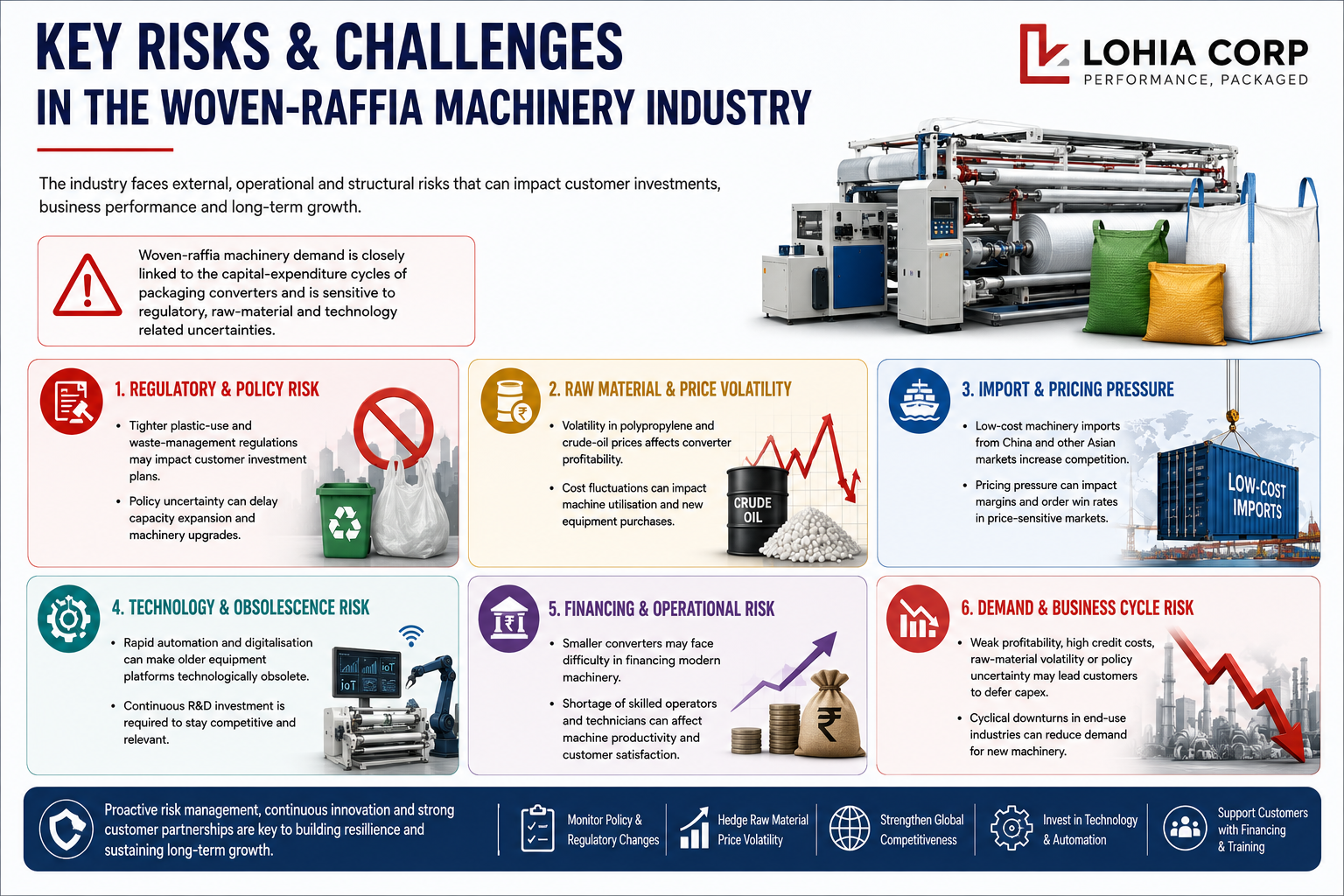
The woven-raffia machinery industry is exposed to the capital-expenditure cycles of packaging converters and to regulatory sentiment surrounding plastic products. Even when end-use consumption remains stable, customers may defer equipment purchases during periods of weak profitability, expensive credit, raw-material volatility or policy uncertainty. Technology and pricing competition also require continuous product development.
The key factors are:
Tighter plastic-use and waste-management rules may affect customer investment decisions
Volatility in polypropylene and crude-oil prices can influence converter profitability and machine utilisation
Low-cost machinery imports from China and other Asian markets create pricing pressure
Rapid automation and digitalisation can make older equipment platforms technologically obsolete
Smaller converters may face difficulty financing modern machinery and training skilled operators
Government Policy Support
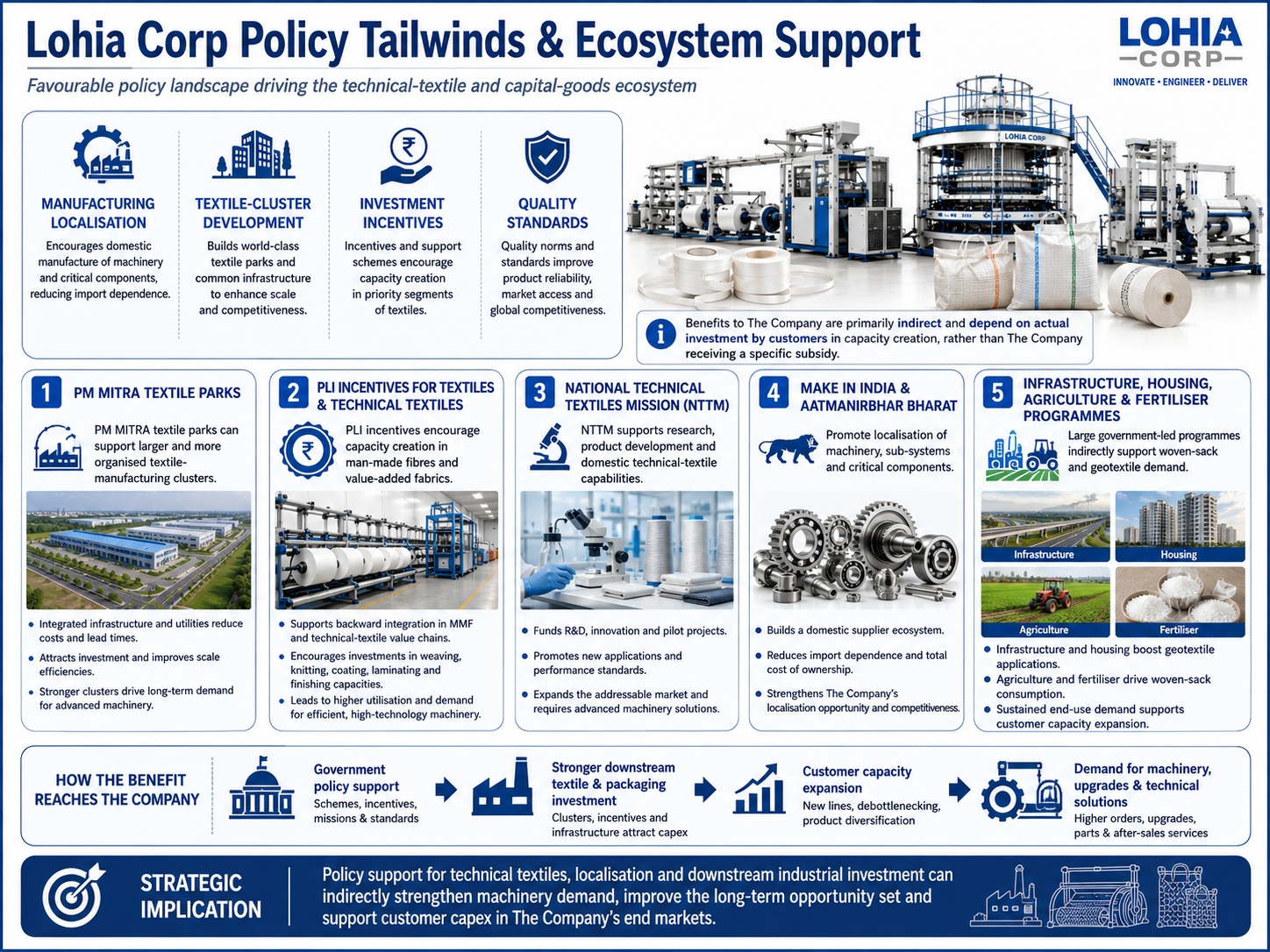
Government policy supports the technical-textile and capital-goods ecosystem through manufacturing localisation, textile cluster development, investment incentives and quality standards. These measures can stimulate downstream investment in textile production and create demand for domestic machinery. The benefit to Lohia Corp is primarily indirect and depends on actual investment by customers rather than the IPO Company receiving a specific subsidy.
The key factors are:
PM MITRA textile parks can support larger and more organised textile-manufacturing clusters
PLI incentives for textiles and technical textiles encourage capacity creation in man-made fibres and value-added fabrics
The National Technical Textiles Mission supports research, product development and domestic technical-textile capabilities
Make in India and Aatmanirbhar Bharat promote localisation of machinery and critical components
Infrastructure, housing, agricultural and fertiliser programmes indirectly support woven-sack and geotextile demand
Fundraise/Future Plans
Shareholding
Pre-issue shareholding
Promoter Holding 0.0%
Category
Pre-Issue%
Promoters
0.0%
Total Promoter Holding
0.0%
Additional Shareholders
0.0%
Total Additional Holding
0.0%
Total Shareholding
0.0%
- Overview
- Business
- Financial Highlights
- Industry Overview
- Fundraise/Future Plans
- Documentation
Get the Preqt App and keep in touch around the clock!
 Monitor your investments in real-time.
- Receive tailored deal suggestions.
- Get real-time updates and alerts.