


Shankesh Jewellers
Crafting Timeless EleganceJewels Beyond Generations
IPO Summary (PrEqT)
Shankesh Jewellers Limited is a Mumbai-based B2B wholesale gold jewellery company focused on hand-crafted 22K and 18K products. The Company follows an asset-light production model: it owns the customer relationship, design library, gold procurement, quality assurance and dispatch, while fabrication is executed through a network of third-party jobworkers / Karigars. FY26 revenue was INR 1,630.8 Cr and PAT was INR 106.7 Cr, with EBITDA margin expanding to 9.7%. The IPO comprises a fresh issue of 2.9 Cr shares and an OFS of 1.0 Cr shares at an announced price band of INR 88-INR 93 per share.
IPO Review Rating
Average
MainboardCelebrating Every Occasion Through Timeless Design and Fine Craftsmanship
Shankesh combines 23.9% 2 Year revenue CAGR, sharply improving profitability and a compelling 10.2x P/E, while 74.7% of the offer is fresh capital.
The main weakness is cash conversion: FY26 OCF was only INR 0.3 Cr against PAT of INR 106.7 Cr, alongside high inventory and working-capital requirements.
Customer concentration is manageable at 39.6%, but 91.2% supplier concentration deserves attention.
PARAMETER
WEIGHT
SCORE
KEY FACTORS
Financial Performance
40.0%
3.0/5
Revenue grew at 23.9% 2 Year CAGR, while EBITDA margin reached 9.7% and ROE increased to 50.9%. However, operating cash flow of only INR 0.3 Cr against PAT of INR 106.7 Cr indicates weak cash conversion.
Show more
Detailed Analysis
Revenue increased from INR 1,061.8 Cr in FY24 to INR 1,630.8 Cr in FY26, representing a CAGR of 23.9%
EBITDA increased from INR 65.4 Cr in FY25 to INR 157.9 Cr in FY26, while EBITDA margin expanded from 4.7% to 9.7%
PAT increased from INR 40.3 Cr in FY25 to INR 106.7 Cr in FY26, while PAT margin improved from 2.9% to 6.5%
Debt-to-equity improved from approximately 1.4x in FY25 to 0.8x in FY26
ROE increased from 40.1% in FY25 to 50.9% in FY26
Operating cash flow improved from INR -23.1 Cr in FY25 to INR 0.3 Cr in FY26, remaining significantly below FY26 PAT
Top-10 customer contribution increased from 30.6% in FY24 to 39.6% in FY26
Industry
15.0%
3.0/5
The wholesale gold-jewellery market is projected to grow at 12.4% CAGR, while organised players benefit from industry formalisation. However, gold-price volatility, regulation and high working-capital requirements remain structural risks.
Show more
Detailed Analysis
Indian wholesale gold jewellery market is projected to reach INR 337,500.0 Cr by CY29P, representing a CAGR of 12.4% from CY25P–CY29P
Organised manufacturers represented only 12.9% of the market in CY24, while organised wholesale is projected to grow at 14.7% CAGR
Mandatory BIS hallmarking, HUID traceability, gold-import rules and customs regulations materially affect industry operations
Indian gold-jewellery exports increased to INR 94,940.0 Cr in FY25, representing growth of 2.8% YoY
Management
15.0%
4.0/5
The promoters have 30+ years of experience, independent directors constitute 50.0% of the Board, and RPTs have declined to 3.9% of revenue. Governance is broadly satisfactory, although listed-company experience and outstanding litigation warrant monitoring.
Show more
Detailed Analysis
The promoter family has 30+ years of jewellery-industry experience, with the original business commencing in 1992
The Board comprises 6 directors, including 3 independent directors, resulting in 50.0% independence
No promoter shares are pledged, although Company/director taxation and legal proceedings remain outstanding
RPTs declined from 9.0% of revenue in FY24 to 4.9% in FY25 and 3.9% in FY26
Valuation
20.0%
4.0/5
At 10.2x P/E, Shankesh trades at a 54.4% discount to the disclosed peer average, while EV/EBITDA is also relatively attractive. However, the 5.2x P/B multiple is expensive and a reliable.
Show more
Detailed Analysis
At INR 93.0, the IPO is valued at approximately 10.2x FY26 earnings, versus the peer average of 22.4x, representing a discount of 54.4%
Estimated EV/EBITDA is approximately 9.7x versus the selected peer average of approximately 16.8x, implying a peer/issuer ratio of 1.7x
The upper price band of INR 93.0 represents approximately 5.2x FY26 NAV of INR 17.8 per share
RoNW increased from 21.3% in FY24 to 40.1% in FY25 and 51.0% in FY26
Merchant Banker Track Record
10.0%
3.0/5
The BRLM sample recorded strong average subscription of 88.5x, but average listing return was -1.78% with only a 50.0% positive-listing rate. The banker track record is therefore mixed rather than a major strength.
Show more
Detailed Analysis
The four selected mainboard IPOs generated an average listing return of approximately -1.8%
The selected issues recorded average final subscription of approximately 88.5x
2 of 4 issues listed above their issue price, resulting in a positive-listing rate of 50.0%
Both BRLMs are established merchant bankers but have a smaller institutional/mainboard franchise than Tier-1 investment banks
TOTAL
100%
3.4/5
Weighted Composite Score
Issue Price
₹88.0 to ₹93.0
As of 29 Aug 2026
GMP
₹2.8
As of 29 Aug 2026
Estimated Gain / Loss
+2.9%
Lot Size
160.0 Shares
Grey Market Premium (GMPs) are shared for knowledge purpose only. PrEqt doesn’t promote or execute the trades.
| Issue size | |
|---|---|
| Overall | ₹367.0 Cr |
| Fresh Issue | ₹274.0 Cr |
| Offer for Sale | ₹93.0 Cr |
Minimum Investment
₹14,880.0 / 25,600 shares

Merchant Banker
Aryaman Financial Services Ltd.; Smart Horizon Capital Advisors Pvt Ltd
IPO Document
RHP / Anchor Document
Offer Start Date
18th Aug 2026
Offer End Date
20th Aug 2026
Valuation
₹1,367.4 Cr
Revenue FY'26
₹1,630.9 Cr
PAT (FY'26)
₹106.7 Cr
Issue Size
₹367.0 Cr
Face Value
₹ 5.0Offer Price
₹ 93.0Lot Size
160.0 sharesSale Type
Fresh capital cum OFSPAT (FY'26)
₹ 106.7 CrPAT Margin (FY'26)
6.5 %P/E Multiple
10.2xEBITDA (FY'26)
₹ 157.9 CrCAGR Growth 3Y
23.9 %ROE (FY'26)
50.9 %ROCE (FY'26)
41.6 %Price to Book Value
5.2xDebt/Equity
0.8xCompany Website
www.shankeshjewellers.comExplore new deals
Overview
Fund Allocation
Total: ₹0 CrSource:Company DRHP
Timeline
IPO Open Date
To Be Announced
IPO Close Date
To Be Announced
Tentative Allotment
To Be Announced
Initiation of Refunds
To Be Announced
Credit of Shares to Demat
To Be Announced
Tentative Listing Date
To Be Announced
Business
Products
Business Model
Geographical Presence
Sales Channel
Clients
Financial Highlights
Income Statement
Revenue growth with EBITDA and PAT margins
| Financial Metric | FY 2024 | FY 2025 | FY 2026 |
|---|---|---|---|
| Revenue (₹ Cr) | 1,061.9 | 1,403.9 | 1,630.9 |
| Growth (%) | 16.8% | 32.2% | 16.2% |
| EBITDA (₹ Cr) | 28.6 | 65.4 | 157.9 |
| EBITDA Margin (%) | 2.7% | 4.7% | 9.7% |
| PAT (₹ Cr) | 12.8 | 40.3 | 106.7 |
| PAT Margin (%) | 1.2% | 2.9% | 6.5% |
OBSERVATIONS & INSIGHTS
FY24-FY26 revenue CAGR was ~23.9%. Growth accelerated with organised-customer mix and higher rupee gold realisations, but FY26 gold processed declined materially, so headline revenue should not be read as equivalent physical-volume growth
EBITDA margin increased from 2.7% to 9.7%. The mix shift toward 18K / higher-value products, pricing and better gross spread supported profitability; sustainability should be tested through future gold-price cycles
PAT rose from INR 12.8 Cr in FY24 to INR 106.7 Cr in FY26. Lower relative finance-cost burden and operating-margin expansion amplified earnings growth
Balance Sheet
| Financial Metric | FY 2024 | FY 2025 | FY 2026 |
|---|---|---|---|
| Net Worth | ₹ 60.3 Cr | ₹ 100.6 Cr | ₹ 209.4 Cr |
| Total Assets | ₹ 177.1 Cr | ₹ 249.6 Cr | ₹ 403.8 Cr |
| Total Borrowing | ₹ 109.8 Cr | ₹ 145.6 Cr | ₹ 167.3 Cr |
| Reserves & Surplus | ₹ 57.5 Cr | ₹ 90.8 Cr | ₹ 150.7 Cr |
OBSERVATIONS & INSIGHTS
Asset growth is working-capital led: inventory + receivables reached ~INR 366.4 Cr in FY26, more than 90% of total assets
Equity more than doubled in FY26 while current borrowings still increased to ~INR 167.3 Cr; this explains improving debt/equity despite higher absolute debt
Cash Flow
| Financial Metric | FY 2024 | FY 2025 | FY 2026 |
|---|---|---|---|
CFO in Cr Cash generated from core business operations. | +1.5 Cr | -23.1 Cr | +0.3 Cr |
CFI in Cr Cash used in / generated from investing activities. | -1.0 Cr | -2.9 Cr | -12.7 Cr |
CFF in Cr Cash from / used in financing activities. | -0.5 Cr | +25.8 Cr | +12.4 Cr |
Working Capital
| Efficiency Metric | FY 2023 | FY 2024 | FY 2025 |
|---|---|---|---|
Debtor Days Average number of days taken to collect customer payments. | - | - | - |
Creditor Days Average time taken to pay suppliers and vendors. | - | - | - |
Inventory Days Average number of days inventory remains unsold. | - | - | - |
CCC (Cash Conversion Cycle) (Debtor Days + Inventory Days - Creditor Days) | - | - | - |
Financial Ratios
Measures the company’s leverage relative to shareholder equity.
OBSERVATIONS & INSIGHTS
Debt/Equity improved from 1.82x in FY24 to 0.81x in FY26 as the equity base and profits expanded faster than borrowings; total debt nevertheless rose from ~INR 109.8 Cr to ~INR 167.8 Cr
FY26 ROE / ROCE reached 50.9% / 41.6%; these are strong but coexist with high working-capital needs and an equity base that increased materially in FY26
Interest coverage improved sharply from ~2.62x in FY24 to ~11.75x in FY26 as PBT scaled materially faster than finance costs, which increased from ~INR 10.7 Cr to ~INR 13.3 Cr
ROA increased from ~18.9% in FY25 to ~32.7% in FY26, alongside FY26 ROE / ROCE of 50.9% / 41.6%; these returns should be read with the Company's rising working capital intensity
Industry Overview
Industry Drivers
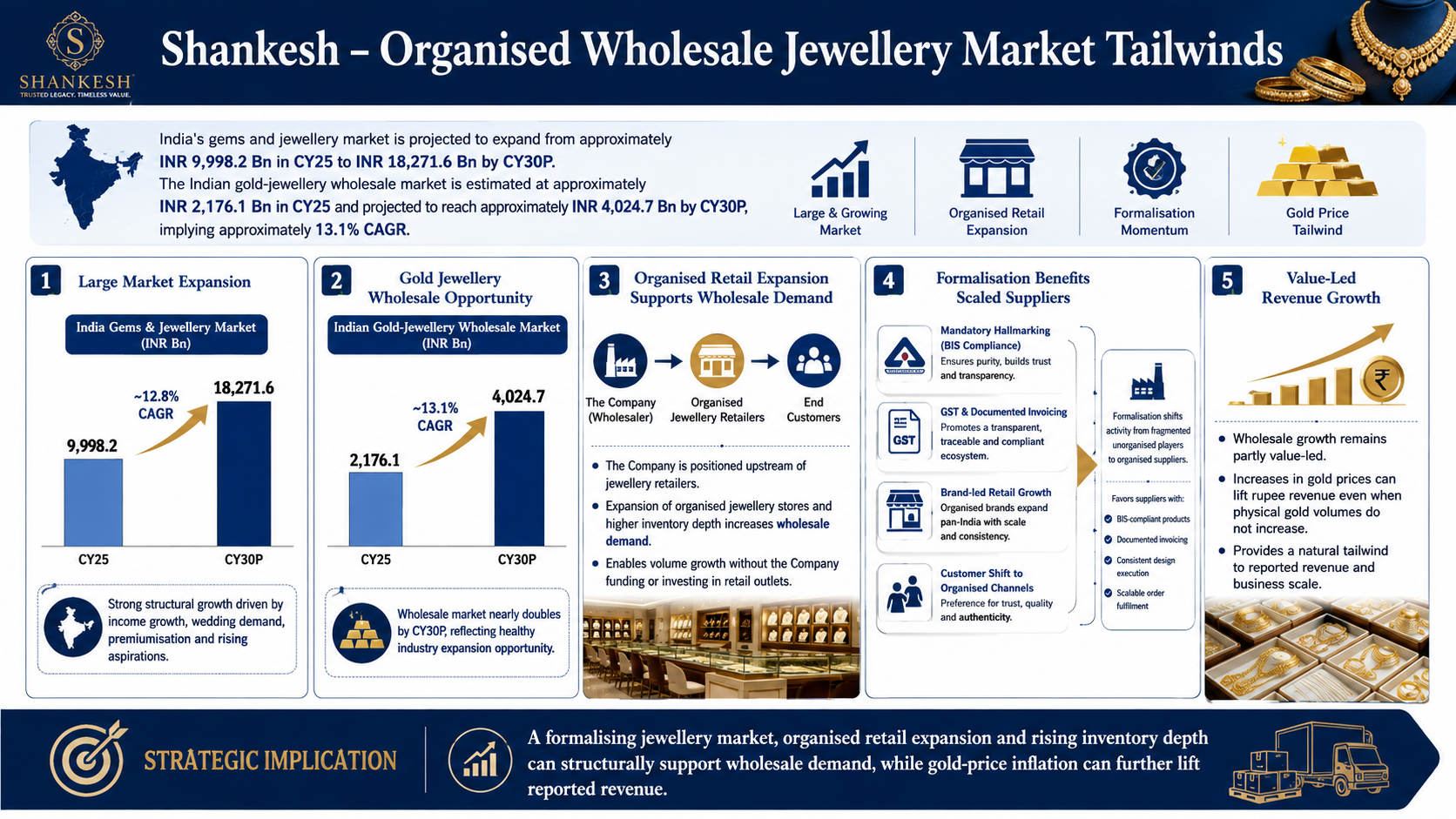
Industry Tailwind: Formalisation and Scale-Up of Indian Gold Jewellery Wholesale
India's gold-jewellery wholesale market is expanding alongside formalisation of the broader jewellery value chain. The industry section estimates the wholesale market at INR 2,176.1 Bn in CY25 and INR 4,024.7 Bn by CY30P, implying a 13.1% CAGR. GST, mandatory hallmarking, branded retail expansion and greater quality transparency are progressively shifting demand toward organised suppliers.
The key tailwinds are:
Organised manufacturers represented only 13.1% of the wholesale market in CY25, leaving substantial room for formal-sector share gains as branded and certified jewellery penetration rises
The organised wholesale-manufacturer segment is projected to grow from about INR 286 Bn in CY25 to INR 584 Bn by CY30P, a faster ~15.4% CAGR
Expansion of organised retail into tier-II and tier-III cities increases retailer restocking needs and creates a larger addressable B2B market for wholesalers such as Shankesh
Wedding, Festival and Affluence-Led Gold Demand
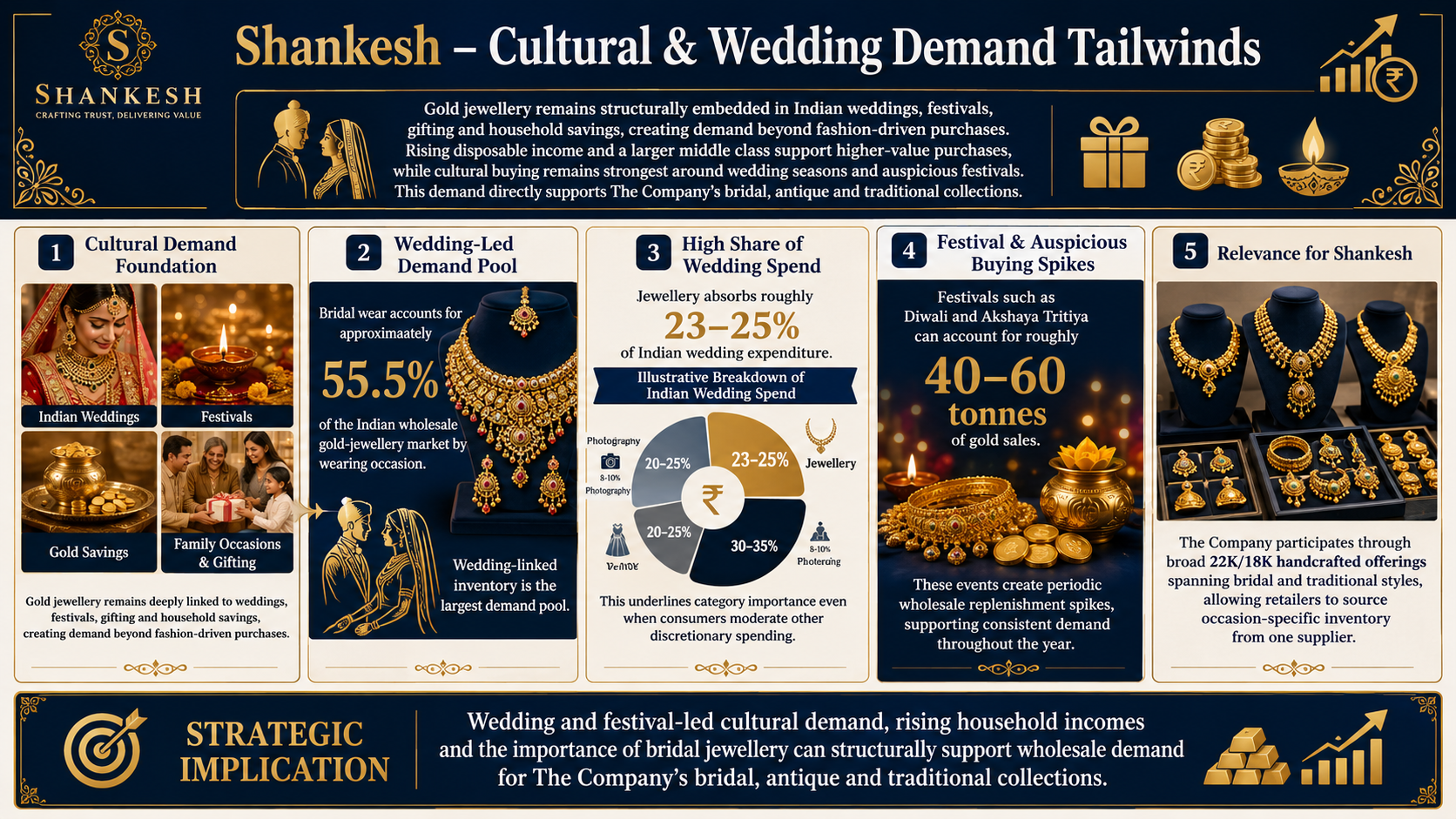
Gold jewellery remains structurally embedded in Indian weddings, festivals, gifting and household savings, which gives the category a demand base beyond pure fashion consumption. Rising disposable income and a larger middle class support higher-value purchases, while cultural buying remains strongest around wedding seasons and auspicious festivals. This demand directly supports Shankesh's bridal, antique and traditional collections
The key details are:
Bridal wear accounts for approximately 55.5% of the Indian wholesale gold-jewellery market by wearing occasion, making wedding-linked inventory the largest demand pool
Jewellery absorbs roughly 23-25% of Indian wedding expenditure, underlining the category's importance even when consumers moderate other discretionary spending
CareEdge notes that festivals such as Diwali and Akshaya Tritiya can account for roughly 40-60 tonnes of gold sales, creating periodic wholesale replenishment spikes
Organised Retailer Expansion Expands the B2B Supplier Opportunity
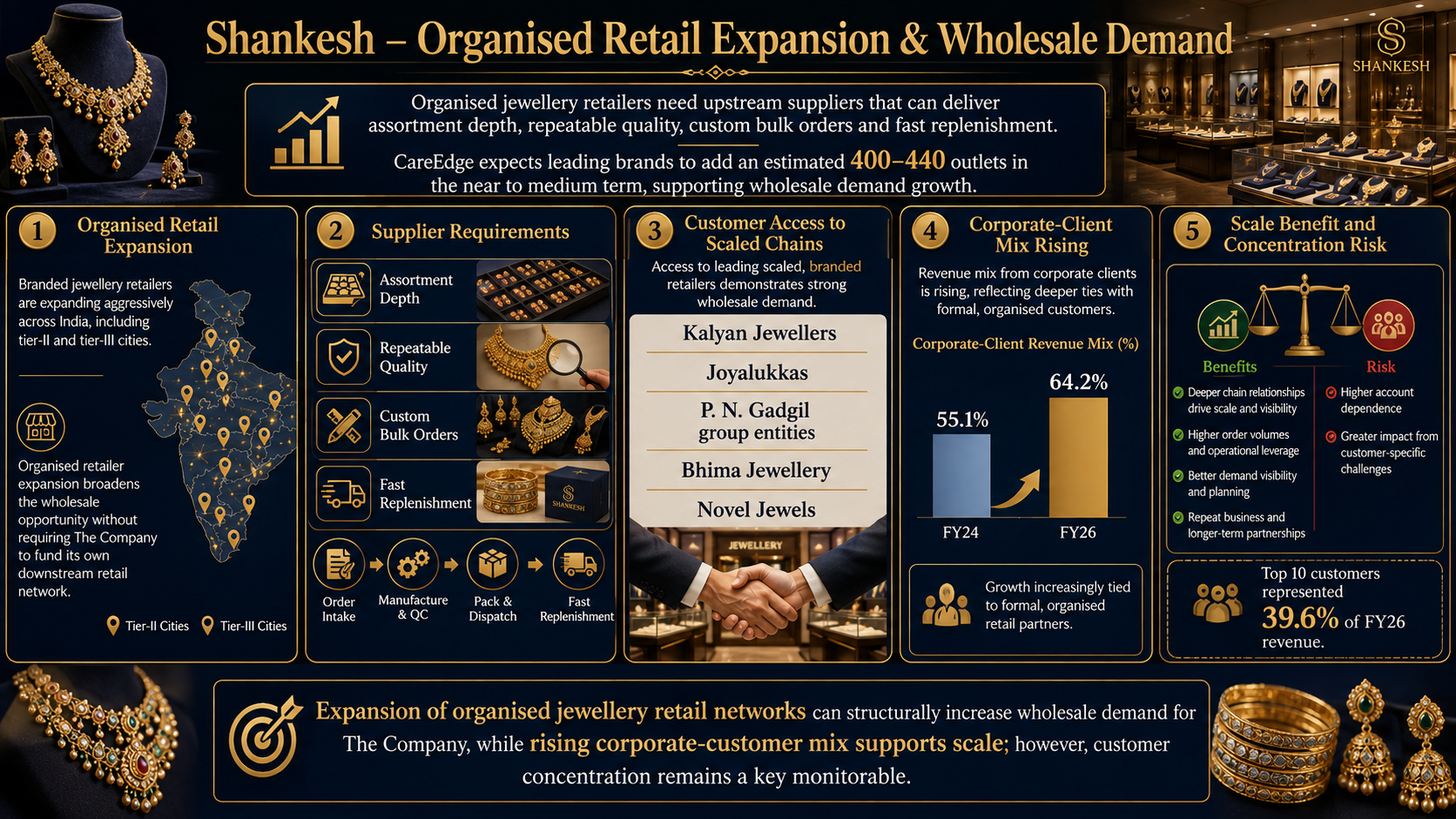
Large jewellery chains are increasing store density and moving deeper into non-metro markets, which raises the need for suppliers that can deliver assortment depth, repeatable quality, custom bulk orders and fast replenishment. CareEdge expects leading brands to add an estimated 400-440 outlets in the near to medium term. Shankesh already supplies several national and regional organised jewellery chains
The key details are:
Organised retailer expansion into tier-II and tier-III cities broadens the wholesale opportunity without requiring Shankesh to fund its own downstream retail network
Named customers include Kalyan Jewellers, Joyalukkas, P. N. Gadgil group entities, Bhima Jewellery and Novel Jewels, demonstrating access to scaled branded-retail demand
Corporate-client revenue mix increased from ~55.1% in FY24 to ~64.2% in FY26, indicating that growth is increasingly tied to formal organised customers.
Risks in the Industry
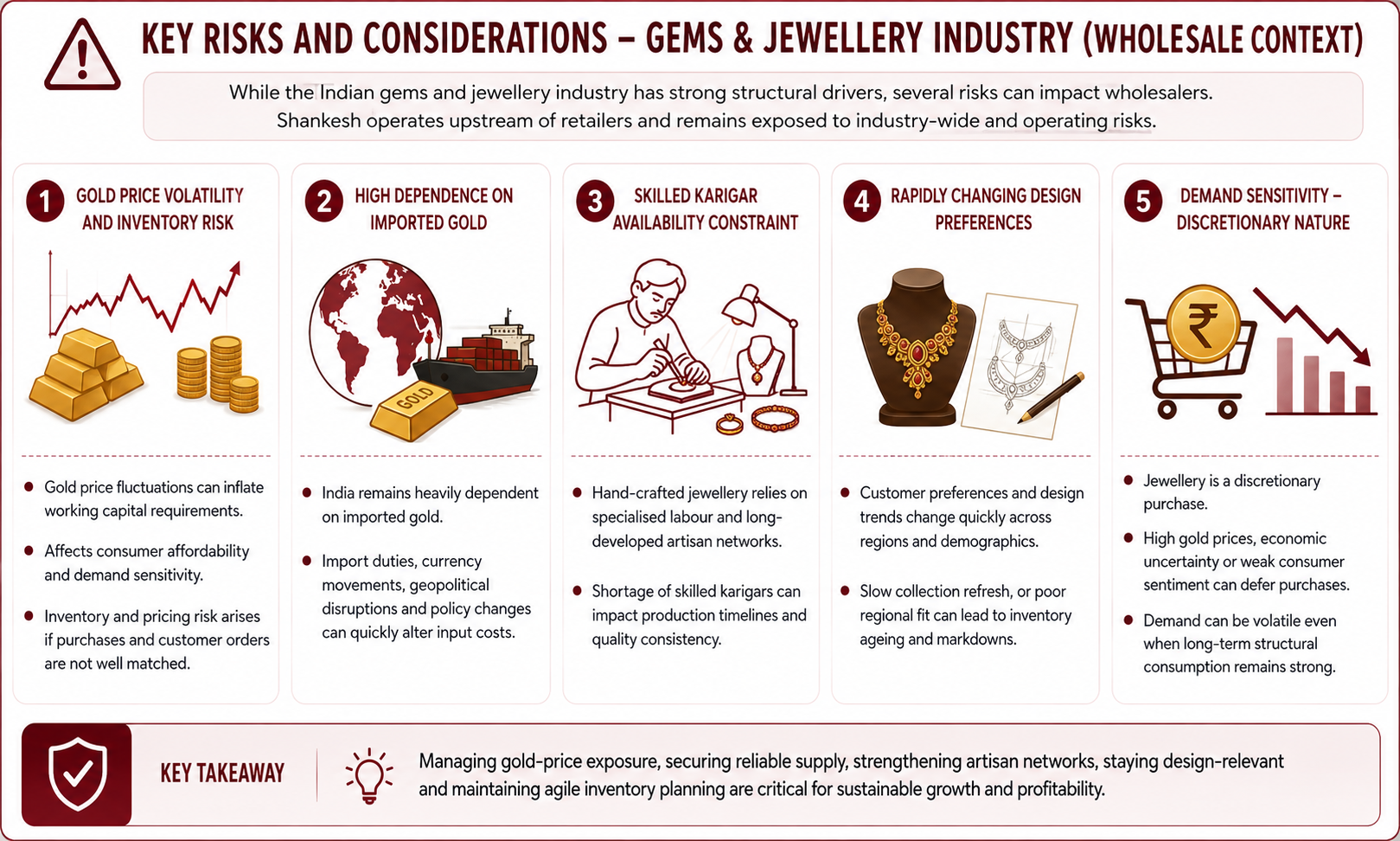
Gold-price volatility can inflate working-capital requirements, affect consumer affordability and create inventory / pricing risk if purchases and customer orders are not well matched
India remains heavily dependent on imported gold; import duties, currency movements, geopolitical disruptions and policy changes can alter input costs quickly
Skilled Karigar availability is a structural constraint. Hand-crafted products rely on specialised labour and long-developed artisan networks
Design preferences can change rapidly; slow collection refresh or poor regional fit can create inventory ageing and customer returns
Jewellery is a discretionary purchase, so high gold prices or weak consumer sentiment can defer demand even when long-term structural consumption remains intact
Government Policy Support
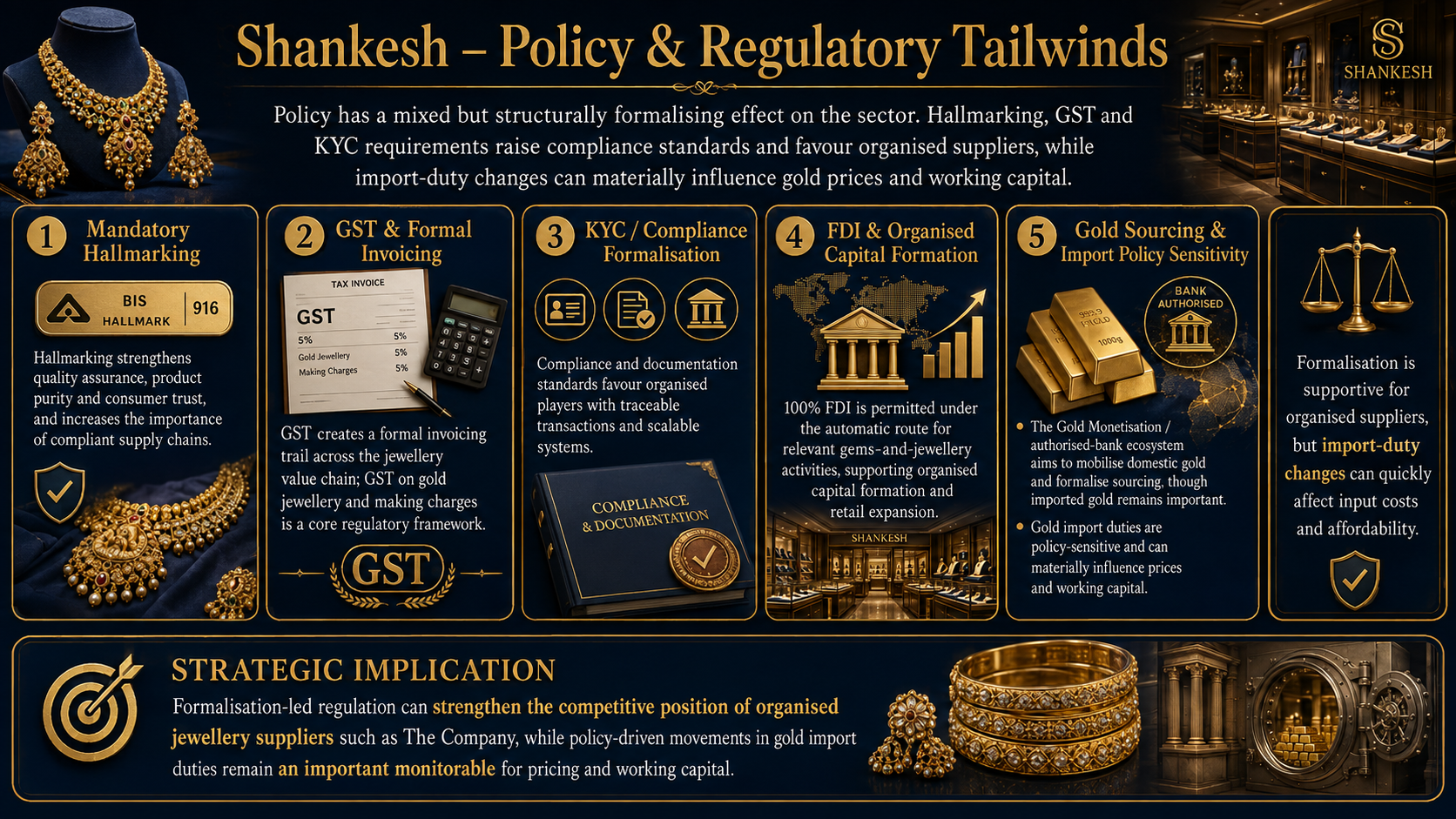
Policy has a mixed but structurally formalising effect on the sector. Hallmarking, GST and KYC requirements raise compliance standards and favour organised suppliers, while import-duty changes can materially influence gold prices and working capital
The key policies are:
Mandatory hallmarking strengthens quality assurance and consumer trust while increasing the importance of compliant supply chains
GST creates a formal invoicing trail across the jewellery value chain. The industry report discusses GST on gold jewellery and making charges as a core regulatory framework
100% FDI is permitted under the automatic route for relevant gems-and-jewellery activities, supporting organised capital formation and retail expansion
The Gold Monetisation / authorised-bank ecosystem aims to mobilise domestic gold and formalise sourcing, though imported gold remains important
Fundraise/Future Plans
Shareholding
Pre-issue shareholding
Promoter Holding 0.0%
Post-Issue Shareholding
Promoter Holding 0.0%
Category
Pre-Issue%Post-Issue%
Promoters
Manoj Kantilal Jain
26.7%17.8%
Kantilal Kheemraj Jain
24.7%16.5%
Mahavir Kantilal Jain
22.8%18.3%
Other Promoter Group
21.2%17.0%
Total Promoter Holding
95.4%69.6%
Additional Shareholders
0.0%0.0%
Total Additional Holding
0.0%0.0%
Total Shareholding
95.4%69.6%
- Overview
- Business
- Financial Highlights
- Industry Overview
- Fundraise/Future Plans
- Documentation
Get the Preqt App and keep in touch around the clock!
 Monitor your investments in real-time.
- Receive tailored deal suggestions.
- Get real-time updates and alerts.