


Shiprocket
Shipping Made SeamlessDelivering Business Possibilities
IPO Summary (PrEqT)
Shiprocket is a merchant-first, API-led e-commerce enablement platform that combines domestic shipping, fulfilment, cross-border logistics, checkout, marketing and other merchant solutions. The Company processed 202.1 million transactions for 214,769 active merchants in FY26, while emerging businesses increased their revenue contribution to 26.6%. Revenue reached INR 2,024.1 Cr in FY26 and adjusted EBITDA remained positive, although the Company continued to report a PAT loss of INR 79.2 Cr. The IPO comprises a primary issue of approximately INR 885.6 Cr and an OFS of approximately INR 732.0 Cr at the upper price band, with proceeds directed toward platform growth, technology, marketing, debt repayment and acquisitions. The investment case rests on operating leverage and cross-selling across a large merchant base, balanced against thin adjusted EBITDA margins, sustained accounting losses and dependence on third-party logistics partners.
IPO Review Rating
Risky
MainboardSimplifying E-Commerce Fulfilment from Checkout to Customer Doorstep
Shiprocket has built a scaled and strategically relevant e-commerce enablement platform, supported by diversified merchants, strong sector growth and improving operating metrics. The main weakness is that reported consolidated profitability has not yet been achieved. Investors are being asked to value the Company at approximately 4.0x book value despite negative EPS, reported EBITDA and RoNW. The 45.3% OFS component is also meaningful, although the fresh issue will provide INR 885.5 Cr for growth, debt repayment and acquisitions.
PARAMETER
WEIGHT
SCORE
KEY FACTORS
Financial Performance
40.0%
3.0/5
Revenue grew at 24.0% CAGR, customer concentration is low and operating cash flow improved to INR 52.6 Cr. However, reported EBITDA, PAT and RoNW remain negative, indicating that consolidated profitability is not yet established.
Show more
Detailed Analysis
Revenue increased from INR 1,316.0 Cr in FY24 to INR 2,024.1 Cr in FY26, representing a CAGR of 24.0%
Reported EBITDA improved from INR -495.9 Cr in FY24 to INR -16.6 Cr in FY26, while the FY26 margin remained negative at -0.8%
The loss reduced from INR 595.2 Cr in FY24 to INR 79.2 Cr in FY26, resulting in a FY26 PAT margin of -3.9%
Borrowings increased from INR 213.3 Cr in FY24 to INR 242.0 Cr in FY26, while debt-to-equity remained low at 0.2x
RoNW improved from -46.1% in FY24 to -5.2% in FY26, but remained negative because the Company continued to report losses
Operating cash flow improved from INR 1.9 Cr in FY25 to INR 52.6 Cr in FY26, remaining positive in both years
The largest merchant contributed INR 57.4 Cr, or only 2.8% of FY26 revenue, while the top five contributed 7.4%
Industry
15.0%
4.0/5
Shiprocket operates in a high-growth digital-commerce ecosystem, with online retail projected to grow at 20–25% CAGR.
Show more
Detailed Analysis
Online retail’s share of Indian retail is projected to increase from 8.0% in CY25 to 14–15% by CY30, representing a CAGR of 20–25%
Direct commerce represented only 11.0% of Indian e-commerce GMV in CY25, indicating early-stage adoption and substantial growth headroom
The platform covers five major commerce functions—logistics, checkout, payments, fulfilment and cross-border trade—creating both policy support and regulatory compliance exposure
Management
15.0%
3.0/5
Board independence is strong at 57.1%, and related-party transactions are contained at 3.6% of revenue. However, the presence of four criminal proceedings involving directors materially reduces the governance assessment.
Show more
Detailed Analysis
Shiprocket’s operating journey began with Kartrocket in 2012, providing approximately 14 years of platform-building experience
The Board comprises seven directors, including four independent directors, representing independence of 57.1%'
The RHP discloses four criminal proceedings against directors, including an FIR involving the Managing Director
Valuation
20.0%
1.0/5
The IPO is priced at approximately 4.0x book value, while RoNW is -5.2% and GMP is INR 14.
Show more
Detailed Analysis
The Company reported FY26 diluted EPS of INR -1.2; therefore, P/E is negative and not economically meaningful
The Company reported FY26 EBITDA of INR -16.6 Cr; therefore, a conventional EV/EBITDA comparison cannot be made
At INR 97.0, investors are paying approximately 4.0x FY26 NAV of INR 24.0 per share
RoNW improved from -46.1% in FY24 to -5.2% in FY26, but remained negative.
TOTAL
100%
2.7/5
Weighted Composite Score
Issue Price
₹92.0 to ₹97.0
As of 29 Aug 2026
GMP
₹33.0
As of 29 Aug 2026
Estimated Gain / Loss
+34.0%
Lot Size
154.0 Shares
Grey Market Premium (GMPs) are shared for knowledge purpose only. PrEqt doesn’t promote or execute the trades.
| Issue size | |
|---|---|
| Overall | ₹1,617.0 Cr |
| Fresh Issue | ₹885.0 Cr |
| Offer for Sale | ₹732.0 Cr |
Minimum Investment
₹14,938.0 / 23,716 shares

Merchant Banker
Axis Capital Ltd.; BofA Securities India; JM Financial; Kotak Mahindra Capital
IPO Document
RHP / Anchor Document
Offer Start Date
12th Aug 2026
Offer End Date
14th Aug 2026
Valuation
₹7,057.5 Cr
Revenue (FY'26)
₹2,077.4 Cr
PAT (FY'26)
₹-79.2 Cr
Issue Size
₹1,617.0 Cr
Face Value
₹ 10.0Offer Price
₹ 97.0Lot Size
154.0 sharesSale Type
Fresh capital cum OFSPAT (FY'26)
₹ -79.2 CrPAT Margin (FY'26)
-3.9 %EBITDA (FY'26)
₹ -16.6 CrCAGR Growth 3Y
23.7 %ROE (FY'26)
-5.2 %ROCE (FY'26)
-2.6 %Price to Book Value
4.0xDebt/Equity
0.2xCompany Website
www.shiprocket.inExplore new deals
Overview
Fund Allocation
Total: ₹0 CrSource:Company DRHP
Timeline
IPO Open Date
To Be Announced
IPO Close Date
To Be Announced
Tentative Allotment
To Be Announced
Initiation of Refunds
To Be Announced
Credit of Shares to Demat
To Be Announced
Tentative Listing Date
To Be Announced
Business
Business Model
Geographical Presence
Sales Channel
Financial Highlights
Income Statement
Revenue growth with EBITDA and PAT margins
| Financial Metric | FY 2024 | FY 2025 | FY 2026 |
|---|---|---|---|
| Revenue (₹ Cr) | 1,357.8 | 1,674.8 | 2,077.4 |
| Growth (%) | 20.9% | 24.0% | 24.0% |
| EBITDA (₹ Cr) | -495.9 | -16.7 | -16.6 |
| EBITDA Margin (%) | -9.7% | -1.0% | -0.8% |
| PAT (₹ Cr) | -595.2 | -74.4 | -79.2 |
| PAT Margin (%) | -43.8% | -4.6% | -3.8% |
OBSERVATIONS & INSIGHTS
Revenue increased 24.0% in FY26 to INR 2,024.1 Cr, driven by higher revenue from both Core and Emerging Businesses, increased Power Merchants and higher merchant ARPU. Emerging Business grew faster and lifted its revenue mix to 26.6%
PAT loss widened modestly to INR 79.2 Cr in FY26 despite adjusted EBITDA improvement because employee, technology, marketing and other operating costs remained elevated and reported EBITDA stayed negative
FY24 losses were unusually high because of exceptional items and substantial share-based payment and acquisition-related charges. The subsequent reduction in loss reflects normalisation of these items rather than complete operating profitability.
Balance Sheet
| Financial Metric | FY 2024 | FY 2025 | FY 2026 |
|---|---|---|---|
| Net Worth | ₹ 1,286.2 Cr | ₹ 1,491.2 Cr | ₹ 1,524.3 Cr |
| Total Assets | ₹ 2,051.2 Cr | ₹ 2,308.6 Cr | ₹ 2,504.8 Cr |
| Total Borrowing | ₹ 213.3 Cr | ₹ 244.7 Cr | ₹ 242.0 Cr |
OBSERVATIONS & INSIGHTS
Net worth increased modestly to INR 1,524.3 Cr despite the FY26 loss because of capital restructuring and reserve movements. The large increase in share capital reflects conversion and bonus actions, not operating profit generation
Current borrowings remained broadly stable at INR 242.0 Cr, while lease liabilities increased with the expansion of leased fulfilment and operating facilities
Total assets increased 8.5% in FY26 to INR 2,504.8 Cr, primarily because other non-current financial assets and trade receivables increased, partly offset by lower other bank balances
Cash Flow
| Financial Metric | FY 2024 | FY 2025 | FY 2026 |
|---|---|---|---|
CFO (₹ Cr) Cash generated from core business operations. | -216.0 Cr | +1.9 Cr | +52.6 Cr |
CFI (₹ Cr) Cash used for investments and long-term assets. | +175.7 Cr | -144.0 Cr | +53.2 Cr |
CFF (₹ Cr) Cash flow related to funding and borrowings. | -2.4 Cr | +152.8 Cr | -44.9 Cr |
Working Capital
| Efficiency Metric | FY 2023 | FY 2024 | FY 2025 |
|---|---|---|---|
Debtor Days Average number of days taken to collect customer payments. | - | - | - |
Creditor Days Average time taken to pay suppliers and vendors. | - | - | - |
Inventory Days Average number of days inventory remains unsold. | - | - | - |
CCC (Cash Conversion Cycle) (Debtor Days + Inventory Days - Creditor Days) | - | - | - |
Financial Ratios
Measures the company’s leverage relative to shareholder equity.
OBSERVATIONS & INSIGHTS
Leverage remained moderate at approximately 0.2x debt-to-equity, but interest coverage is not meaningful because reported EBIT remained negative in all three RHP periods
The current ratio declined to 1.1x in FY26 from 1.7x in FY25 because other bank balances reduced after liquidity was redeployed, while current liabilities and merchant-related obligations increased
ROCE improved sharply from the FY24 loss-distorted level but remained negative in FY26, confirming that operating earnings have not yet generated a positive return on the enlarged capital base
ROE remained negative at 5.2% in FY26 because the Company continued to report losses, although the magnitude improved materially from FY24 as the loss base reduced and net worth increased
Industry Overview
Industry Drivers
Industry Tailwind: Expansion of Online Retail and Direct Commerce
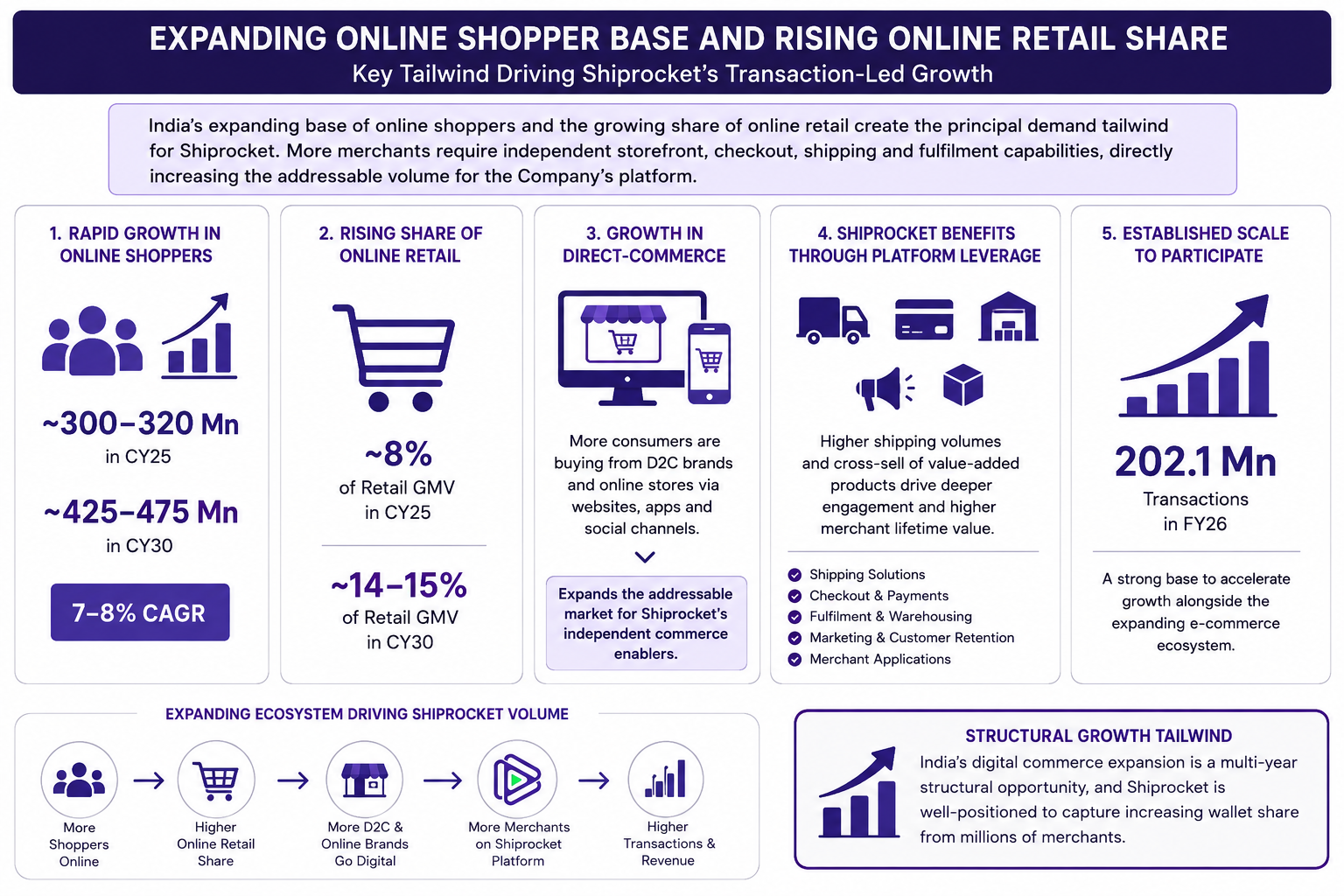
India’s expanding base of online shoppers and the growing share of online retail create the principal demand tailwind for Shiprocket. More merchants require independent storefront, checkout, shipping and fulfilment capabilities, directly increasing the addressable volume for the Company’s transaction-led platform.
The key tailwinds are:
Online shoppers are projected to increase from approximately 300-320 million in CY25 to 425-475 million by CY30, representing 7-8% CAGR
Online retail is expected to increase from approximately 8% of retail GMV in CY25 to 14-15% by CY30
Direct-commerce growth supports merchants selling through their own websites, apps and social channels rather than relying solely on marketplaces
Shiprocket benefits through higher shipping volumes and cross-sell of checkout, marketing, fulfilment and merchant applications
MSME Digitisation and Fragmented Commerce Infrastructure
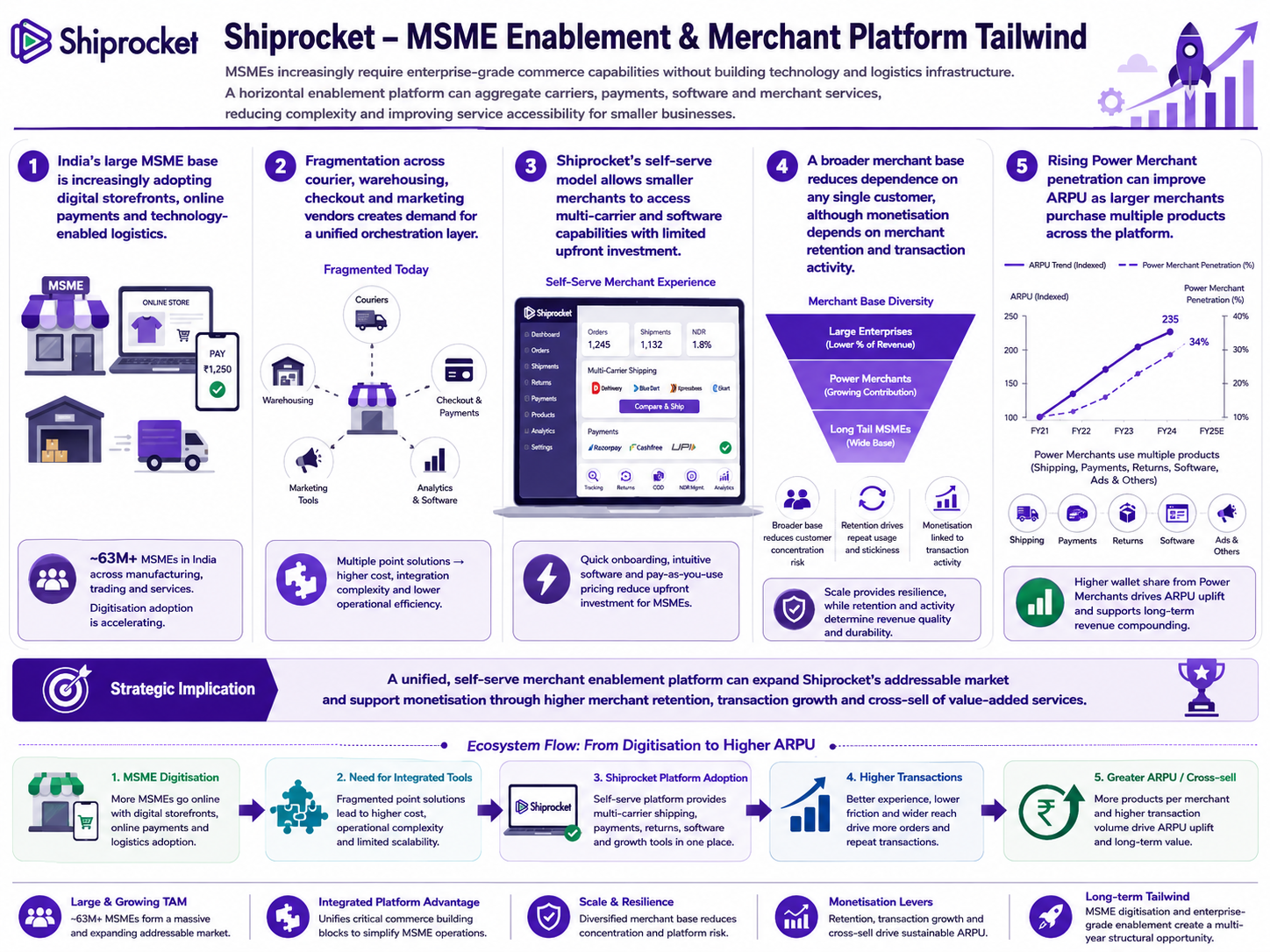
MSMEs increasingly require enterprise-grade commerce capabilities without building technology and logistics infrastructure internally. A horizontal enablement platform can aggregate carriers, payments, software and merchant services, reducing complexity and improving service accessibility for smaller businesses.
The key details are:
India’s large MSME base is increasingly adopting digital storefronts, online payments and technology-enabled logistics
Fragmentation across courier, warehousing, checkout and marketing vendors creates demand for a unified orchestration layer
Shiprocket’s self-serve model allows smaller merchants to access multi-carrier and software capabilities with limited upfront investment
A broader merchant base reduces dependence on any single customer, although monetisation depends on merchant retention and transaction activity
Rising Power Merchant penetration can improve ARPU as larger merchants purchase multiple products across the platform
Cross-Border, Omnichannel and Hyperlocal Commerce
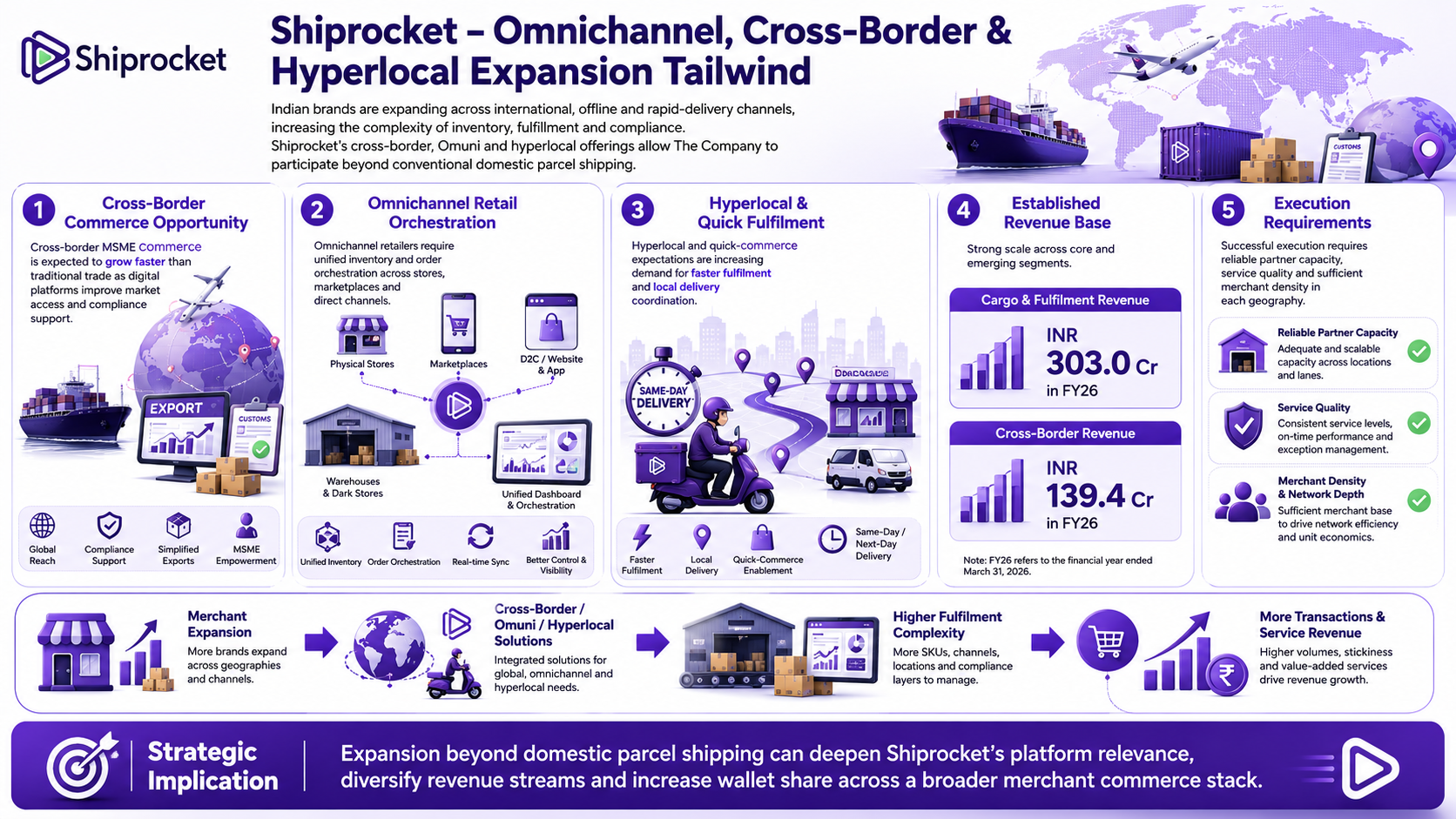
Indian brands are expanding across international, offline and rapid-delivery channels, increasing the complexity of inventory, fulfilment and compliance. Shiprocket’s cross-border, Omuni and hyperlocal offerings allow the Company to participate beyond conventional domestic parcel shipping.
The key details are:
Cross-border MSME commerce is expected to grow faster than traditional trade as digital platforms improve market access and compliance support
Omnichannel retailers require unified inventory and order orchestration across stores, marketplaces and direct channels
Hyperlocal and quick-commerce expectations are increasing demand for faster fulfilment and local delivery coordination
Cargo and fulfilment revenue reached INR 303.0 Cr in FY26, while cross-border revenue reached INR 139.4 Cr
Execution requires reliable partner capacity, service quality and sufficient merchant density in each geography
Risks in the Industry
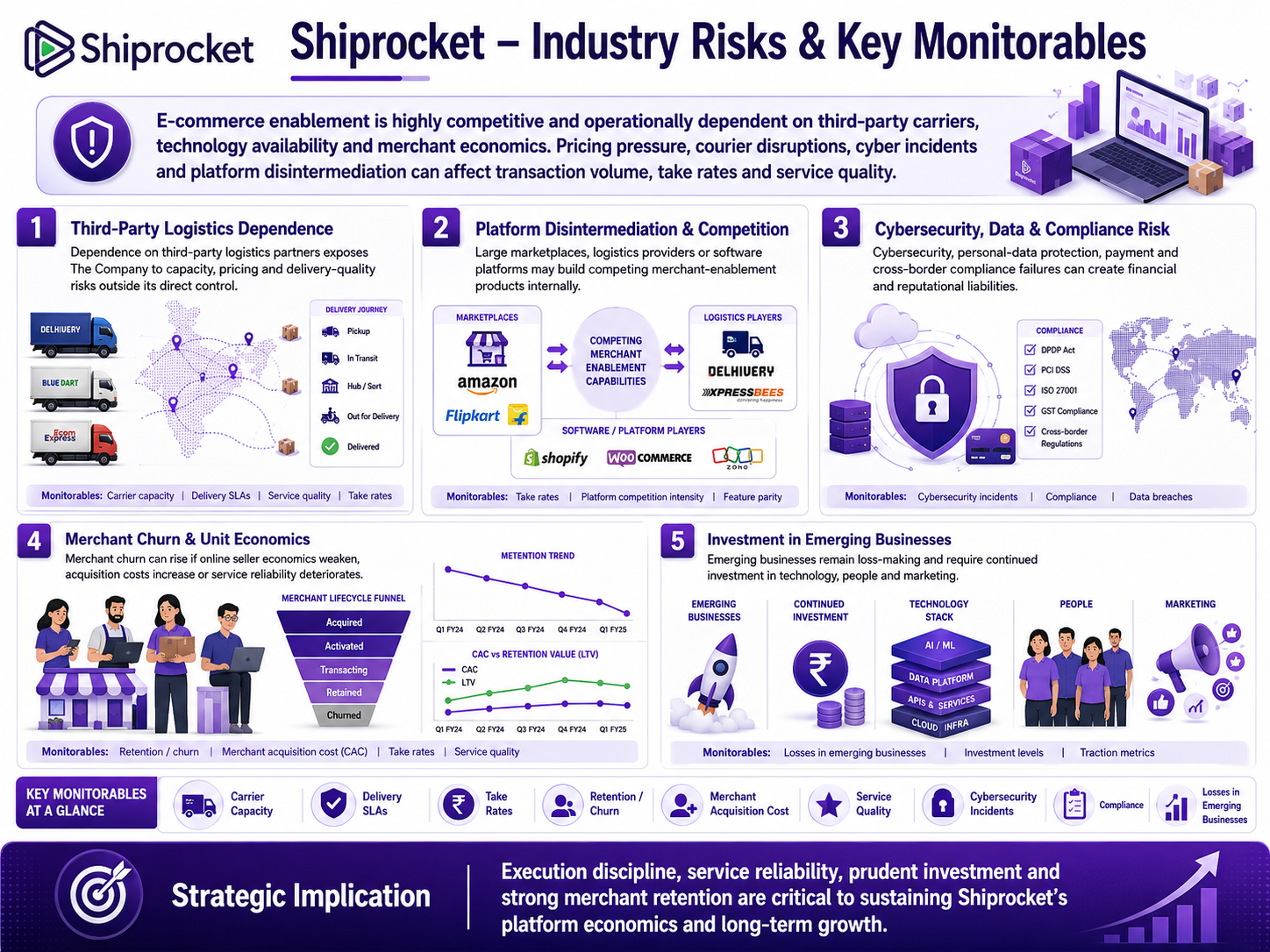
E-commerce enablement is highly competitive and operationally dependent on third-party carriers, technology availability and merchant economics. Pricing pressure, courier disruptions, cyber incidents and platform disintermediation can affect transaction volume, take rates and service quality.
The key risks are:
Dependence on third-party logistics partners exposes the Company to capacity, pricing and delivery-quality risks outside its direct control
Large marketplaces, logistics providers or software platforms may build competing merchant-enablement products internally
Cybersecurity, personal-data protection, payment and cross-border compliance failures can create financial and reputational liabilities
Merchant churn can rise if online seller economics weaken, acquisition costs increase or service reliability deteriorates
Emerging businesses remain loss-making and require continued investment in technology, people and marketing
Government Policy Support
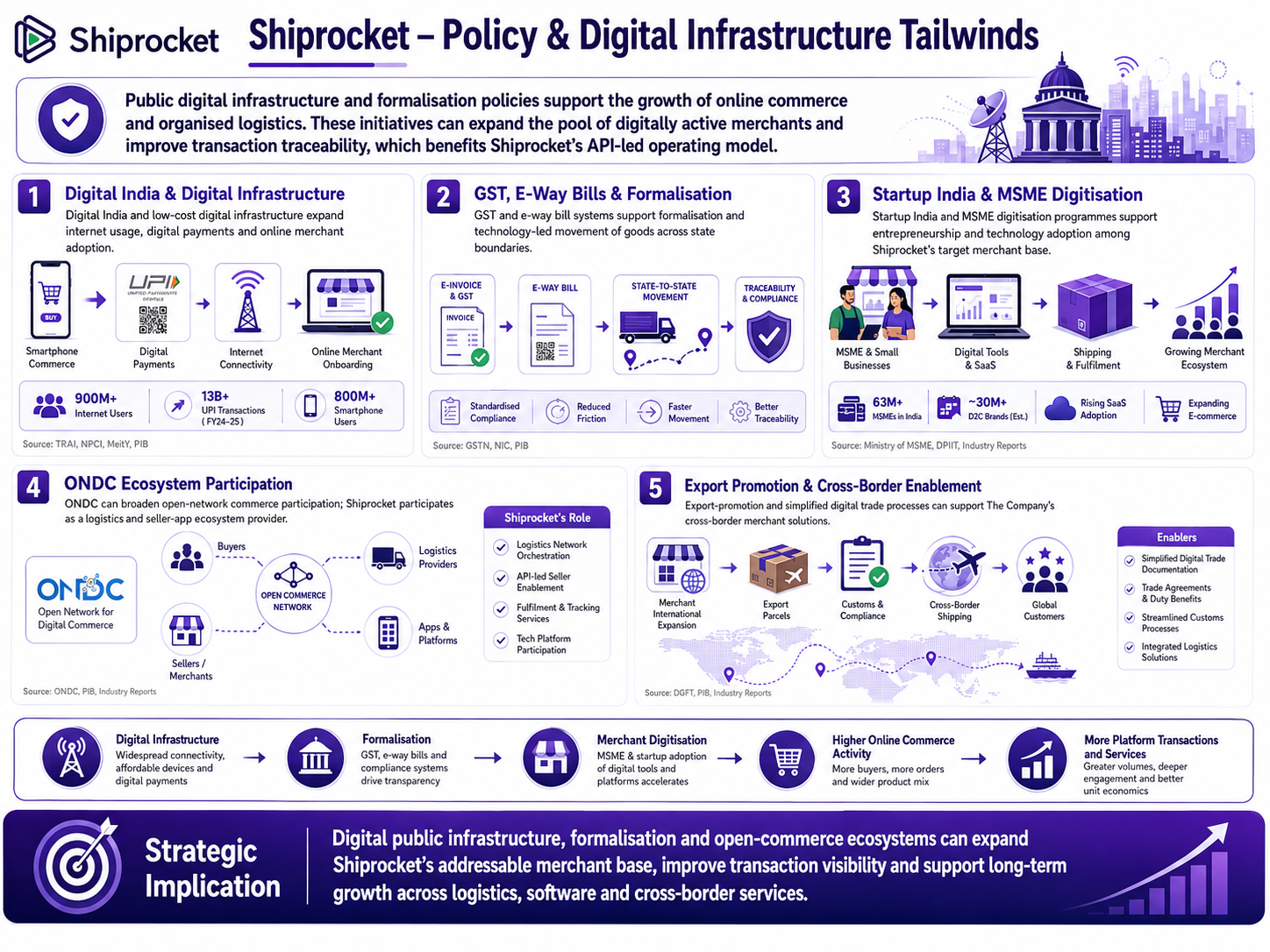
Public digital infrastructure and formalisation policies support the growth of online commerce and organised logistics. These initiatives can expand the pool of digitally active merchants and improve transaction traceability, which benefits Shiprocket’s API-led operating model.
The key policies are:
Digital India and low-cost digital infrastructure expand internet usage, digital payments and online merchant adoption
GST and e-way bill systems support formalisation and technology-led movement of goods across state boundaries
Startup India and MSME digitisation programmes support entrepreneurship and technology adoption among Shiprocket’s target merchant base
ONDC can broaden open-network commerce participation; Shiprocket participates as a logistics and seller-app ecosystem provider
Export-promotion and simplified digital trade processes can support the Company’s cross-border merchant solutions
Fundraise/Future Plans
Shareholding
Pre-issue shareholding
Promoter Holding 0.0%
Post-Issue Shareholding
Promoter Holding 0.0%
Category
Pre-Issue%Post-Issue%
Promoters
Bertelsmann Nederland B.V.
21.3%18.6%
Tribe Capital III LLC - Series 5
7.7%6.8%
Eternal Limited
6.8%6.0%
Shiprocket Employee ESOP Trust
6.0%5.2%
KDT Ventures Holdings, LLC
5.5%4.8%
MacRitchie Investments Pte. Ltd.
5.3%4.6%
Saahil Goel
4.8%3.4%
Gautam Kapoor
4.8%3.4%
Total Promoter Holding
62.2%52.8%
Additional Shareholders
0.0%0.0%
Total Additional Holding
0.0%0.0%
Total Shareholding
62.2%52.8%
- Overview
- Business
- Financial Highlights
- Industry Overview
- Fundraise/Future Plans
- Documentation
Get the Preqt App and keep in touch around the clock!
 Monitor your investments in real-time.
- Receive tailored deal suggestions.
- Get real-time updates and alerts.