


SRIT India
Technology for TransformationEngineering Smarter Digital Ecosystems
IPO Summary (PreQT)
SRIT India Limited is a Bengaluru-headquartered IT/ITeS solutions company with a 26-year operating track record across electronic governance, telecom/broadband and healthcare technology. FY26 revenue from operations increased 15.6% YoY to INR 450.0 Cr, EBITDA margin improved to 14.4%, and PAT rose 28.8% to INR 43.3 Cr; the June 2026 order book of approximately INR 1,204.7 Cr was ~2.7x FY26 revenue. At the cap price of INR 130.0, the fresh-only IPO implies a post-issue market capitalisation of approximately INR 835.5 Cr and FY26 P/E of 13.7x. The operating profile combines government-led digitalisation, long project relationships and a sizeable executable order book, offset by government/customer concentration, working-capital intensity, high receivables/contract assets and negative FY26 operating cash flow.
IPO Review Rating
Average
MainboardConnecting People and Institutions Through Secure Digital Technology Solutions
SRIT demonstrates strong revenue and PAT growth, high return ratios, low leverage and a broadly comparable peer valuation. SRIT's principal strengths include its 28.8% revenue CAGR, 22.0% PAT CAGR, 30.2% RoNW, 28.8% ROCE, low 0.2x debt-to-equity ratio and 100% fresh issue structure. At the INR 130 upper price band, its post-issue P/E of 19.3x is only approximately 6.6% above the peer average of 18.1x.
The principal risks include negative FY26 operating cash flow, significant customer concentration, substantial dependence on government customers and meaningful exposure to e-governance. Related-party transactions are also material, while a significant portion of project execution continues to depend on subcontractors.
The anchor book, QIB subscription and overall subscription remain the most important pending indicators and can materially influence the IPO once available.
PARAMETER
WEIGHT
SCORE
KEY FACTORS
Financial Performance
40.0%
4.0/5
The Company demonstrates strong historical growth, high return ratios and low leverage. These strengths are partly offset by weak FY26 cash conversion and substantial dependence on a concentrated base of government customers
Show more
Detailed Analysis
The Company recorded a strong FY24–FY26 revenue CAGR of 28.8%, demonstrating healthy business expansion over the period
The Company reported an EBITDA margin of 14.4% in FY26, reflecting a healthy operating margin despite some historical volatility
The Company recorded a PAT margin of 9.6% in FY26, indicating reasonably strong profitability at the net income level
The Company's debt-to-equity ratio stood at a low 0.2x in FY26, indicating a conservative leverage profile
The Company generated a strong 30.2% RoNW in FY26, demonstrating efficient utilisation of shareholder capital
The Company's operating cash flow deteriorated to negative ₹12.1 Cr in FY26, despite reporting ₹43.3 Cr of PAT during the year
Industry
15.0%
3.0/5
SRIT operates across structurally attractive technology themes including government digitalisation, telecom, healthcare IT, cloud and artificial intelligence. Overall IT-BPM industry growth remains healthy, while several underlying digital subsegments are growing materially faster
Show more
Detailed Analysis
The Indian IT-BPM industry is estimated to have grown from approximately US$167 Bn in FY18 to US$315 Bn in FY26E, implying an industry CAGR of around 8.3%
The Company's exposure to government contracts, data handling and cybersecurity requirements creates a moderate-to-high regulatory and compliance risk profile
The industry remains structurally supported by continued digitalisation, cloud adoption, artificial intelligence, cybersecurity and enterprise technology modernisation
Management
15.0%
3.0/5
SRIT benefits from experienced promoters, no promoter share pledge and a 100% fresh issue. Governance concerns primarily relate to moderate Board independence, limited listed-company Board experience, material related-party transactions and pending contractual and tax-related proceedings
Show more
Detailed Analysis
The Company's promoters and senior management possess approximately 22–35+ years of relevant technology-sector experience, providing substantial operating experience
Four of the Company's ten directors are Independent Directors, resulting in 40.0% Board independence
No promoter shares are pledged, although the Company is involved in several disclosed contractual, tax, GST and arbitration proceedings
Gross FY26 related-party transactions before elimination amounted to approximately ₹80.4 Cr, equivalent to 17.9% of revenue, which is material
Valuation
20.0%
3.0/5
SRIT's post-issue valuation is relatively close to the peer group despite the Company's strong historical growth and return ratios. The valuation appears supported by its operating profile, although weak FY26 cash conversion remains an important consideration
Show more
Detailed Analysis
SRIT's post-issue P/E of 13.7x is only moderately higher than the peer average of 18.1x, representing a premium of approximately 6.6%
SRIT India is valued at approximately 13.5x EV/EBITDA, compared with an average of approximately 12.6x. This represents a modest premium of approximately 6.8% to the peer average
SRIT is valued at approximately 3.2x historical book value and 2.0x adjusted post-issue book value before issue expenses
The Company generated a strong 30.2% RoNW in FY26, supporting its valuation relative to the peer group
Merchant Banker Track Record
10.0%
4.0/5
Choice Capital has demonstrated a good recent execution record, with its tracked mainboard mandates generally attracting strong subscriptions and listing positively. However, the magnitude of listing returns has varied across transactions
Show more
Detailed Analysis
Choice Capital's tracked recent mainboard IPO mandates have generally delivered positive listing performance, with all six comparable issues listing above their issue prices
Most of Choice Capital's tracked recent IPO mandates attracted strong investor subscriptions, although Sonaselection experienced comparatively modest subscription
The tracked comparable mandates have achieved a strong success rate, with all six issues recording positive listing gains
TOTAL
100%
3.5/5
Weighted Composite Score
Issue Price
₹123.0 to ₹130.0
As of 25 Sep 2026
GMP
₹22.0
As of 25 Sep 2026
Estimated Gain / Loss
+16.9%
Lot Size
115.0 Shares
Grey Market Premium (GMPs) are shared for knowledge purpose only. PrEqt doesn’t promote or execute the trades.
| Issue Size (in Cr) | |
|---|---|
| Overall | ₹218.0 Cr |
| Fresh Issue | ₹218.0 Cr |
| Offer for Sale | ₹0.0 Cr |
Minimum Investment
₹14,950.0 / 13,225 shares

Merchant Banker
Choice Capital Advisors Pvt.Ltd.
Choice Capital Advisors Pvt.Ltd.
IPO Document
Offer Start Date
Offer End Date
Valuation
Revenue (FY'26)
PAT (FY'26)
Issue Size (in Cr)
Face Value
₹ 5.0Offer Price
₹ 130.0Lot Size
115.0 sharesSale Type
Fresh capital onlyPAT (FY'26)
₹ 43.3 CrPAT Margin (FY'26)
9.6 %P/E Multiple
13.7xEBITDA (FY'26)
₹ 64.8 CrCAGR Growth 2Y
28.8 %ROE (FY'26)
30.2 %ROCE (FY'26)
28.8 %Price to Book Value
2.0xDebt/Equity
0.2xCompany Website
www.sritindia.comExplore new deals
Overview
Fund Allocation
Total: ₹0 CrSource:Company DRHP
Timeline
IPO Open Date
To Be Announced
IPO Close Date
To Be Announced
Tentative Allotment
To Be Announced
Initiation of Refunds
To Be Announced
Credit of Shares to Demat
To Be Announced
Tentative Listing Date
To Be Announced
Business
Business Model
Sales Channel
Key Risk Factor
Financial Highlights
Income Statement
Revenue growth with EBITDA and PAT margins
| Financial Metric | FY 2024 | FY 2025 | FY 2026 |
|---|---|---|---|
| Revenue (₹ Cr) | 271.1 | 389.3 | 450.0 |
| Growth (%) | 78.5% | 43.6% | 15.6% |
| EBITDA (₹ Cr) | 41.0 | 49.8 | 64.8 |
| EBITDA Margin (%) | 15.1% | 12.8% | 14.4% |
| PAT (₹ Cr) | 29.1 | 33.6 | 43.3 |
| PAT Margin (%) | 10.7% | 8.6% | 9.6% |
OBSERVATIONS & INSIGHTS
Revenue growth moderated from 78.5% in FY24 and 43.6% in FY25 to 15.6% in FY26. FY26 growth was driven by higher e-governance and telecom/broadband revenue, including ramp-up of system-integration, software-licensing, rail-connectivity and fibre-network programmes
EBITDA margin recovered to 14.4% in FY26 from 12.8% in FY25 as subcontracting/technical costs grew slower than revenue and the project mix improved. FY25 margin had compressed as outsourcing-intensive turnkey work increased
PAT rose 28.8% in FY26 to INR 43.3 Cr, faster than revenue, and PAT margin improved to 9.6% from 8.6%. FY24-FY26 PAT CAGR was approximately 22.0%
Balance Sheet
| Financial Metric | FY 2024 | FY 2025 | FY 2026 |
|---|---|---|---|
| Net Worth | ₹ 81.1 Cr | ₹ 93.7 Cr | ₹ 193.8 Cr |
| Total Assets | ₹ 429.0 Cr | ₹ 496.6 Cr | ₹ 614.2 Cr |
| Total Borrowing | ₹ 22.3 Cr | ₹ 51.3 Cr | ₹ 36.1 Cr |
| Reserves & Surplus | ₹ 53.5 Cr | ₹ 72.9 Cr | ₹ 169.5 Cr |
OBSERVATIONS & INSIGHTS
Total assets increased 43.2% from FY24 to FY26, driven primarily by working-capital assets and technology/intangible investment
Equity more than doubled to INR 193.8 Cr in FY26, reducing debt/equity to 0.23x even as operating scale increased
Current trade receivables rose to INR 234.8 Cr and other current assets to INR 174.3 Cr, demonstrating the balance-sheet intensity of project execution
Cash declined to INR 5.6 Cr at FY26; liquidity therefore depends on collections, bank facilities and fresh issue proceeds rather than a large cash buffer
Cash Flow
| Financial Metric | FY 2023 | FY 2024 | FY 2025 |
|---|---|---|---|
CFO (₹ Cr) Cash generated from core business operations. | +34.2 Cr | +18.0 Cr | -12.1 Cr |
CFI (₹ Cr) Cash used for investments and long-term assets. | -15.2 Cr | -27.3 Cr | -31.5 Cr |
CFF (₹ Cr) Cash flow related to funding and borrowings. | +2.1 Cr | +0.3 Cr | +33.7 Cr |
Working Capital
| Efficiency Metric | FY 2023 | FY 2024 | FY 2025 |
|---|---|---|---|
Debtor Days Average number of days taken to collect customer payments. | - | - | - |
Creditor Days Average time taken to pay suppliers and vendors. | - | - | - |
Inventory Days Average number of days inventory remains unsold. | - | - | - |
CCC (Cash Conversion Cycle) (Debtor Days + Inventory Days - Creditor Days) | - | - | - |
Financial Ratios
Measures the company’s leverage relative to shareholder equity.
OBSERVATIONS & INSIGHTS
Interest coverage improved to 4.1x in FY26 as EBIT growth outpaced finance-cost growth
Current ratio improved to 1.4x from 1.2x, but a large part of current assets is tied up in receivables, contract assets and other working-capital balances rather than cash
Debt/Equity increased to 0.7x in FY25 from 0.3x in FY24, which the RHP attributes to additional loans from directors. It then declined sharply to 0.2x in FY26 as shareholder equity increased through fresh share issuances and director loans/current borrowings reduced
ROA improved from a FY24 closing-balance proxy of 6.8% to 7.3% in FY25 and 7.79% in FY26 as PAT growth outpaced average total-asset growth. This is positive for asset productivity even as the balance sheet became larger
ROE declined from 44.1% in FY24 to 38.8% in FY25 and 30.2% in FY26 because the equity base expanded faster than earnings
ROCE declined from 47.5% in FY24 to 37.4% in FY25 and 28.8% in FY26 because capital employed increased significantly through equity, project assets and working-capital deployment. The decline is therefore denominator-driven despite higher absolute EBIT
Industry Overview
Industry Drivers
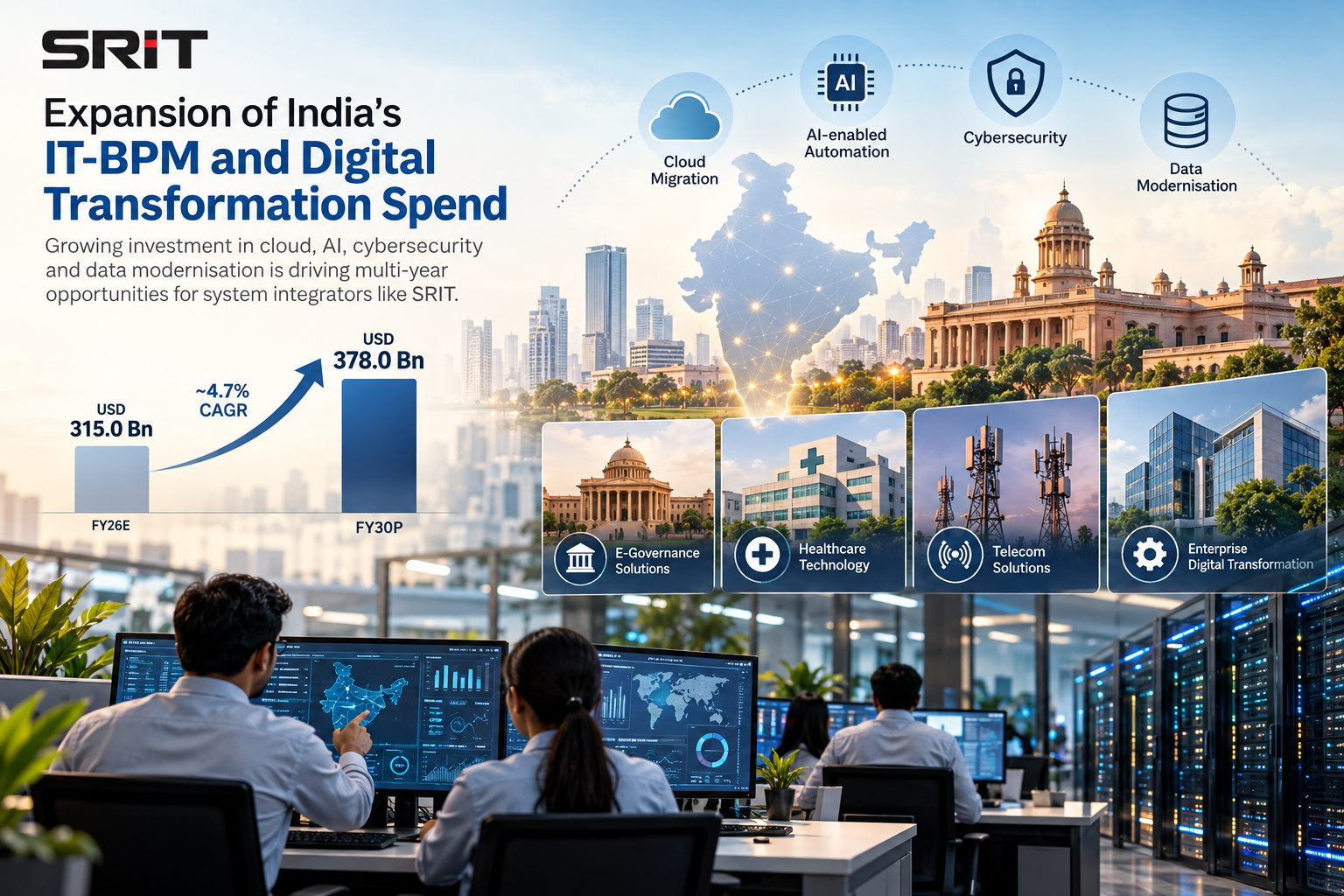
Expansion of India's IT-BPM and Digital Transformation Spend
India's IT-BPM ecosystem is expanding as enterprises and public-sector organisations increase spending on cloud migration, application modernisation, cybersecurity, data platforms and AI-enabled automation. The D&B industry report estimates Indian IT-BPM industry revenue at around USD 315.0 billion in FY26E and projects it to reach approximately USD 378.0 billion by FY30P, implying ~4.7% CAGR. For SRIT, the opportunity is relevant because its revenue is tied to multi-year digital-transformation and system-integration programmes rather than a single software product category.
The key drivers are:
Indian IT-BPM revenue is projected to rise from ~USD 315.0 Bn in FY26E to ~USD 378.0 Bn by FY30P
Cloud, AI, cybersecurity and data modernisation are increasing technology intensity across public and private sectors
Large implementation programmes create demand for system integrators with domain expertise and local execution capabilities
SRIT participates through e-governance, healthcare and telecom solutions, directly linking its addressable market to these trends
Public Digital Infrastructure and E-Governance Modernisation
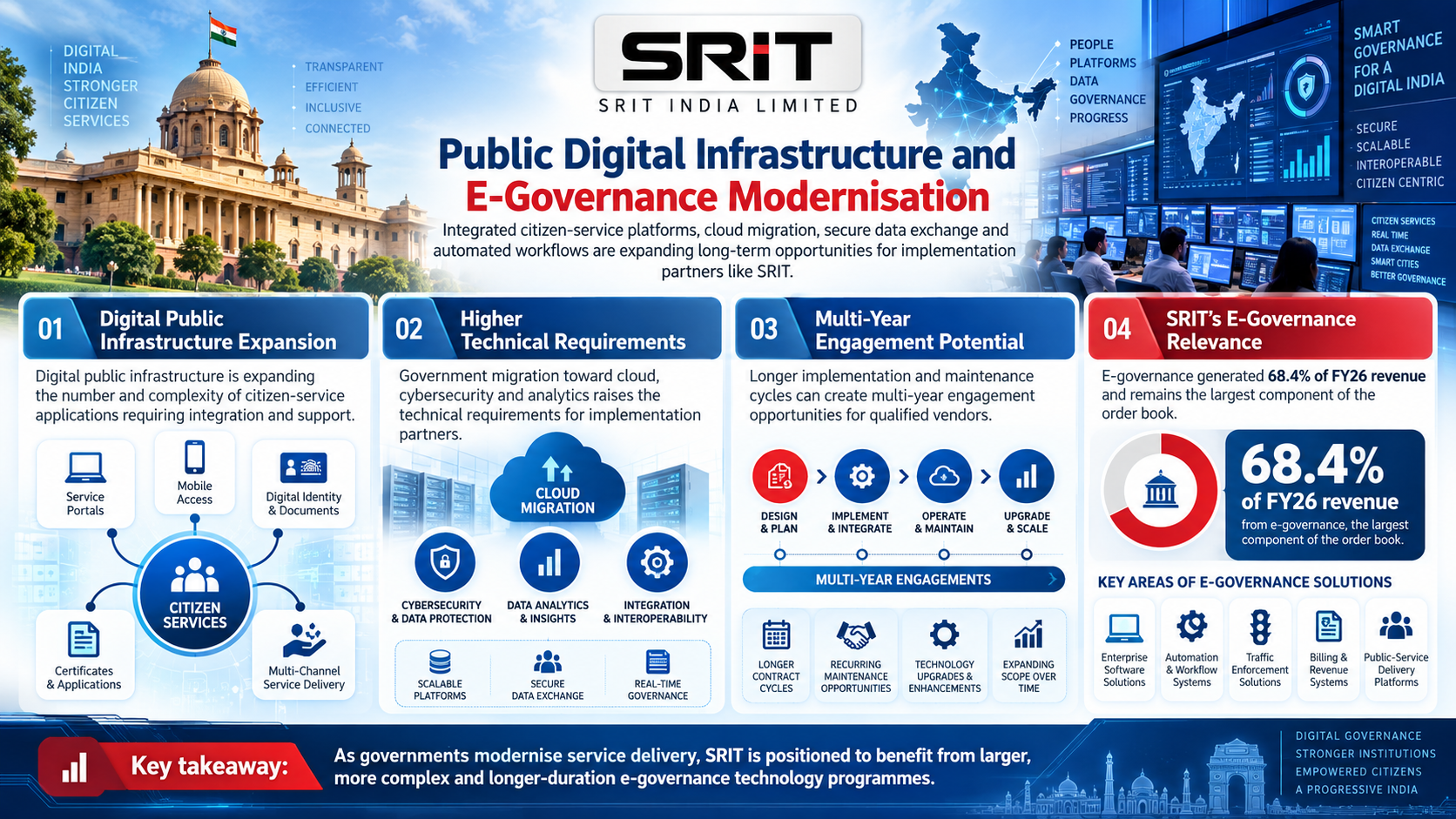
Government digitisation has moved beyond standalone portals toward integrated service delivery, cloud-hosted applications, secure data exchange and automated citizen-facing workflows. Digital India, India Stack, UMANG, DigiLocker, MeghRaj and state-level modernisation programmes continue to broaden the scope of public-sector IT. This is particularly material for SRIT because electronic governance generated 68.4% of FY26 revenue and remained the largest component of its order book.
The key drivers are:
Digital public infrastructure is expanding the number and complexity of citizen-service applications requiring integration and support
Government migration toward cloud, cybersecurity and analytics raises the technical requirements for implementation partners
Longer implementation and maintenance cycles can create multi-year engagement opportunities for qualified vendors
SRIT's e-governance portfolio includes enterprise software, automation, traffic-enforcement, billing/revenue systems and public-service delivery platforms
Healthcare Digitisation and Interoperable Health Records
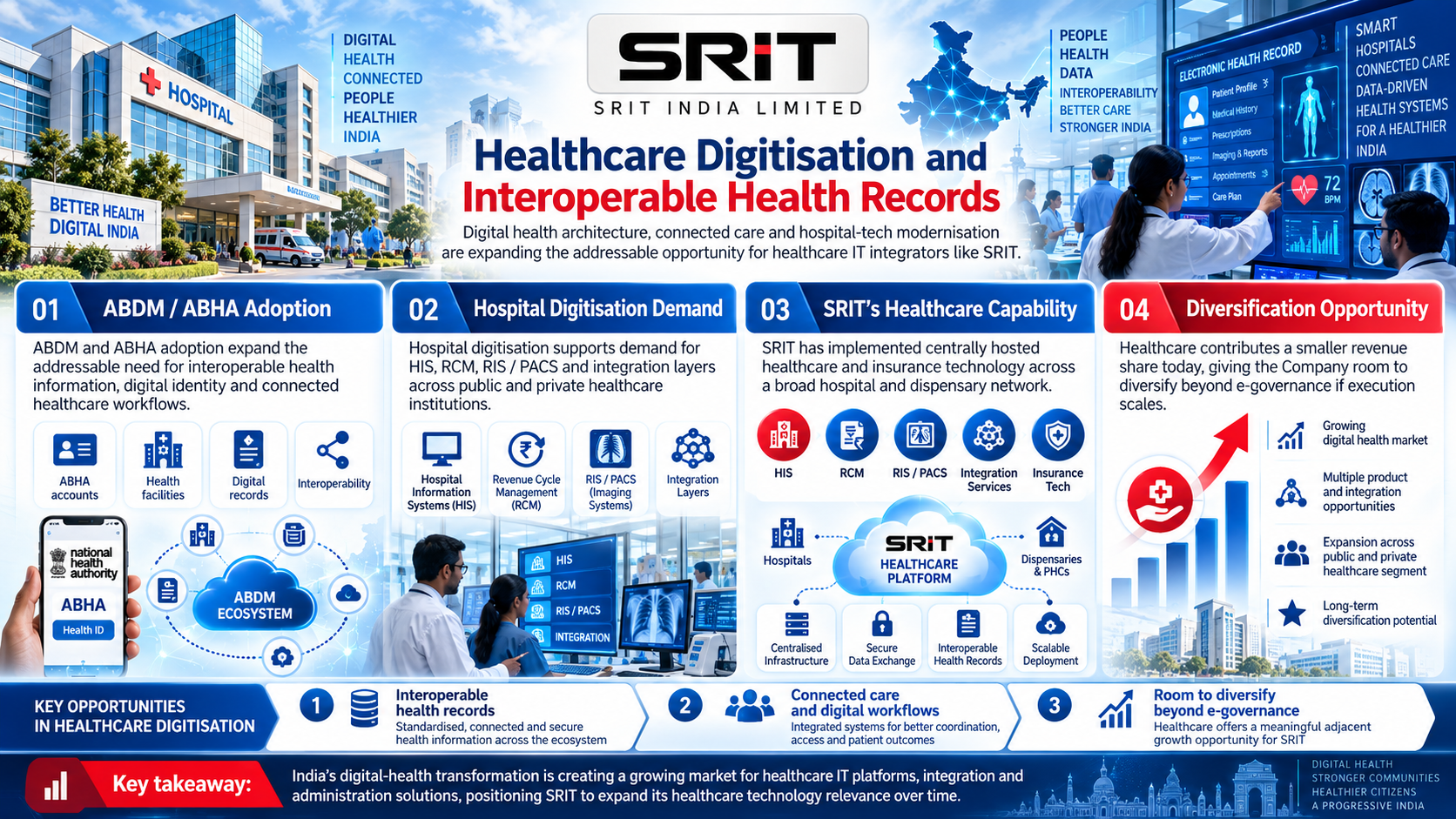
India's healthcare system is steadily moving toward interoperable digital records, connected care and technology-enabled administration. The Ayushman Bharat Digital Mission is building a national digital-health architecture through ABHA accounts, registered health facilities and interoperable health information. This supports demand for hospital information systems, revenue-cycle management, imaging platforms and integration services - areas where SRIT has established domain offerings.
The key drivers are:
ABDM/ABHA adoption expands the addressable need for interoperable health information and digital workflows
Hospital digitisation supports demand for HIS, RCM, RIS/PACS and integration layers across public and private healthcare
SRIT has implemented centrally hosted healthcare/insurance technology across a broad hospital and dispensary network
Healthcare contributes a smaller revenue share today, giving the Company room to diversify beyond e-governance if execution scales
Risks in the Industry
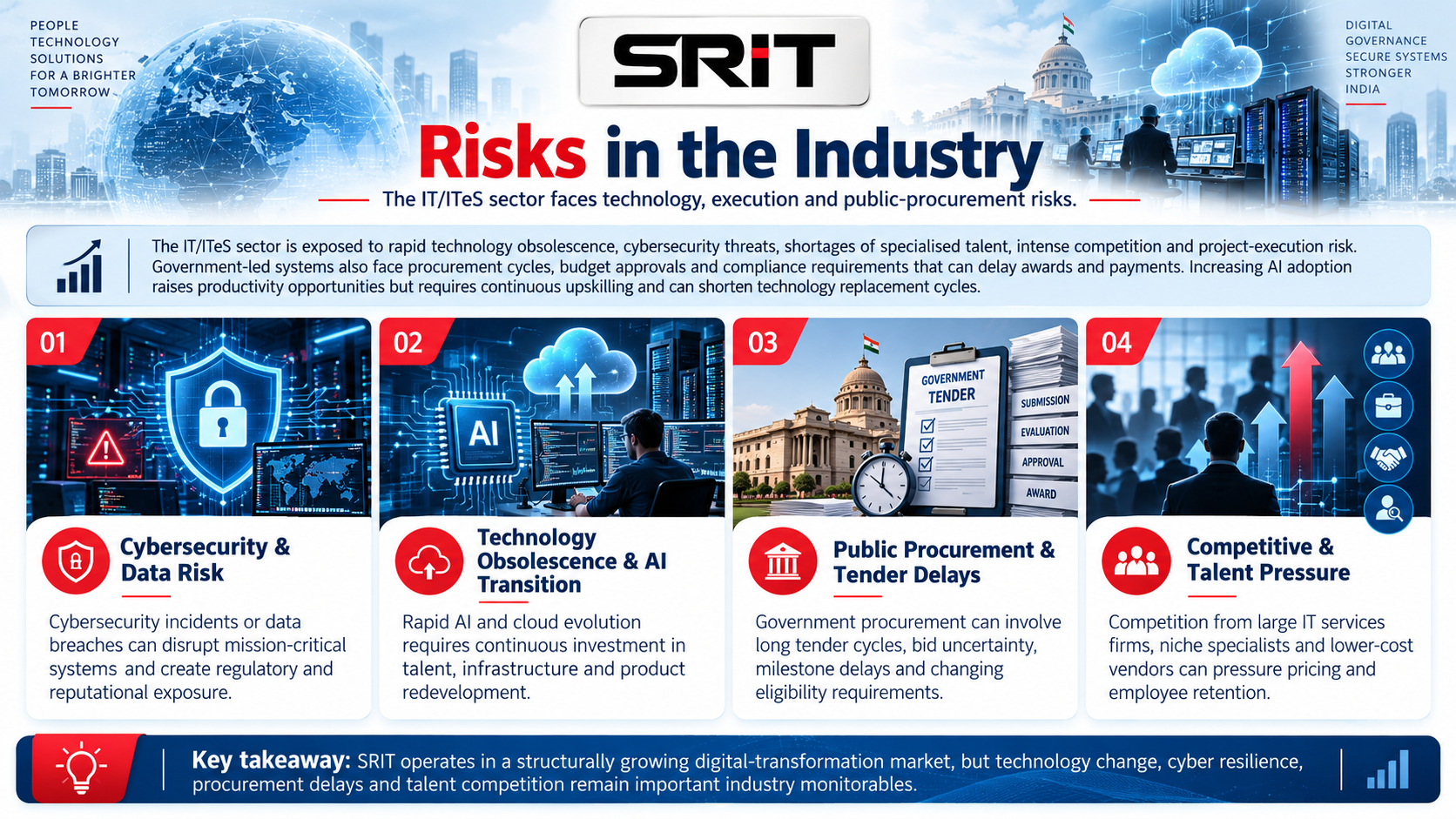
The IT/ITeS sector is exposed to rapid technology obsolescence, cybersecurity threats, shortages of specialised talent, intense competition and project-execution risk. Government-led systems also face procurement cycles, budget approvals and compliance requirements that can delay awards and payments. Increasing AI adoption raises productivity opportunities but requires continuous upskilling and can shorten technology replacement cycles.
The key risks are:
Cybersecurity incidents or data breaches can disrupt mission-critical systems and create regulatory/reputational exposure
Rapid AI/cloud evolution requires continuous investment in talent, infrastructure and product redevelopment
Public procurement can involve long tender cycles, bid uncertainty, milestone delays and changing eligibility requirements
Competition from large IT services firms, niche specialists and lower-cost vendors can pressure pricing and employee retention
Government Policy Support
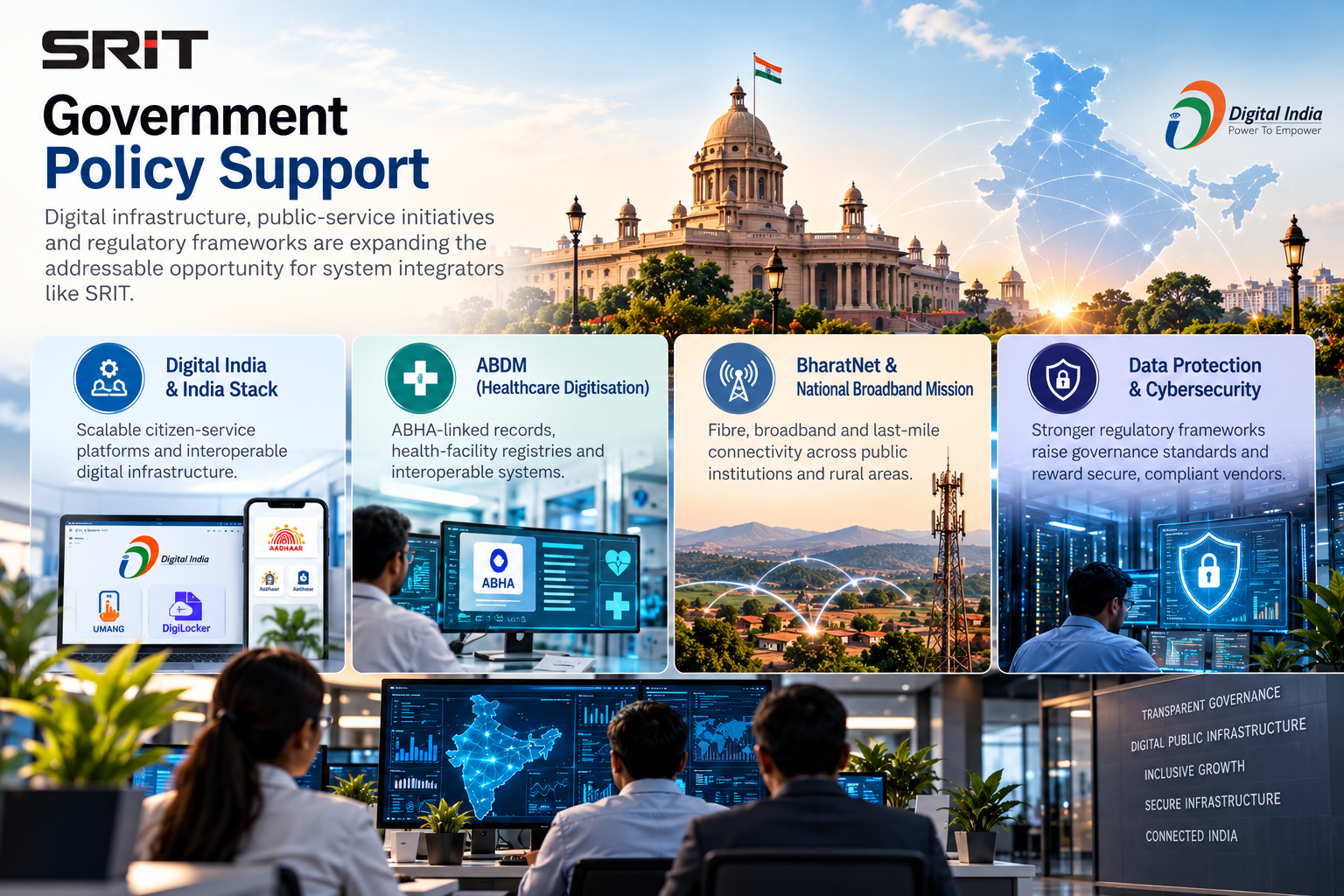
Policy support is primarily digital-infrastructure and public-service-led rather than subsidy-driven. Digital India, ABDM, BharatNet/National Broadband Mission and government cloud programmes expand the number of technology-enabled services requiring design, integration and managed operations. Data-protection and cybersecurity rules simultaneously raise compliance standards, favouring vendors that can demonstrate mature processes and certifications.
The key policies are:
Digital India and India Stack promote scalable citizen-service platforms and interoperable digital infrastructure
ABDM supports healthcare digitisation through ABHA-linked records, health-facility registries and interoperable systems
National Broadband Mission 2.0 and BharatNet support fibre, broadband and last-mile connectivity across public institutions and rural areas
Data-protection/cybersecurity frameworks increase governance requirements and can reward vendors with robust security controls and certifications
Fundraise/Future Plans
Shareholding
Pre-issue shareholding
Promoter Holding 0.0%
Post-Issue Shareholding
Promoter Holding 0.0%
Category
Pre-Issue%Post-Issue%
Promoters
Dr. Nambiar Raghavan Madhusoodan
50.6%37.4%
Prasaktha Vakkiyl Nambiar
17.6%13.0%
Martin Poovakkulam Chacko
16.7%12.3%
Total Promoter Holding
84.9%62.7%
Additional Shareholders
Other Shareholders
15.1%37.3%
Total Additional Holding
15.1%37.3%
Total Shareholding
100.0%100.0%
- Overview
- Business
- Financial Highlights
- Industry Overview
- Fundraise/Future Plans
- Documentation
Get the Preqt App and keep in touch around the clock!
 Monitor your investments in real-time.
- Receive tailored deal suggestions.
- Get real-time updates and alerts.