

German Green Steel & Power
Building Greener with SteelStrength Meets Sustainability
IPO Summary (PreQT)
German Green Steel and Power Limited is a Gujarat-based vertically integrated steel manufacturer producing Sponge Iron, MS Billets and TMT Bars, with newer offerings including Cut & Bend and epoxy-coated TMT bars. The Group operates facilities at Samakhiyali in Kutch and Viramgam in Ahmedabad district, supported by captive and renewable power capabilities, and has a three-year manufacturing partnership with JSW One Distribution Limited.
In FY26, revenue from operations stood at INR 1,679.0 Cr, EBITDA at INR 167.0 Cr with a 9.9% margin and PAT at INR 79.9 Cr. Revenue and PAT grew at 21.9% and 38.5% CAGRs, respectively, between FY24–FY26, while operating cash flow reached INR 140.8 Cr. Concentration remains notable, with TMT Bars contributing 78.7% of product revenue, Gujarat 97.7% of revenue and top 10 customers 50.6%.
The IPO includes a fresh issue of up to INR 290.0 Cr and OFS of 10,00,000 shares, mainly funding expansion and renewable power capacity, debt repayment and corporate purposes.
IPO Review Rating
Above Avg
MainboardPowering Modern Construction Through Reliable and Greener Steel Solutions
The strongest part of the profile is the combination of growth, improving profitability and cash conversion. Revenue increased at approximately 21.9% CAGR over FY24–FY26, EBITDA margin expanded from 7.0% to 9.9%, PAT almost doubled to INR 79.9 Cr, and operating cash flow increased to INR 140.8 Cr. Leverage has simultaneously improved to 0.79x.
The IPO structure is also favourable from a capital-raising perspective. 95.4% of the offer is Fresh Issue, and most of the proceeds are being deployed toward manufacturing expansion and a hybrid renewable-power plant rather than promoter monetisation or simple debt refinancing. Promoter + Promoter Group ownership remains approximately 68.5% post-Issue.
Valuation is another positive. At the upper price band, the required post-Issue methodology produces a 13.1x P/E, materially below the 22.5x peer median and 27.1x simple average. The current unofficial GMP of around 10.8% is additionally supportive, although it should remain a secondary indicator.
The main risks are geographic concentration, commodity cyclicality and governance/legal contingencies. Approximately 97.7% of FY26 Revenue came from Gujarat, while steel prices and raw-material costs can move sharply. Disputed income-tax matters of approximately INR 112.7 Cr are also significant relative to FY26 earnings.
PARAMETER
WEIGHT
SCORE
KEY FACTORS
Financial Performance
40.0%
4.0/5
German Green Steel combines strong revenue growth with expanding EBITDA and PAT margins, improving leverage and excellent operating cash conversion. RoNW remains healthy, while customer concentration has moderated. Key financial risks remain steel-price cyclicality, working-capital requirements and dependence on regional demand
Show more
Detailed Analysis
Revenue increased from INR 1,129.8 Cr in FY24 to INR 1,679.0 Cr in FY26, implying a strong 21.9% CAGR
FY26 EBITDA margin improved to 9.9%, versus 7.8% in FY25 and 7.0% in FY24
FY26 PAT margin improved to 4.8%, from 4.0% in FY25 and 3.7% in FY24
D/E improved substantially from 1.18x in FY25 to 0.79x in FY26
FY26 ROE remained healthy at 18.9%, although below FY24's 23.7%
FY26 OCF was INR 140.8 Cr, comfortably exceeding FY26 PAT of INR 79.9 Cr; OCF remained positive throughout FY24–FY26
Industry
15.0%
3.0/5
Indian steel demand has a supportive medium-term outlook driven by infrastructure, housing and industrial investment. German Green Steel participates directly through TMT bars, but the sector remains cyclical and commodity-sensitive. The Company's exceptionally high Gujarat concentration materially limits geographic diversification
Show more
Detailed Analysis
CareEdge projects India's finished-steel demand to grow at approximately 8.2% CAGR during FY25–FY29, exceeding 200 MT
Environmental approvals, emissions, energy intensity, BIS/QCO requirements and trade-policy changes create material regulatory exposure
97.7% of FY26 sales came from Gujarat, indicating very limited geographic diversification currently
Management
15.0%
3.0/5
Chairman and Whole-time Director Inamulhaq Shamsulhaq Iraki has more than 36 years of iron-and-steel experience, while Managing Director Abdulhaq Shamsulhaq Iraki has more than 31 years. Ibrarulhaq Iraki has over eight years of sector experience and has completed a Strategic Management programme from IIM Ahmedabad
Show more
Detailed Analysis
Inamulhaq Iraki has 36+ years and Abdulhaq Iraki 31+ years of iron-and-steel experience
4 of 8 Directors are Independent coming to 50.0%, including one Independent Woman Director
Promoter shares are unpledged, but significant tax contingencies and a pending electricity-use proceeding reduce comfort
FY26 related-party purchases, sales, unsecured loans and promoter-linked transactions are meaningful but not dominant
Valuation
20.0%
4.0/5
German Green Steel's 13.1x post-Issue P/E is materially below both the disclosed peer median and simple peer average. Healthy RoNW, improving margins and positive cash generation support the valuation, although commodity cyclicality and regional concentration justify retaining some valuation caution
Show more
Detailed Analysis
13.1x post-Issue P/E versus 27.1x simple peer average and 22.5x median
Approximate post-Issue P/B is ~1.5x, before final issue-expense adjustments
FY26 ROE is 18.9%, strong relative to most disclosed peers
Merchant Banker Track Record
10.0%
5.0/5
The three-BRLM consortium has credible execution capability and several strong recent listings, particularly through Systematix and Pantomath. However, its aggregate mainboard track record is smaller and more variable than top-tier investment banks, resulting in a solid rather than exceptional merchant-banker score
Show more
Detailed Analysis
Recent mandates include several strong positive listings, especially for Systematix and Pantomath, although performance has not been uniformly positive
Systematix and Pantomath have handled multiple heavily subscribed 2026 books, demonstrating effective distribution capabilities
Majority of observable recent mandates have achieved positive listings, but the sample is smaller and less consistent than top-tier BRLM franchises
TOTAL
100%
3.8/5
Weighted Composite Score
Issue Price
₹132.0 to ₹139.0
As of 24 Sep 2026
GMP
₹15.0
As of 24 Sep 2026
Estimated Gain / Loss
+10.8%
Lot Size
107.0 Shares
Grey Market Premium (GMPs) are shared for knowledge purpose only. PrEqt doesn’t promote or execute the trades.
| Issue size | |
|---|---|
| Overall | ₹304.0 Cr |
| Fresh Issue | ₹290.0 Cr |
| Offer for Sale | ₹14.0 Cr |
Minimum Investment
₹14,873.0 / 11,449 shares

Merchant Banker
Systematix Corporate Services Ltd., Emkay Global
Systematix Corporate Services Ltd.
Emkay Global
IPO Document
Offer Start Date
Offer End Date
Valuation
Revenue (FY'26)
PAT (FY'26)
Issue Size
Face Value
₹ 10.0Offer Price
₹ 139.0Lot Size
107.0 sharesSale Type
Fresh capital cum OFSPAT (FY'26)
₹ 79.9 CrPAT Margin (FY'26)
4.8 %P/E Multiple
13.1xEBITDA (FY'26)
₹ 167.0 CrCAGR Growth 2Y
21.9 %ROE (FY'26)
18.9 %ROCE (FY'26)
19.3 %Price to Book Value
1.5xDebt/Equity
0.8xCompany Website
www.germansteel.inExplore new deals
Overview
Fund Allocation
Total: ₹0 CrSource:Company DRHP
Timeline
IPO Open Date
To Be Announced
IPO Close Date
To Be Announced
Tentative Allotment
To Be Announced
Initiation of Refunds
To Be Announced
Credit of Shares to Demat
To Be Announced
Tentative Listing Date
To Be Announced
Business
Products
Business Model
Geographical Presence
Sales Channel
Key Risk Factor
Financial Highlights
Income Statement
Revenue growth with EBITDA and PAT margins
| Financial Metric | FY 2024 | FY 2025 | FY 2026 |
|---|---|---|---|
| Revenue (₹ Cr) | 1,137.5 | 1,517.2 | 1,685.4 |
| Growth (%) | - | 33.4% | 11.4% |
| EBITDA (₹ Cr) | 79.3 | 116.8 | 167.0 |
| EBITDA Margin (%) | 7.0% | 7.8% | 9.9% |
| PAT (₹ Cr) | 41.7 | 59.9 | 79.9 |
| PAT Margin (%) | 3.7% | 4.0% | 4.8% |
OBSERVATIONS & INSIGHTS
Revenue increased from INR 1137.5 Cr in FY24 to INR 1685.4 Cr in FY26, representing a two-year CAGR of approximately 21.9%; growth moderated to 11.4% in FY26 after 33.4% in FY25
EBITDA increased from INR 79.3 Cr in FY24 to INR 167.0 Cr in FY26, while margin expanded by approximately 2.9 percentage points to 9.9%
PAT increased from INR 41.7 Cr in FY24 to INR 79.9 Cr in FY26, a two-year CAGR of approximately 38.5%; FY26 PAT growth was 33.3%. PAT margin improved from 3.7% in FY24 to 4.8% in FY26, indicating stronger conversion of incremental revenue into earnings despite finance and depreciation costs
Balance Sheet
| Financial Metric | FY 2024 | FY 2025 | FY 2026 |
|---|---|---|---|
| Net Worth | ₹ 176.1 Cr | ₹ 292.6 Cr | ₹ 421.6 Cr |
| Total Assets | ₹ 559.7 Cr | ₹ 1,015.2 Cr | ₹ 1,220.2 Cr |
| Total Borrowing | ₹ 198.4 Cr | ₹ 347.9 Cr | ₹ 334.4 Cr |
| Reserves & Surplus | ₹ 167.6 Cr | ₹ 241.3 Cr | ₹ 369.2 Cr |
OBSERVATIONS & INSIGHTS
Total assets increased from INR 559.7 Cr in FY24 to INR 1,220.2 Cr in FY26, driven by manufacturing assets, capital work in progress and higher working capital
Inventory and receivables increased materially, while trade payables also rose from INR 105.3 Cr in FY24 to INR 329.5 Cr in FY26 and funded part of the operating cycle
Total borrowings increased from INR 198.4 Cr in FY24 to INR 334.4 Cr in FY26, but the equity base expanded faster, reducing debt/equity to 0.8x
Cash Flow
| Financial Metric | FY 2023 | FY 2024 | FY 2025 |
|---|---|---|---|
CFO (₹ Cr) Cash generated from core business operations. | +28.4 Cr | +74.4 Cr | +140.8 Cr |
CFI (₹ Cr) Cash used for investments and long-term assets. | -63.1 Cr | -224.0 Cr | -134.8 Cr |
CFF (₹ Cr) Cash flow related to funding and borrowings. | +34.7 Cr | -151.2 Cr | -6.8 Cr |
Working Capital
| Efficiency Metric | FY 2023 | FY 2024 | FY 2025 |
|---|---|---|---|
Debtor Days Average number of days taken to collect customer payments. | - | - | - |
Creditor Days Average time taken to pay suppliers and vendors. | - | - | - |
Inventory Days Average number of days inventory remains unsold. | - | - | - |
CCC (Cash Conversion Cycle) (Debtor Days + Inventory Days - Creditor Days) | - | - | - |
Financial Ratios
Measures the company’s leverage relative to shareholder equity.
OBSERVATIONS & INSIGHTS
RHP-reported ROE declined from 23.7% in FY24 to 18.9% in FY26 as the equity base expanded, despite continued PAT growth
Leverage improved to 0.8x in FY26 from 1.2x in FY25, reflecting stronger equity and broadly stable absolute borrowings
Interest coverage remained around 3.1x-3.4x over FY24-FY26, providing a moderate buffer for debt-servicing costs
Current Ratio remained close to 1.0x throughout the period and fell below 1.0x on the unrounded FY26 calculation, highlighting working-capital intensity
ROA was 7.4% in FY24, 5.9% in FY25 and 6.5% in FY26 as the asset base expanded through capex and working capital
ROCE recovered to 19.3% in FY26 from 15.9% in FY25 and exceeded FY24’s 18.6%
Industry Overview
Industry Drivers
Continued Infrastructure & Construction Spending
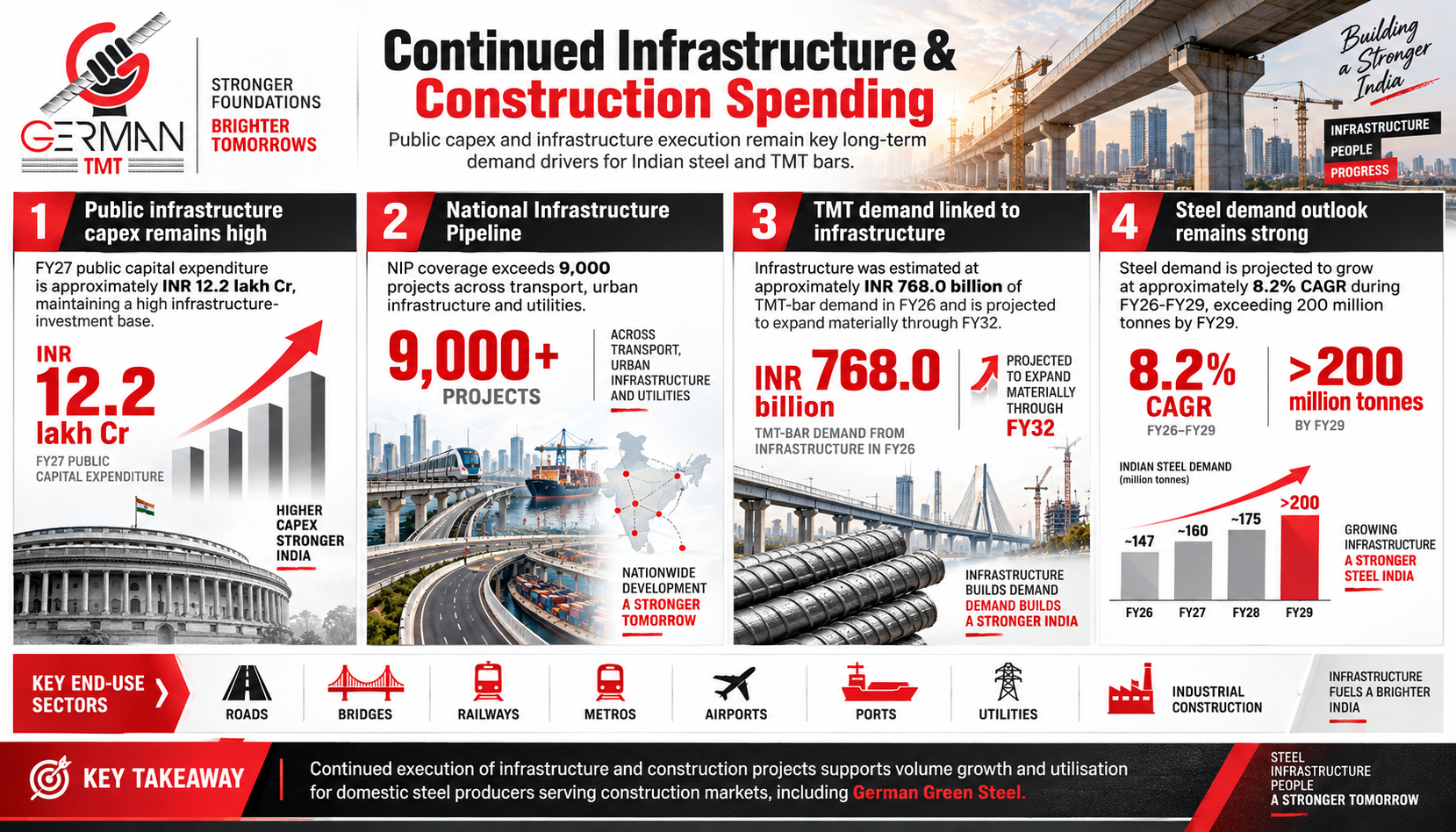
Public infrastructure remains the central structural demand driver for Indian steel and TMT bars. Government capital expenditure for FY27 is approximately INR 12.2 lakh Cr, while the National Infrastructure Pipeline spans more than 9,000 projects across transport, urban infrastructure and utilities. TMT demand benefits directly from roads, bridges, railways, metros, airports, ports, water projects and industrial construction. Continued execution of these projects supports both volume growth and utilisation for domestic steel producers serving construction markets.
The key drivers are:
National Infrastructure Pipeline coverage exceeds 9,000 projects across multiple infrastructure categories
FY27 public capital expenditure is approximately INR 12.2 lakh Cr, maintaining a high infrastructure-investment base
Infrastructure was estimated at approximately INR 768.0 billion of TMT-bar demand in FY26 and is projected to expand materially through FY32
Steel demand is projected to grow at approximately 8.2% CAGR during FY26-FY29, exceeding 200 million tonnes by FY29
Housing, Urbanisation & Organised Real Estate
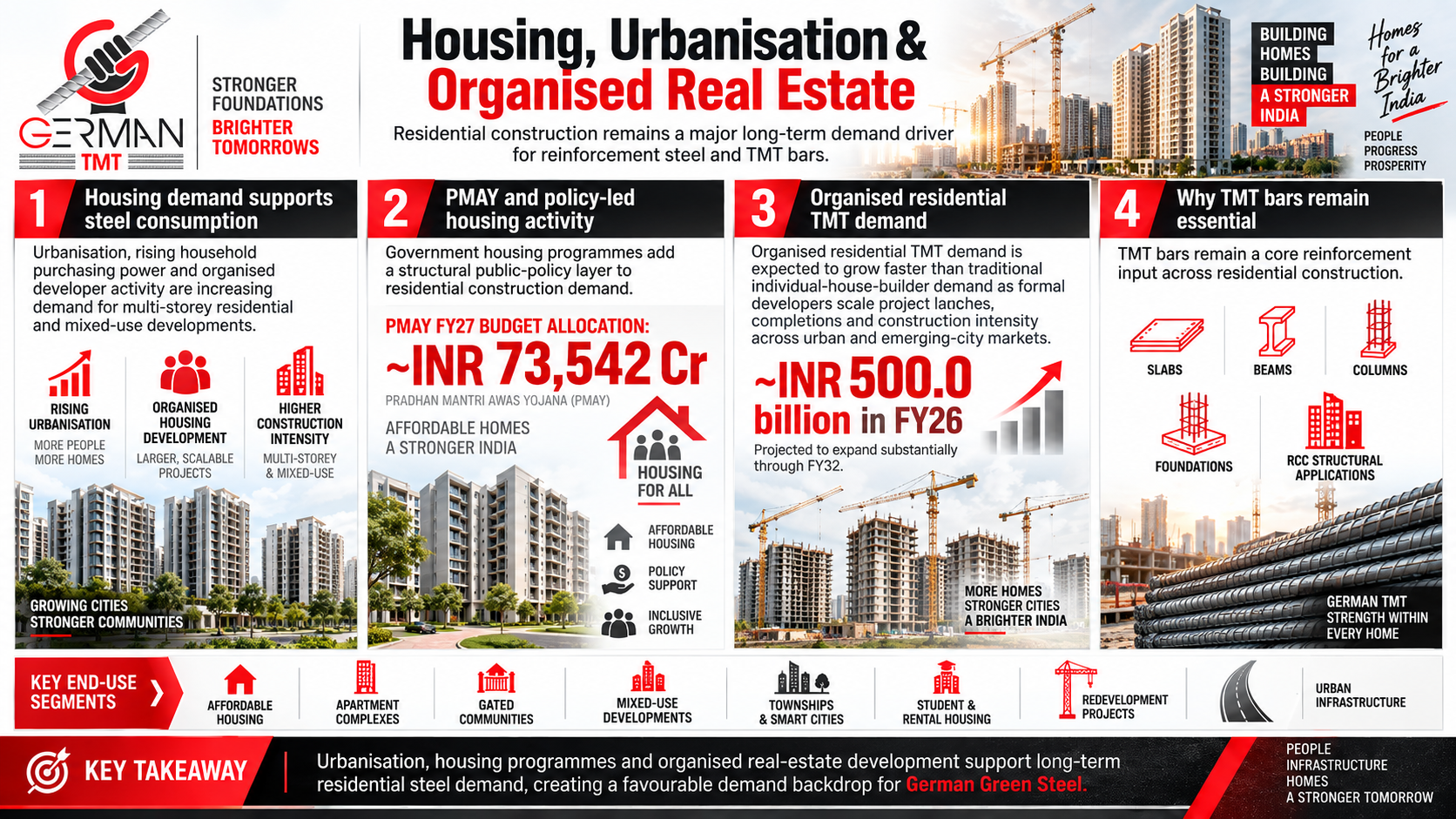
Residential construction is another major consumption channel for reinforcement steel. Urbanisation, rising household purchasing power and organised developer activity continue to increase demand for multi-storey residential and mixed-use developments. Government housing programmes such as PMAY add a public-policy layer to this demand. Organised residential TMT demand is expected to grow faster than traditional individual-house-builder demand as formal developers scale project launches, completions and construction intensity across large urban and emerging-city markets.
The key drivers are:
PMAY received approximately INR 73,542 Cr of budgetary allocation in FY27, supporting continued housing activity
Organised residential TMT demand is estimated at approximately INR 500.0 billion in FY26 and projected to expand substantially through FY32
Urbanisation and rising purchasing power support both new housing formation and higher reinforcement intensity in organised projects
TMT bars remain a core reinforcement input for slabs, beams, columns, foundations and other RCC structural applications
Railways, Metro & Broader Industrial Demand
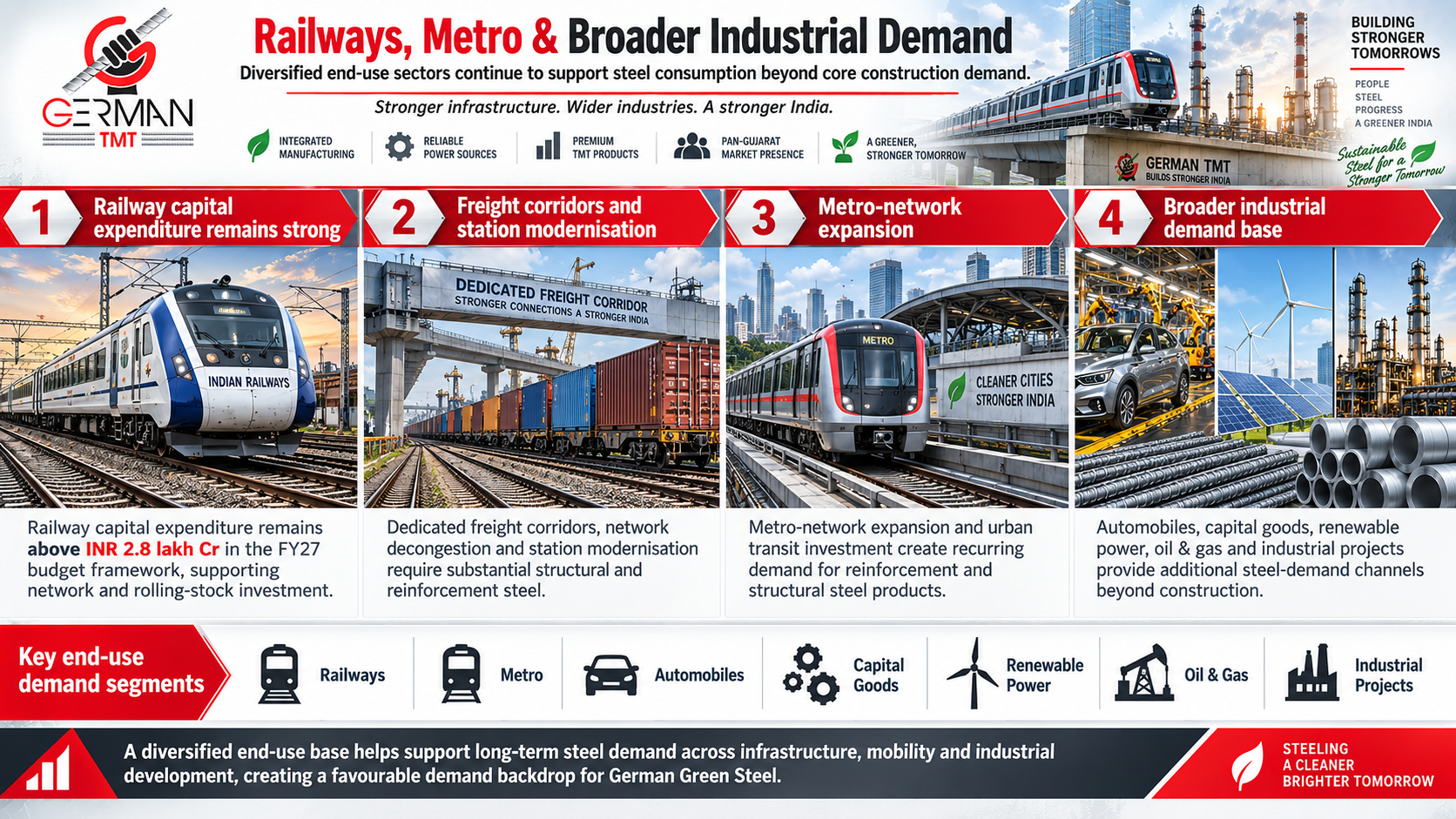
Steel consumption is also supported by expansion in railways, metro systems, automobiles, capital goods, energy and industrial infrastructure. Indian Railways continues to receive significant capital allocation for network capacity, rolling stock, freight corridors and station modernisation, while metro networks are expanding across major cities. In parallel, industrial investment, automobile production and renewable-energy infrastructure generate demand for multiple steel grades. This diversified end-use base reduces reliance on a single national demand category, although individual product segments remain cyclical.
The key drivers are:
Railway capital expenditure remains above INR 2.8 lakh Cr in the FY27 budget framework, supporting network and rolling-stock investment
Dedicated freight corridors, network decongestion and station modernisation require substantial structural and reinforcement steel
Metro-network expansion and urban transit investment create recurring demand for reinforcement and structural steel products
Automobiles, capital goods, renewable power, oil & gas and industrial projects provide additional steel-demand channels beyond construction
Risks in the Industry
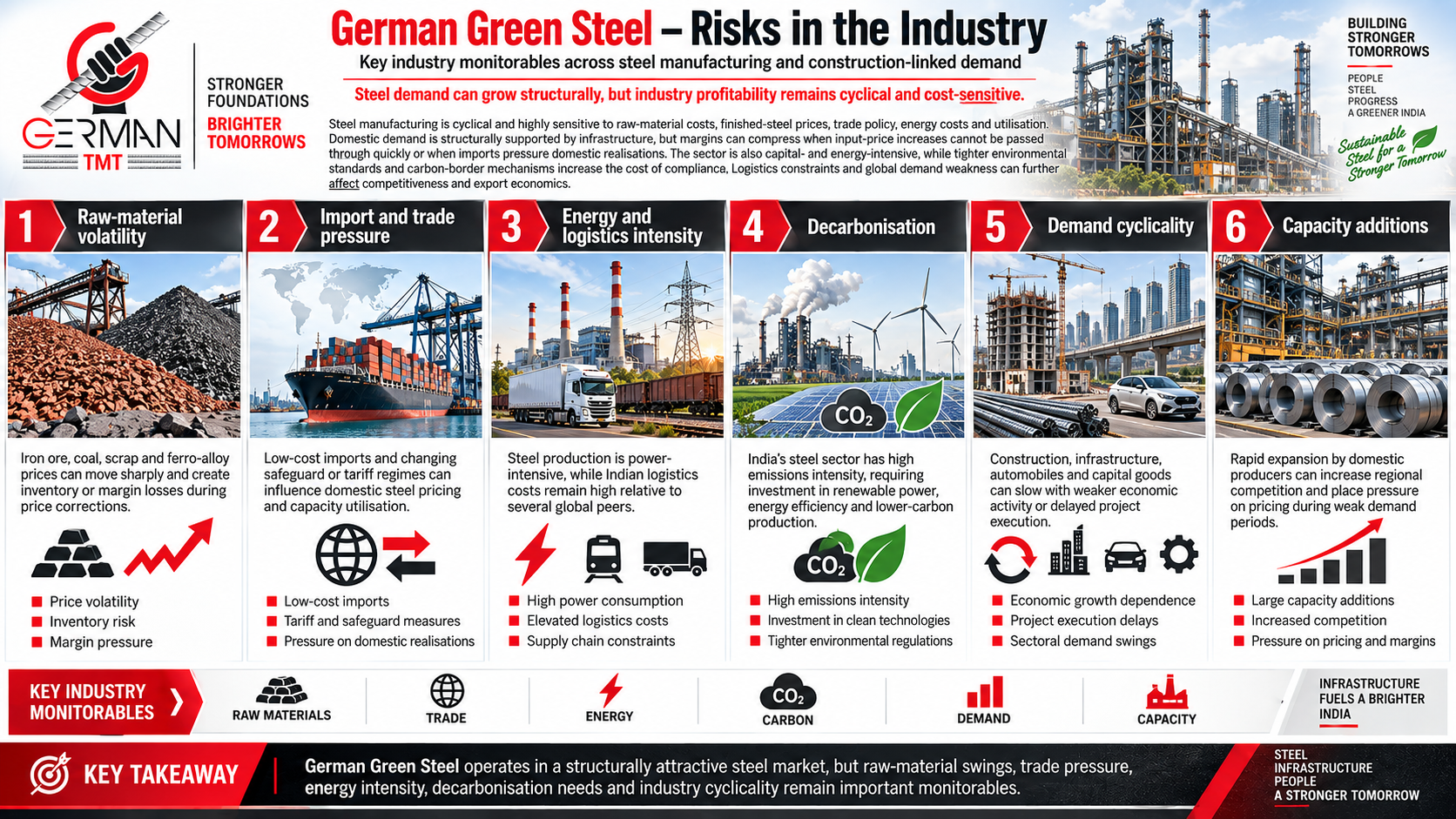
Steel manufacturing is cyclical and highly sensitive to raw-material costs, finished-steel prices, trade policy, energy costs and utilisation. Domestic demand is structurally supported by infrastructure, but margins can compress when input-price increases cannot be passed through quickly or when imports pressure domestic realisations. The sector is also capital- and energy-intensive, while tighter environmental standards and carbon-border mechanisms increase the cost of compliance. Logistics constraints and global demand weakness can further affect competitiveness and export economics.
The key risks are:
Raw-material volatility: Iron ore, coal, scrap and ferro-alloy prices can move sharply and create inventory or margin losses during price corrections
Import and trade pressure: Low-cost imports and changing safeguard or tariff regimes can influence domestic steel pricing and capacity utilisation
Energy and logistics intensity: Steel production is power-intensive, while Indian logistics costs remain high relative to several global peers
Decarbonisation: India’s steel sector has high emissions intensity, requiring investment in renewable power, energy efficiency and lower-carbon production
Demand cyclicality: Construction, infrastructure, automobiles and capital goods can slow with weaker economic activity or delayed project execution
Capacity additions: Rapid expansion by domestic producers can increase regional competition and place pressure on pricing during weak demand periods
Government Policy Support
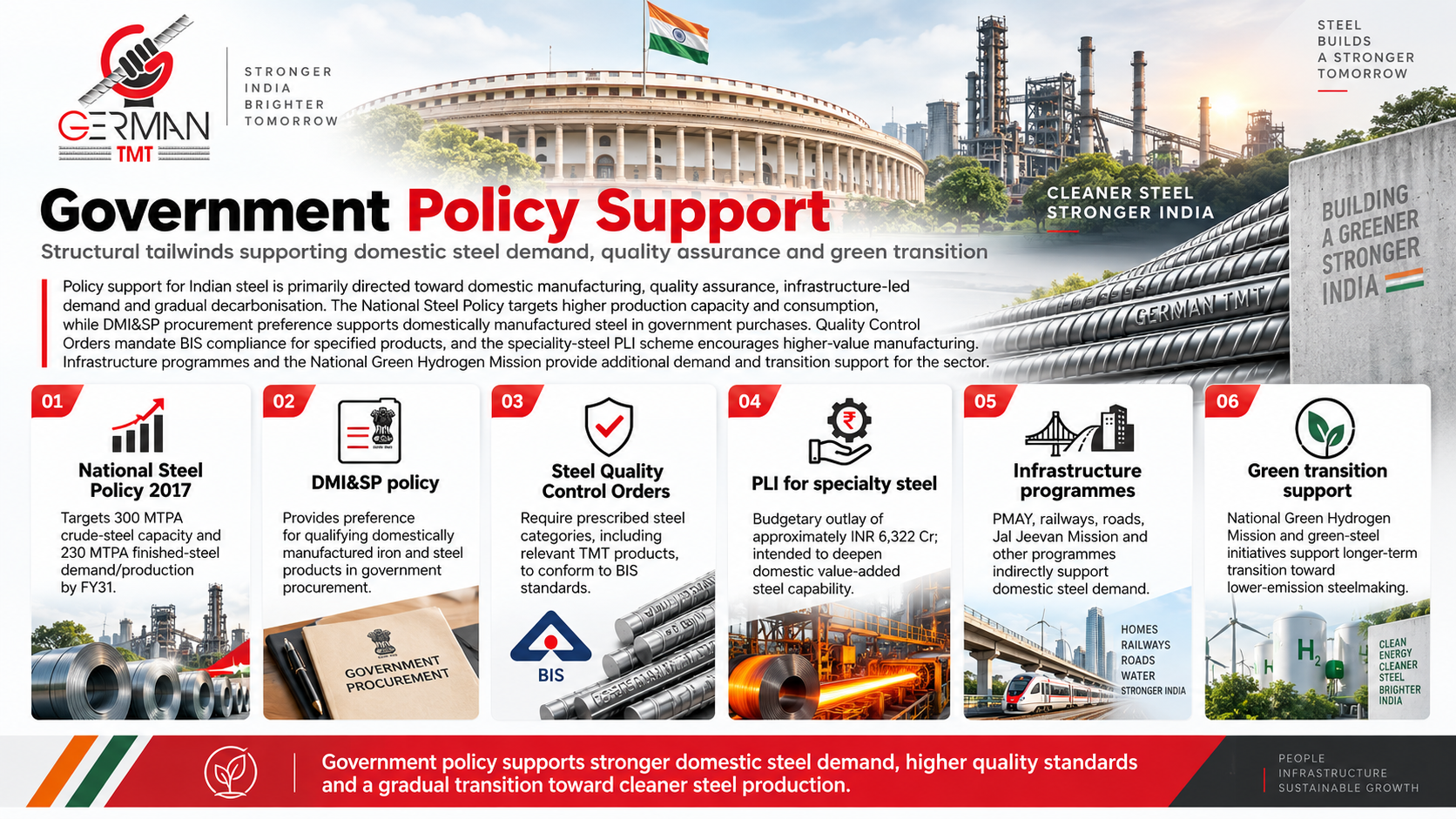
Policy support for Indian steel is primarily directed toward domestic manufacturing, quality assurance, infrastructure-led demand and gradual decarbonisation. The National Steel Policy targets higher production capacity and consumption, while DMI&SP procurement preference supports domestically manufactured steel in government purchases. Quality Control Orders mandate BIS compliance for specified products, and the specialty-steel PLI scheme encourages higher-value manufacturing. Infrastructure programmes and the National Green Hydrogen Mission provide additional demand and transition support for the sector.
The key policies are:
National Steel Policy 2017 targets 300 MTPA crude-steel capacity and 230 MTPA finished-steel demand/production by FY31
DMI&SP policy provides preference for qualifying domestically manufactured iron and steel products in government procurement
Steel Quality Control Orders require prescribed steel categories, including relevant TMT products, to conform to BIS standards
PLI for specialty steel has a budgetary outlay of approximately INR 6,322 Cr and is intended to deepen domestic value-added steel capability
PMAY, railways, roads, Jal Jeevan Mission and other infrastructure programmes indirectly support domestic steel demand
National Green Hydrogen Mission and green-steel initiatives support longer-term transition toward lower-emission steelmaking
Fundraise/Future Plans
Shareholding
Pre-issue shareholding
Promoter Holding 0.0%
Post-Issue Shareholding
Promoter Holding 0.0%
Category
Pre-Issue%Post-Issue%
Promoters
Inamulhaq Shamsulhaq Iraki
40.9%28.9%
Abdulhaq Shamsulhaq Iraki
39.4%27.8%
Ibrarulhaq Inamulhaq Iraki
1.0%0.7%
Promoter Group
15.3%11.1%
Total Promoter Holding
96.6%68.5%
Additional Shareholders
Other Shareholders
3.4%31.5%
Total Additional Holding
3.4%31.5%
Total Shareholding
100.0%100.0%
- Overview
- Business
- Financial Highlights
- Industry Overview
- Fundraise/Future Plans
- Documentation
Get the Preqt App and keep in touch around the clock!
 Monitor your investments in real-time.
- Receive tailored deal suggestions.
- Get real-time updates and alerts.